
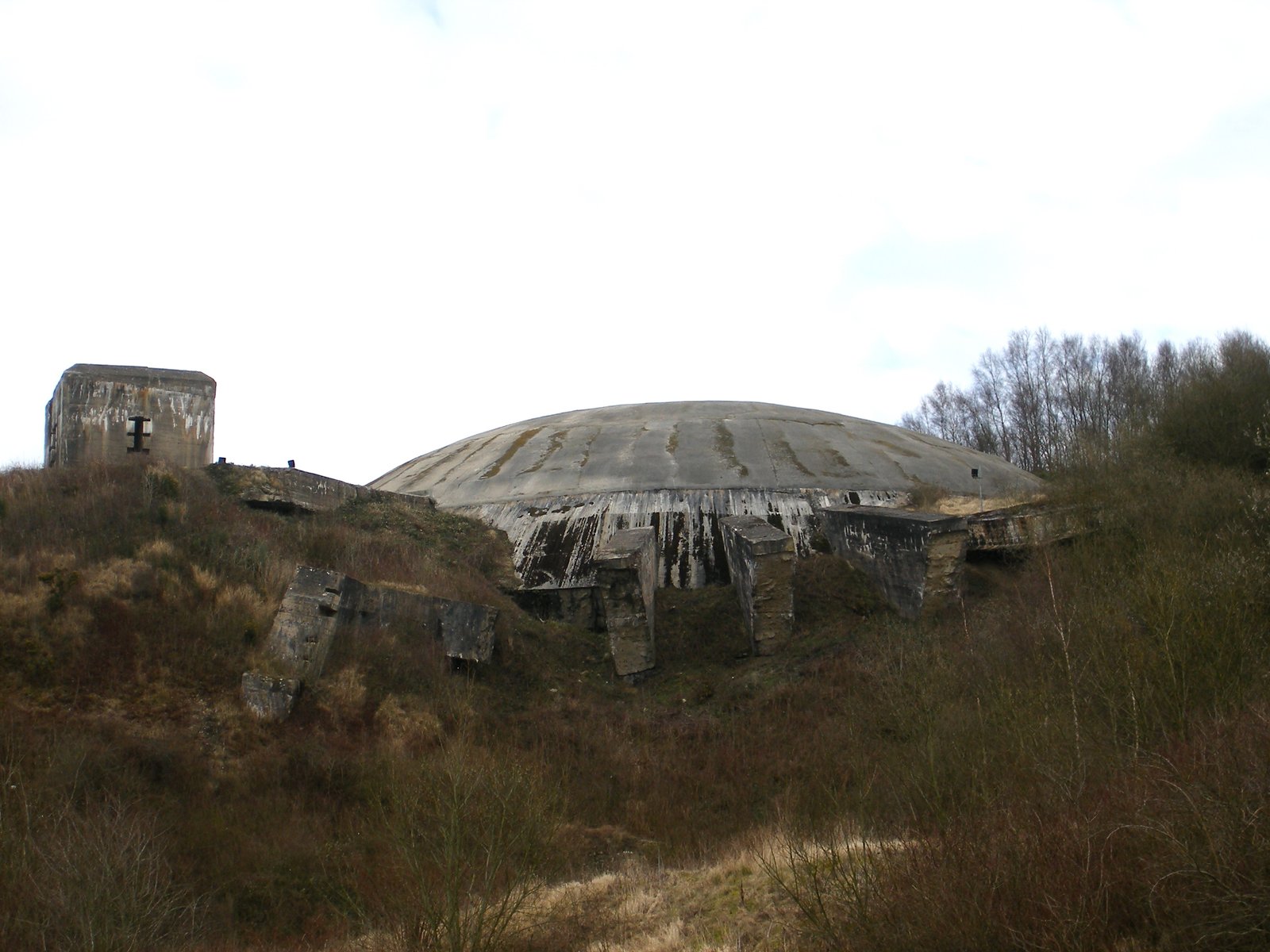
A concrete dome built over a chalk hillside to shelter a factory meant to fire dozens of V-2 rockets at London every day. Sixteen Allied bombing raids made sure it never launched a single one.
At a glance
La Coupole was designed as something the V-weapon campaign had not yet built: not a single launch pad but an industrial production and firing complex, storing, fuelling and launching V-2 rockets from inside a hillside near Saint-Omer, protected by a concrete dome roughly 5 metres thick over some 7 km of galleries cut into the chalk. Built in ten months between October 1943 and July 1944, it was meant to sustain a launch rate the open-air, mobile V-2 sites of 1944 could never match.
It never fired a rocket. Sixteen Allied air raids, more than 800 bombers and over 4,000 tonnes of bombs kept the site from ever becoming operational, and by the time it might have been ready, the war had already moved past the plan that built it.
Key facts
- Built: October 1943 – July 1944, Organisation Todt, contractors Philipp Holzmann AG and Großdeutsche Schachtbau; dome engineered by Werner Flos
- Workforce: around 1,100 in April 1944, rising to 1,400 by June — roughly 60% skilled German labour (including miners from Westphalia for the tunnelling and dome work), the rest forced labour: French conscripts under the Service du Travail Obligatoire and Soviet prisoners of war
- Structure: reinforced-concrete dome roughly 5 m thick over about 7 km of galleries tunnelled into a chalk hill (sources vary on the exact dome dimensions and tonnage)
- Purpose: an industrial-scale launch complex for V-2 rockets against London and southern England, designed to fire far more frequently than the mobile launch sites used elsewhere
- Operation Crossbow: 16 Allied air raids, some 811 bombers, roughly 4,260 tonnes of bombs
- Outcome: never became operational; no V-2 was ever launched from the site. Hitler abandoned the site’s operational plan on 18 July 1944; German forces abandoned it in early September 1944 as Allied troops approached
- Museum: opened May 1997 as the Centre d’Histoire et de Mémoire du Nord-Pas-de-Calais, with a memorial to the region’s wartime dead; a planetarium dedicated to space exploration was added in 2012
- Coordinates: 50.7052° N, 2.2436° E
How it was built
The dome answered a problem earlier V-weapon sites had exposed: anything built in the open, however hardened, could be found and bombed before it fired a shot. La Coupole buried its production line instead — galleries cut horizontally into a chalk hillside, roofed by a concrete dome thick enough, its designers hoped, to detonate bombs before they reached the working spaces below. The scale of labour matched the ambition: over a thousand workers at peak, split between skilled German tunnellers and miners and a forced-labour workforce of French conscripts and Soviet prisoners, working through the winter of 1943–44 to finish a complex meant to fire V-2s at a rate no mobile site could sustain.
It was still unfinished, functionally, when Allied bombers made the question moot. Sixteen raids under Operation Crossbow, the Allied campaign against V-weapon sites, hit the complex repeatedly through the first half of 1944, and while the dome itself largely held, the infrastructure needed to actually launch from inside it never came together in time.
A factory that never fired
By July 1944, with Allied forces ashore in Normandy and the site still not operational, Hitler abandoned the plan to use La Coupole as a launch complex at all. German forces held the position a few more weeks before abandoning it in early September as Allied troops advanced through the Pas-de-Calais. No V-2 was ever launched from the dome that had taken ten months, over a thousand workers and forty thousand tonnes of concrete to build.
Who tells it, and where the accounts diverge
La Coupole today is a museum organised, in large part, around the V-2’s place in the history of rocketry — and since 2012, a planetarium dedicated to the conquest of space stands alongside the wartime galleries, drawing a direct line from Nazi Germany’s weapon of terror to the technology that later put humans in orbit. It is a documented and defensible line to draw: the V-2’s chief engineer, Wernher von Braun, went on to lead the American space programme.
What that line tends to leave in the background is who built the dome the rockets were meant to launch from. The forced-labour workforce — French conscripts and Soviet prisoners, working alongside skilled German miners through a hard winter — is documented in the historical record of the site’s construction, but it sits uneasily next to a visitor narrative organised around technological ambition and the romance of space travel. A weapon built partly by prisoners, housed under a dome that never worked, telling a story today about how rockets eventually reached orbit, is three different histories occupying the same tunnel.
What you see today
- The dome and tunnel network, open to visitors, with exhibits on V-weapon technology, the Occupation of northern France, and the site’s construction.
- A memorial to the region’s deportees and executed resistance members, part of the same museum complex.
- The Planétarium 3D, added in 2012, dedicated to the history of space exploration.
Getting there
La Coupole lies on the D210 at Helfaut, just south of Saint-Omer, Pas-de-Calais.
Nearby
- Blockhaus d’Éperlecques, 14 km north-north-west, the earlier V-2 site whose bombing led directly to La Coupole’s design
- Saint-Omer, the nearest town, with its own wartime and pre-war heritage
Sources
- Wikipedia (English and French), La Coupole / Coupole d’Helfaut — construction dates, contractors, workforce, Operation Crossbow, outcome.
- Wikimedia Commons category and file metadata for La Coupole photographs, cross-checked for licensing.
Find it on the map
See this place and what’s around it →📷 Become a Cultural Heritage Online photographer
Share your photos of places: they stay published under your name as the author. The more they're seen, the more you get noticed — and soon a contest will reward the most appreciated photos.
Log in or sign up free to add a photo