
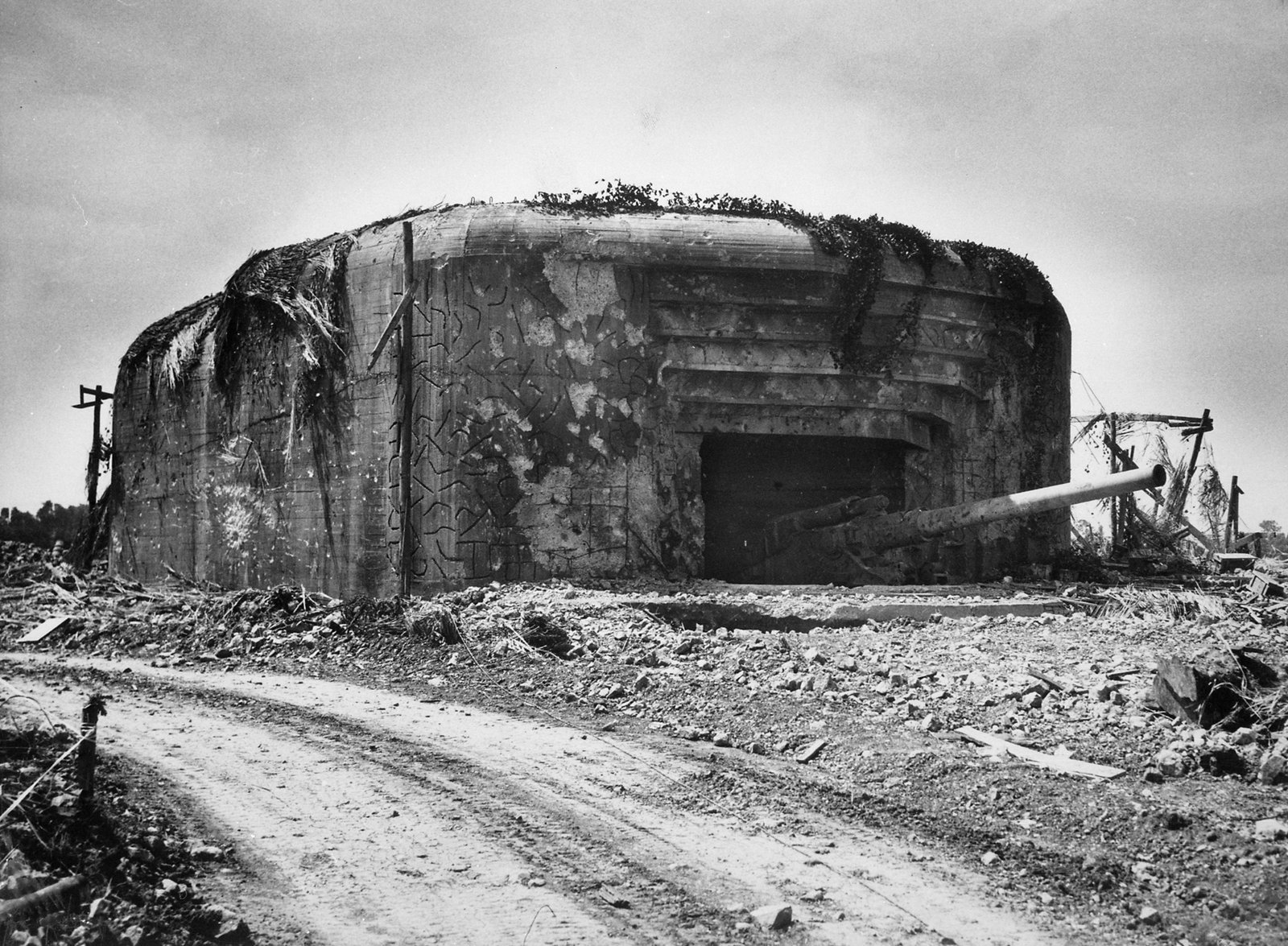
At 5:52 on the morning of 6 June 1944, this battery fired the first shots of D-Day at the invasion fleet. Half an hour later it sank an American destroyer — though the US Navy’s own official account and the battery’s own log do not agree on how.
At a glance
Crisbecq, overlooking Utah Beach from high ground near Saint-Marcouf, was armed with three 210 mm Škoda K39/40 guns capable of reaching over 30 km — enough to hit ships anywhere off the invasion beaches. Construction, begun in 1942, was incomplete on D-Day: only two of four planned casemates were finished. It made no difference to what the battery could still do. At 5:52 on 6 June, before any other coastal gun on the invasion front, Crisbecq opened fire on the American ships standing off Utah Beach.
It fought on, isolated and surrounded by American forces on land, for five more days after the landings — one of the very few Atlantic Wall positions to remain in action that long.
Key facts
- Built: from mid-1942, Organisation Todt; only 2 of 4 planned R683-type casemates complete by D-Day (walls up to roughly 3 m)
- Armament: three 210 mm Škoda K39/40 guns (range over 30 km), one 105 mm gun, six 75 mm anti-aircraft guns, three 20 mm guns, around 70 machine guns
- Garrison: 300–400 men, a Kriegsmarine core (around 300) plus roughly 100 infantry of the 919th Grenadier Regiment; commander Oberleutnant zur See Walter Ohmsen
- 6 June 1944: opened fire at 5:52–5:55 on Allied warships off Utah Beach, including USS Tuscaloosa, Quincy and Nevada; at 6:30 struck and sank the destroyer USS Corry, the largest single Allied ship loss of the landings
- By 9:00: a second gun disabled by Allied naval gunfire
- Held out: isolated by the American advance, resisting until 11 June, when ammunition and medical supplies ran out; Ohmsen, wounded, ordered a night breakout — 78 men escaped, 21 wounded were left behind
- Fell: 12 June 1944, taken without a fight by the US 39th Infantry Regiment, 9th Infantry Division
- Coordinates: 49.4795° N, 1.2970° W
How it was built, and how it kept firing
Crisbecq was unfinished business on the morning of the invasion: two of the four casemates planned for it were still open positions rather than sealed concrete, and its Škoda guns, Czech-built and pressed into German service, traversed on mounts less protected than a purpose-built naval turret. None of that stopped it from being the first gun position on the entire invasion front to fire, nor from staying in action days after most coastal batteries nearby had been silenced or overrun. What kept Crisbecq fighting was less the concrete than the range: 210 mm guns on high ground could reach targets other batteries could not, for as long as ammunition and men held out.
6 June to 12 June
The battery’s first rounds, at 5:52, opened the naval battle of D-Day before any landing craft had reached the sand. Thirty-eight minutes later, its guns struck USS Corry, which sank — the single largest Allied ship loss of the landings. Allied warships answered directly: by mid-morning a second gun was disabled by naval gunfire. But Crisbecq did not fall with the beach. Cut off by American troops advancing inland, the garrison held the position for five more days, fighting with what it had left until ammunition and medical supplies ran out on 11 June. Ohmsen, wounded, led a breakout that night; 78 men got out, 21 too badly wounded to move were left in the position. The Americans took the empty battery the next morning without a fight.
Who tells it, and where the accounts diverge
How USS Corry actually sank is not settled. The US Navy’s official report attributes the loss to a mine. A dedicated research site maintained for the ship’s veterans and their families disputes this directly: it cites the original account from officers aboard — «none of us had ever experienced anything that could have been the explosion of a mine» — physical evidence that the ship moved away from the beach rather than toward it, inconsistent with a mine strike from the seaward side, and the German battery’s own war log, which at 6:35 explicitly claims «direct hits of heavy calibre» on the ship.
French-language accounts of the battle tend to credit the direct hit; the English Wikipedia record stays more cautious and does not resolve the question either way. Both explanations are documented by people who were there or who kept the records at the time — a mine-clearance report on one side, a gun log claiming credit on the other — and the disagreement has never been closed. It is worth holding as an open question rather than a settled fact, precisely because both sides have a record, not just a memory.
What you see today
- The battery is preserved as a private museum, with surviving casemates, including Casemate No. 19, damaged in a munitions explosion on 21 August 1944 after capture.
- The site retains its wartime layout of gun positions, command bunker and anti-aircraft emplacements on the high ground above the invasion beaches.
Getting there
The Batterie de Crisbecq lies on the D69 near Saint-Marcouf, Manche, a short distance inland from Utah Beach.
Nearby
- Utah Beach and its landing museum, the invasion sector the battery fired on directly
- The Merville Gun Battery, further east along the coast, another Atlantic Wall position stormed on D-Day
Sources
- Wikipedia (English and French), Crisbecq Battery — construction, armament, garrison, the D-Day action and the five-day defence.
- uss-corry-dd463.com, ship history and veterans’ documentation — disputed cause of the Corry‘s loss, contemporary officer testimony.
- Base Mérimée/POP (Ministère de la Culture), notice PA50000118 — heritage protection status.
- Batterie de Crisbecq, official museum site — site orientation.
Find it on the map
See this place and what’s around it →📷 Become a Cultural Heritage Online photographer
Share your photos of places: they stay published under your name as the author. The more they're seen, the more you get noticed — and soon a contest will reward the most appreciated photos.
Log in or sign up free to add a photo