
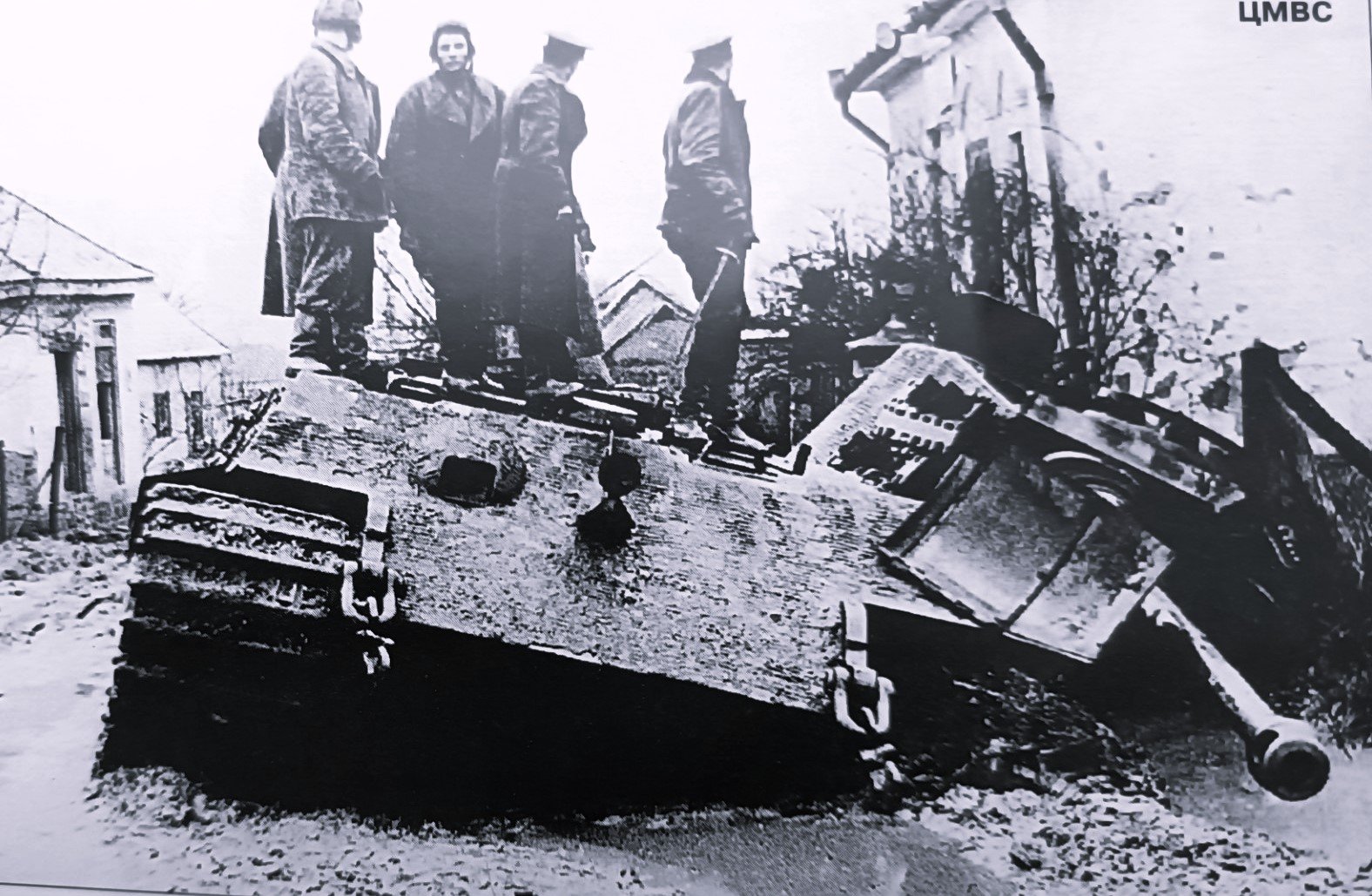
A village of 2,144 people on Hitler’s last defensive line before Lake Balaton, taken and retaken seven times in six weeks. The operational histories of this front count tanks and armies; the county archive that has actually documented the village counts something else — 181 named civilian dead, and a six-week-old child who starved.
At a glance
Balatonfőkajár sat directly on the Margit Line, the German-Hungarian defensive position built after Romania’s defection in August 1944 to shield the approach to Lake Balaton and, beyond it, Vienna. Soviet troops first entered the village on 8 December 1944, opening six weeks of siege in which the settlement changed hands seven times. Three months later, in March 1945, the same ground became the southern edge of Operation Frühlingserwachen (Spring Awakening) — the last major German offensive of the war, launched to hold the Nagykanizsa oilfields, the Axis’s last significant reserve.
The offensive failed within nine days against prepared Soviet defences 30–35 km deep. For the operational histories, Balatonfőkajár is a location on a map, part of a front line. For the county archive that has since gathered its residents’ letters and testimony, it is the settlement that lost a larger share of its people, proportionally, than all but six others in Hungary.
Key facts
- Siege of the village: 8 December 1944 – c. 17 January 1945, changed hands seven times
- Civilian toll: 181 deaths recorded in 1947 statistics, out of a 1941 population of 2,144; at least 35 dead between 8–26 December 1944 alone; 101 bodies exhumed outside the cemetery by Dr. Lajos Barabás in April 1945
- Damage: the Catholic and Jewish places of worship destroyed outright, the Reformed church severely damaged, most houses destroyed or badly damaged
- Operation Frühlingserwachen: 6–15 March 1945, roughly 260,000 German troops (6th SS Panzer Army, 6th Army, 2nd Panzer Army) against 465,000 Soviet troops of the 3rd Ukrainian Front
- Objective: the Nagykanizsa oilfields, the last significant oil reserve still available to the European Axis
- Outcome: German advance stopped by 15 March against Soviet defences up to 35 km deep; Soviet counter-offensive began the next day; roughly 30,000 German dead in the counter-offensive that followed
- Significance: the last major German offensive of the Second World War
- Coordinates: 47.0203° N, 18.2122° E (Balatonfőkajár)
How the line was built
The Margit Line was not a system of casemates like the Árpád Line further east; it was a hastily prepared belt of trenches, anti-tank positions and strongpoints laid out after Romania’s switch of sides in August 1944 exposed Hungary’s southern flank. Balatonfőkajár’s position on that line was a matter of geography, not choice: it sat on ground the German command needed to hold to keep the road to Lake Balaton and, further west, to Vienna, closed to the Red Army.
What the village’s own record shows is what holding that ground actually meant for the people living on it. Personal accounts gathered by the county archive describe families sheltering in cellars for weeks at a time — one account describes four families sharing a single cellar from 9 December until 17 January, going outside as little as possible — and residents burying food and possessions on the advice that, as one woman later recalled her mother saying, «only what goes into the ground stays yours». A letter written in March 1945 records that no food remained at all; the wheat had been taken.
Two battles, three months apart
The village’s ordeal was not one battle but two, separated by a winter. The December 1944 fighting was the slower, crueller one: house-to-house control changing seven times in six weeks, no clear front line, civilians caught in a contest that had nothing to do with them. By the time it ended, in mid-January, at least 35 residents were already dead and a six-week-old infant had starved on 20 December.
The March 1945 fighting was different in kind: a set-piece German offensive, three armies and 650 tanks, launched with a clear strategic aim — hold the oilfields, buy time, deny Vienna to the Soviets for as long as possible. It failed in nine days against defences the Red Army had spent months preparing. Roughly 30,000 German soldiers died in the Soviet counter-offensive that followed. Both battles are usually folded into the single label «fighting around Lake Balaton». They were fought for different reasons, at different scales, and by different logics — one a siege that ground down a village street by street, the other a doomed armoured gamble that used the same ground for three weeks and then moved past it.
Who tells it, and where the accounts diverge
The operational history of Spring Awakening is told in armies and tank counts: 260,000 men against 465,000, 650 tanks against 407, a front measured in kilometres of prepared defence. It is a true account, and it explains why the offensive failed. It has almost nothing to say about Balatonfőkajár as a place where people lived.
The county archive’s account, built from letters, exhumation records and the testimony of people who were children in the cellars, measures the same months in a different unit entirely: 181 named dead in a village of 2,144, a proportional loss the archive itself ranks seventh-worst in the country, a six-week-old child who did not survive the siege at all. Neither record contradicts the other. The operational history explains why the front sat where it did for three months; the village’s own record is what actually happened to the people who could not leave when it did.
Telling only the operational story leaves Balatonfőkajár as a place on a map that changed hands. The village’s own archive insists it was also, for six weeks and then three more, a place where surviving was the entire content of the news.
What you see today
- Balatonfőkajár today is a small working village on the eastern shore approach to Lake Balaton; the wartime damage to its churches and housing stock was rebuilt in the postwar decades.
- No dedicated battlefield museum or visitor circuit marks the 1944–45 fighting on site; the record survives principally in the Veszprém county archive’s documentation project.
- Isolated remains of the wider Margit Line — trench lines and strongpoints — survive in the open countryside around the Lake Balaton and Lake Velence region, mostly undocumented as a heritage circuit.
Getting there
Balatonfőkajár lies on route 64, on Lake Balaton’s eastern approach between Székesfehérvár and Balatonvilágos, about 100 km south-west of Budapest.
Nearby
- Lake Balaton itself, immediately south-west, the offensive’s namesake and the objective the German advance never reached in force
- Székesfehérvár, roughly 25 km north, which changed hands repeatedly in the same winter and spring fighting
Sources
- Magyar Nemzeti Levéltár Veszprém Vármegyei Levéltára, «Veszprém vármegye kincsestára 43. – Harc a túlélésért: Balatonfőkajár a második világháborúban» — siege dates, civilian casualty figures, exhumation record, personal testimony.
- Wikipedia, Operation Spring Awakening — forces, dates, objectives and outcome of the March 1945 offensive, cross-checked for consistency.
Find it on the map
See this place and what’s around it →📷 Become a Cultural Heritage Online photographer
Share your photos of places: they stay published under your name as the author. The more they're seen, the more you get noticed — and soon a contest will reward the most appreciated photos.
Log in or sign up free to add a photo