
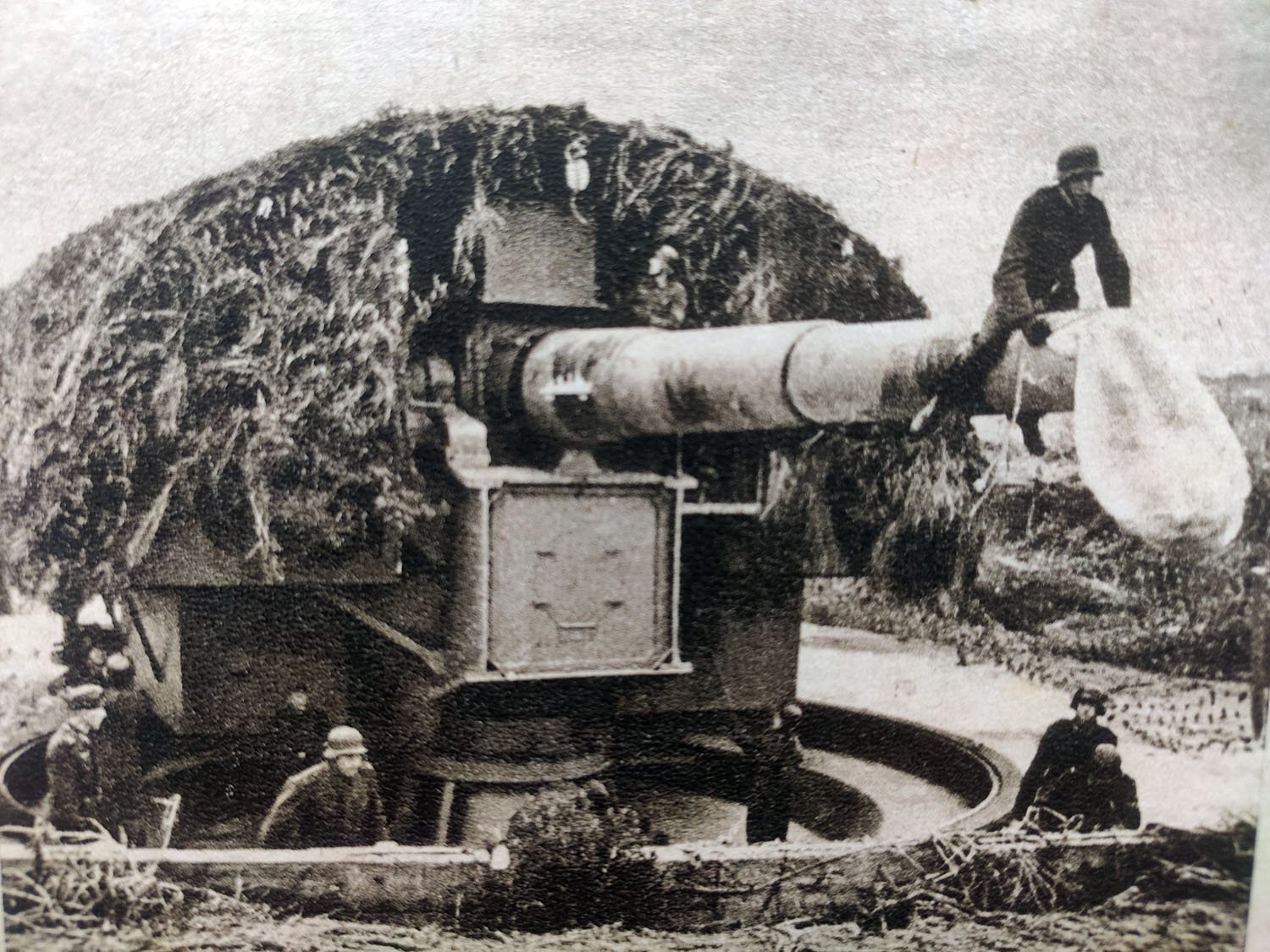
Three German naval guns, built from spare parts meant for a First World War battleship, credited by their own crew with sinking a Soviet destroyer leader that in fact struck a Romanian mine. The battle they actually fought lasted twenty minutes and left the port of Constanța almost untouched.
At a glance
In the winter of 1940, German and Romanian crews began mounting three 280 mm naval guns on the coast at Constanța, Romania’s principal Black Sea port and, after 1940, a key fuel-export point for the Axis war effort. The guns, named Tirpitz after the German admiral, fired their first live rounds in April 1941 and their only shots in combat two months later, on 26 June, when the Soviet Black Sea Fleet raided the port at dawn.
The raid lasted barely twenty minutes. It cost the Soviets a destroyer leader and nine bombers, and the Romanian and German defenders one damaged ship. It is remembered on the Axis side, not quite accurately, as the day the Tirpitz battery sank the Moskva.
Key facts
- Built: winter 1940 – April 1941, jointly by German and Romanian forces, nominally under Romanian command with German Kriegsmarine operational control
- Guns: three 28 cm SK L/45 naval guns, repurposed from spare parts built for the WWI-era Nassau-class battleships
- Garrison: roughly 700 Kriegsmarine personnel, supported by 75 mm and 20 mm anti-aircraft guns
- The raid: 26 June 1941, 04:02–04:21, Soviet cruiser Voroshilov and destroyer leaders Moskva and Kharkov against the Romanian destroyer Regina Maria, flotilla leader Mărăști, the Romanian coastal battery Elisabeta and the German Tirpitz battery
- Losses: Moskva sunk (268+ dead, 69 captured), Kharkov damaged, 9 Soviet bombers shot down; no Romanian or German ship lost
- Only combat use: the Tirpitz battery fired 39 rounds this single time in its operational life
- End: blown up by its own German garrison on the night of 25–26 August 1944, rather than be handed over intact after Romania’s switch of sides
- Coordinates: 44.1767° N, 28.6508° E (Constanța)
How it was built
The three guns at Constanța were never designed for a coastal battery at all. They were spare barrels manufactured for the German Imperial Navy’s Nassau-class dreadnoughts, laid down before the First World War and long since scrapped or interned; two decades later, with Romania’s oilfields feeding the German war machine and the Black Sea coast needing defence against exactly the navy that would eventually attack it, the Kriegsmarine mounted the leftover barrels in concrete emplacements above the port. It was a battery built, in effect, from a war that had already ended, to fight one that had not yet started.
Command of the position reflected the awkwardness of the alliance it served: Romanian by flag, German by crew and by the operational authority of Vice Admiral Helmuth Brinkmann. Romania supplied its own defences alongside it — the older coastal battery Elisabeta, and a minefield laid by the minelayer Amiral Murgescu and other Romanian vessels in the ten days before the battle that mattered.
26 June 1941, four in the morning
At 04:02, Soviet destroyer leaders Moskva and Kharkov opened fire on Constanța from close range, firing more than 350 shells in a few minutes while the cruiser Voroshilov stood further out and a battleship waited a hundred miles offshore in reserve. Romanian ships and the two coastal batteries returned fire; the Tirpitz battery’s rounds struck Kharkov, damaging her steam piping. By 04:12 the Soviet force was withdrawing under smoke. At 04:21, Moskva struck a mine and sank within minutes, with the loss of most of her crew.
The raid achieved almost nothing: a few fuel tanks set alight, port facilities lightly damaged, no Romanian or German vessel sunk. Its main effect was on Soviet tactics — after Constanța, Vice Admiral Filipp Oktyabrsky used his Black Sea Fleet’s surface ships far more cautiously for the rest of the war.
Who tells it, and where the accounts diverge
The photograph that survives from the Tirpitz battery is itself a claim: taken almost a year after the battle, it shows one of the three guns with the name «Moskva» chalked onto the barrel — the crew’s own record of what they believed they had done. It is the kind of evidence that looks most convincing exactly where it is least reliable: a claim of a kill, written by the people making it, on the weapon that supposedly did it.
The operational record does not support the chalk mark. Most accounts of the action agree that Moskva was lost to a Romanian mine laid days before the battle, not to Tirpitz’s shells — though even here the record is not unanimous: a minority of sources have proposed that she was hit by gunfire, or even struck by a torpedo from her own side, the Soviet submarine Shch-206, in the confusion of the withdrawal. What the sources agree Tirpitz actually did — damage Kharkov‘s steam piping — was a lesser, more survivable hit, and a less satisfying story to chalk on a gun barrel.
Neither the crew’s claim nor the mine explanation needs the other to be a lie. A battery can fire accurately, believe it has sunk an enemy ship, and be wrong about which weapon actually did the killing — and the only photograph of the gun that survives is proof, unintentionally, of exactly that gap between what a weapon does and what its crew is told, or tells itself, that it did.
What you see today
- The Tirpitz battery’s emplacements do not survive as a managed heritage site; the battery was demolished by its own garrison in August 1944, and the port area has been built over and remains an active commercial harbour.
- Constanța’s historic centre, a short distance from the former battery site, preserves the city’s Romanian, Ottoman and Genoese-influenced layers largely untouched by the 1941 raid.
Getting there
Constanța is Romania’s principal Black Sea port and largest coastal city, reachable by rail and motorway (A2/A4) from Bucharest, about 225 km south-west, and served by its own international airport (Mihail Kogălniceanu).
Nearby
- Ploiești, the refining hub the Constanța batteries indirectly helped protect the fuel export route for, about 200 km inland
- Mamaia, Romania’s principal Black Sea resort, immediately north of Constanța
Sources
- Wikipedia, Raid on Constanța and German coastal battery Tirpitz — forces, timeline, losses, construction and end of the battery. Cross-checked between both articles for consistency.
- Forțele Navale Române (navy.ro), historical section on Romanian coastal defences at Constanța.
- Jürgen Rohwer, Chronology of the War at Sea 1939–1945 (Naval Institute Press, 2005); Robert Kirchubel, Operation Barbarossa 1941 (Osprey) — cited via Wikipedia’s sourcing for the battery and the raid.
Find it on the map
See this place and what’s around it →📷 Become a Cultural Heritage Online photographer
Share your photos of places: they stay published under your name as the author. The more they're seen, the more you get noticed — and soon a contest will reward the most appreciated photos.
Log in or sign up free to add a photo