
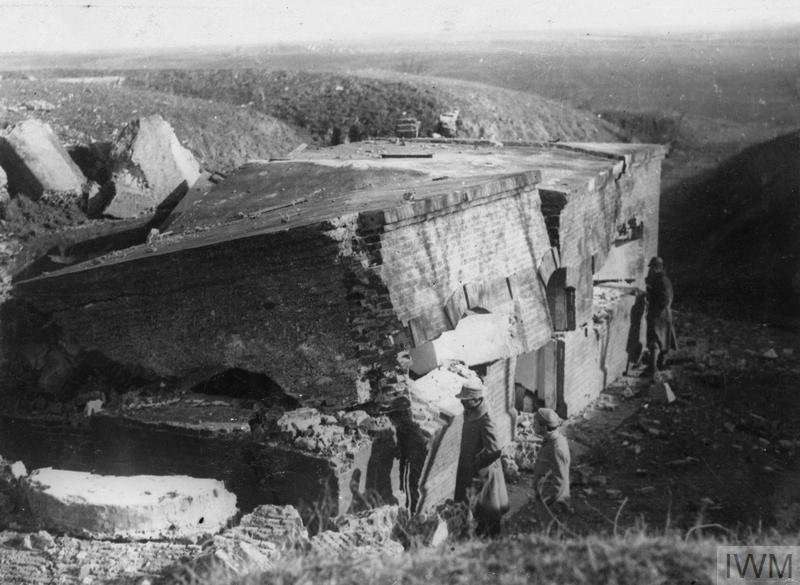
A 180-kilometre chain of casemates rebuilt at enormous cost between 1940 and 1943 to close the one gap through which an army the size of the Red Army could reach Bucharest. It is famous for a war it fought a generation earlier, and silent about the one it was actually built for — not because it failed, but because the government that ordered it fell before the Soviets ever needed to test it.
At a glance
The land between Focșani, Nămoloasa and Galați is Wallachia’s only wide, defensible approach from Moldavia — the «Focșani Gate», the single corridor an army too large to cross the Carpathians on secondary roads has to use. Romania first fortified it in 1888–93 against Russia. It was here, in the summer of 1917, that Romanian and Russian troops stopped a German offensive at Mărășești, one of the country’s best-remembered victories of the First World War.
Between 1940 and 1943, under orders from Marshal Ion Antonescu, the line was rebuilt on a much larger scale against the same neighbour the original works had been designed for: some 1,600 reinforced-concrete casemates, 60 km of anti-tank ditches and 1,800 firing positions along the 180 km front. It was never used. On 23 August 1944 the government that had ordered it was arrested in Bucharest, and Soviet forces crossed the position it defended without a fight.
Key facts
- First fortified: 1888–1893, against Russia, after the 1878 Congress of Berlin
- Tested in 1917: held through the Battle of Mărășești (6 August – 3 September), stopping the German Ninth Army’s advance on Moldavia
- Rebuilt: 1940–1943, ordered by Marshal Ion Antonescu against a renewed Soviet threat; camouflage works ordered as late as 13 November 1943
- Scale of the WWII line: roughly 180 km, from Măgura Cașin near Onești to the Trotuș–Siret confluence; about 1,600 concrete casemates, 60 km of anti-tank ditches, 1,800 firing positions
- Archive: Arhivele Naționale Vrancea, fond Prefectura Putna (works orders and reports, 1940–1943)
- Fate: taken without a fight after the 23 August 1944 coup that removed Antonescu; the Romanian 3rd Army and German 6th Army, encircled further north-east by the Iași–Chișinău offensive, never reached it
- Coordinates: 45.6973° N, 27.1857° E (Focșani, the line’s southern anchor)
How it was built
The Focșani Gate has one property that made it worth fortifying twice: geography does not change with the century. Any force large enough to threaten Bucharest from the north-east has to pass through the same 20-kilometre-wide corridor between the Carpathian foothills and the Danube marshes, whether it wears a German uniform in 1917 or a Soviet one in 1944. The interwar and wartime engineers who rebuilt the line under Antonescu were not improvising a new defence; they were re-arming a position whose value had already been proven once.
Construction ran in bursts rather than a single campaign: the first orders reached the county prefectures in June 1940, casemate building followed through the rest of that year, a much larger programme of works continued through the spring of 1941, and the position was still being camouflaged in November 1943 — three and a half years of intermittent, urgent work, driven by a threat that kept changing shape as the war on the Eastern Front turned against Germany and, with it, against Romania.
Two wars, one position
In the late summer of 1917, the line’s original works, rebuilt and reinforced after 1916, held. The Battle of Mărășești, fought over four weeks between Focșani, Panciu and the Siret, stopped the German Ninth Army’s push toward the last unoccupied Romanian province, in an army whose Russian allies were already disintegrating behind it. It remains one of the most-commemorated Romanian battles of the First World War, marked today by the Mărășești mausoleum.
The line built between 1940 and 1943 never had its equivalent. By August 1944 the war it had been designed for was arriving from a different direction than planned: Soviet forces struck the Iași–Chișinău sector further north-east, encircling roughly 180,000 Romanian and German troops before they could fall back on the Focșani–Nămoloasa–Galați position at all. On 23 August, King Michael I had Antonescu arrested and announced Romania’s break with Germany. The position considered, by more than one later analysis, close to impassable to a force the size of the Red Army was crossed the same week without a shot fired at it — not because it was weak, but because the war had already been decided somewhere else, and the government that would have ordered it defended no longer existed.
Who tells it, and where the accounts diverge
Ask what happened at the Focșani Gate and the answer, in Romania, is Mărășești: a mausoleum, a national holiday-adjacent memory, a battle that stopped an invasion. It is a true and well-documented answer, and it is about 1917.
The 1940s line, three and a half years of concrete and labour on a scale the earlier works never approached, has almost no comparable record, and the reason is not neglect. A Romanian strategic commentary on the position states it plainly: this line «never functioned against an attack from the east — only against the Central Powers’ attack from the west, in 1916–1917». It was built, in other words, to refight the war it had already won, against an enemy that in the event never had to attack it at all. The only photograph available of the position shows it in 1916, ruined by the war it is remembered for, twenty-four years before the war it was rebuilt to fight.
Neither story is wrong. The gap between them is the space where a defence can be real, expensive and entirely untested, all at once — and where the record a country keeps is shaped by which war a position actually fought, not by which one it was built for.
What you see today
- Scattered remains of concrete casemates and anti-tank ditches survive along the former line, on private and agricultural land, unmarked and largely undocumented as a heritage circuit.
- The Mărășești Mausoleum, the commemorated counterpart from the earlier war fought on the same ground, remains the area’s principal war-heritage site.
- This is not a managed visitor site: what survives of the 1940s line requires local knowledge to locate.
Getting there
Focșani, on the E85/DN2 and the Bucharest–Iași railway, anchors the southern end of the former line. Mărășești, with the mausoleum, lies about 25 km to the north on the same road and rail corridor.
Nearby
- Mărășești Mausoleum, 25 km north, commemorating the 1917 battle fought on the same defensive line
- Galați, the line’s eastern anchor on the Danube, about 90 km south-east
Sources
- Historia.ro, «Ultima cazemată din Poarta Focșanilor» — construction chronology 1888–93 and 1940–43, scale figures, Arhivele Naționale Vrancea citation.
- George Damian, «Linia de apărare Focșani-Galați și abandonarea Moldovei» (georgedamian.ro) — strategic assessment of the line’s role and non-use in 1944.
- Wikipedia and related summaries of the Iași–Chișinău offensive and the 23 August 1944 coup, cross-checked for the encirclement of Romanian and German forces and the coup’s timing.
- Wikipedia, Battle of Mărășești — 1917 battle dates and outcome, cross-checked.
Find it on the map
See this place and what’s around it →📷 Become a Cultural Heritage Online photographer
Share your photos of places: they stay published under your name as the author. The more they're seen, the more you get noticed — and soon a contest will reward the most appreciated photos.
Log in or sign up free to add a photo