

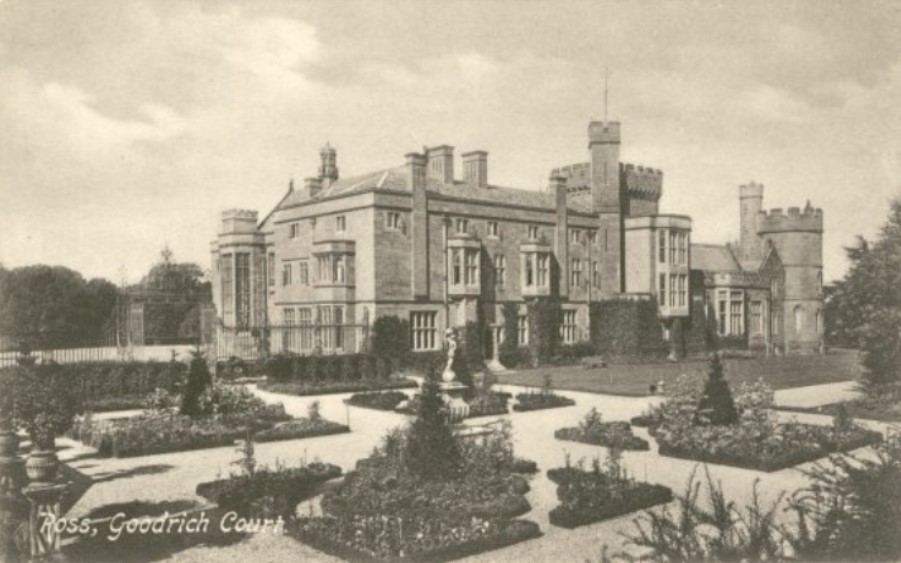
A neo-gothic mock castle designed by Edward Blore for antiquarian Sir Samuel Rush Meyrick, whose ambitious vision provoked the ire of William Wordsworth—and lasted barely a century.
At a glance
Built in 1828 on a hilltop facing the medieval Goodrich Castle, this tower-bedecked house was erected to display one of England’s finest private collections of arms and armour. Though demolished in 1949–50, fragments of the estate survive, including the Monmouth Gatehouse.
History
Sir Samuel Rush Meyrick, a devoted antiquarian, commissioned the architect Edward Blore to design this extraordinary residence to house his remarkable collection of armour and antiquities. Completed in 1828, the court immediately became a focal point of scholarly and artistic interest, drawing visitors as part of the fashionable Wye Tour through the region.
The building’s prominent position and theatrical design aroused considerable criticism. Poet William Wordsworth was so offended by what he saw as an impertinent intrusion upon the landscape that he declared his wish to demolish it entirely.
After Meyrick’s death, with his son having predeceased him, the court passed through successive owners. During the Second World War, it served as a boarding house for pupils from Felsted School. When they departed, the building fell into decline. It was stripped of its contents and completely demolished between 1949 and 1950.
What you see
Pevsner characterized the court as a “fantastic and enormous tower-bedecked house”—a romantic, picturesque fantasy in the neo-gothic style. Its theatrical profile was deliberately designed to echo the genuine medieval fortress visible across the valley.
Today, almost nothing remains. The Monmouth Gatehouse stands on the Monmouth to Ross-on-Wye Road; a small lodge and stables survive on the grounds. The main structure exists now only in historical records and period illustrations.
Cultural significance
Goodrich Court embodied the 19th-century passion for collecting and displaying medieval artefacts. Meyrick’s assemblage was of such importance that major portions entered the British Museum and the Wallace Collection, where they remain today.
The court itself became a cultural landmark, featured in the picturesque tourism circuit of the Wye Valley during its heyday. Its swift demolition reflects the changing attitudes toward Victorian antiquarianism and the impermanence of even ambitious country houses.
Key facts
- Built 1828; demolished 1949–50
- Architect: Edward Blore
- Owner: Sir Samuel Rush Meyrick, antiquarian collector
- Location: Goodrich, Herefordshire, England
- Coordinates: 51.8814, -2.6314
- Surviving features: Monmouth Gatehouse, lodge, stables
Practical information & getting there
Goodrich Court no longer stands, but the Monmouth Gatehouse can be viewed from the Monmouth to Ross-on-Wye Road. The nearby medieval Goodrich Castle, which inspired Meyrick’s folly, remains open to visitors and offers context for understanding the site’s historical landscape.
Sources & resources
Find it on the map
See this place and what’s around it →📷 Become a Cultural Heritage Online photographer
Share your photos of places: they stay published under your name as the author. The more they're seen, the more you get noticed — and soon a contest will reward the most appreciated photos.
Log in or sign up free to add a photoIs this page about you?
This page is read by travellers and heritage enthusiasts who find it on Google. Tell us how you are connected to this place and we will take it from there.