

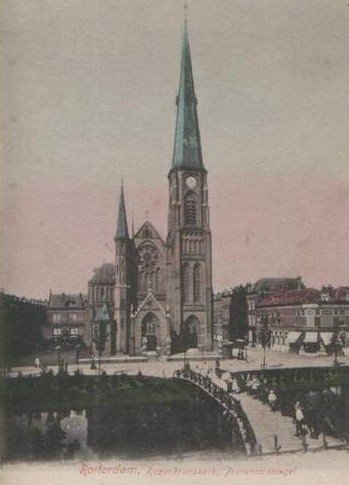
A neo-Gothic Roman Catholic church built on Rotterdam’s Proveniershuis canal, the Provenierskerk served its parish for over seventy years before demolition in the post-war era.
At a glance
The church was designed by the architectural firm of Albert Margry and Joseph Snickers and completed in 1899. Its three-aisled nave and tower reflected confident neo-Gothic ambitions during the city’s period of Catholic growth. Though it survived Rotterdam’s devastating World War II bombing, the building was demolished in 1976 when parish numbers declined and preservation seemed economically unfeasible.
History
Construction began in 1898 and concluded the following year, with the Bishop of Haarlem consecrating the church on May 8, 1899. Initially part of the Allerheiligst Hart van Jezuskerk parish, the Provenierskerk achieved independent status in 1923 as Catholic migration to the district accelerated. Before World War II, the neighborhood flourished; the church overflowed with worshippers.
During the Nazi occupation, the church became a center of resistance organized by local priests. German soldiers looted the church bells in 1942, though replacements were installed in 1947. When Rotterdam’s post-war Catholic population dispersed, attendance plummeted. The final Mass was celebrated on August 31, 1975, and the city purchased and demolished the building shortly after. A nursing home now occupies the site.
What you see
Margry designed a three-aisled church in neo-Gothic style with a tower positioned beside the main facade. Interior embellishments included a marble communion rail installed in 1914 and a notable Stations of the Cross created by the renowned Royal Delft factory. Church bells were added in 1910, and an organ joined the interior in 1916. Dominican friars served the parish.
Cultural significance
The Provenierskerk embodied Rotterdam’s nineteenth-century Catholic expansion and its community resilience during wartime. Though demolished without preservation efforts—deemed historically unremarkable by contemporary judgment—its artworks survive. The Stations of the Cross and a statue of Maria were transferred to the Albertus de Grotekerk in Blijdorp, preserving fragments of the congregation’s spiritual heritage.
Key facts
- Country: Netherlands
- City: Rotterdam
- Completed: 1899
- Architects: Albert Margry and Joseph Snickers
- Coordinates: 51.927°N, 4.470°E
- Demolished: 1976
Practical information & getting there
The Provenierskerk no longer stands. You can visit the Albertus de Grotekerk in Blijdorp, Rotterdam, to view the surviving Stations of the Cross and statue of Maria relocated from the original church.
Sources & resources
Find it on the map
See this place and what’s around it →📷 Become a Cultural Heritage Online photographer
Share your photos of places: they stay published under your name as the author. The more they're seen, the more you get noticed — and soon a contest will reward the most appreciated photos.
Log in or sign up free to add a photoIs this page about you?
This page is read by travellers and heritage enthusiasts who find it on Google. Tell us how you are connected to this place and we will take it from there.