
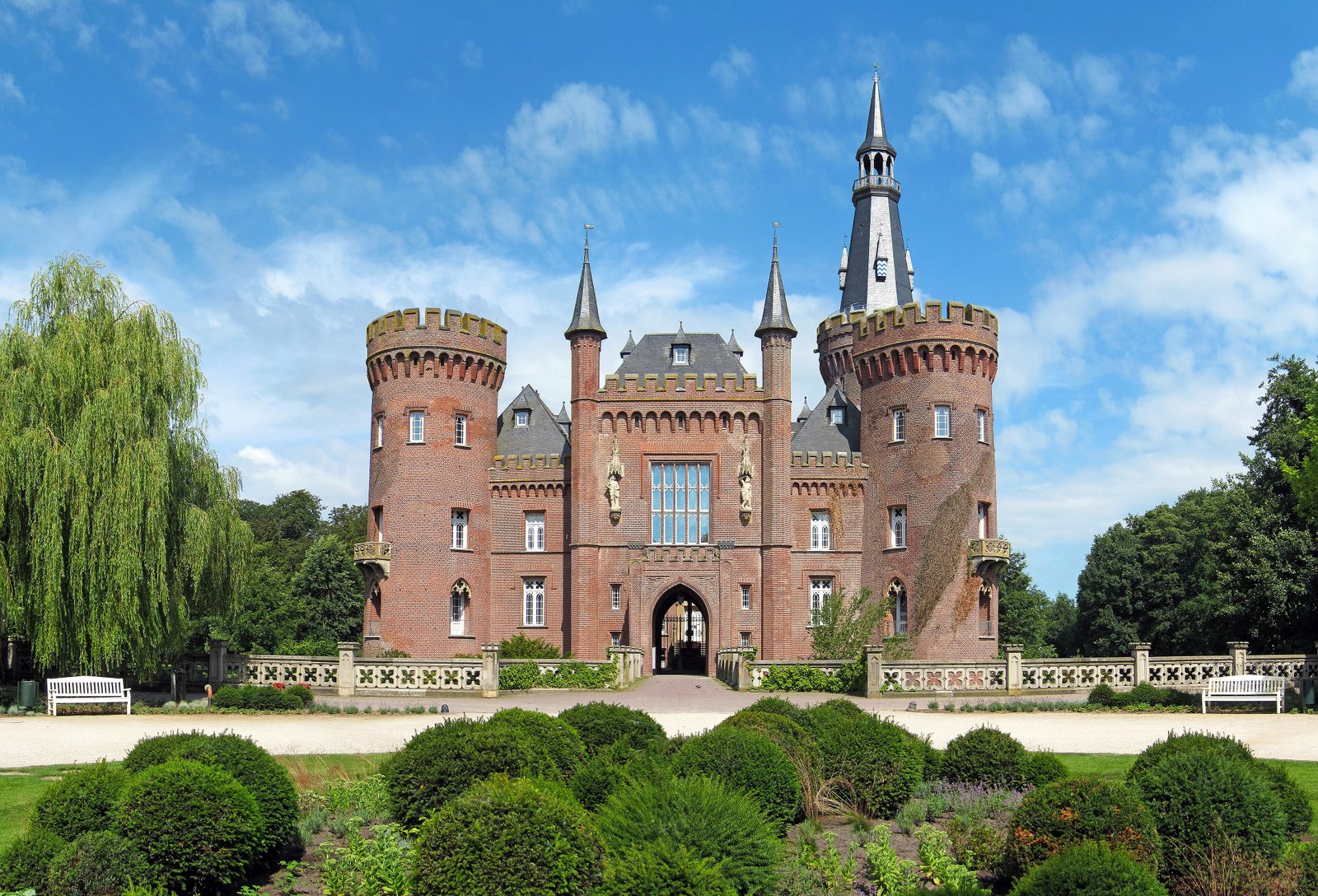
A moated neo-Gothic castle in the Lower Rhine region that now houses the world’s largest collection of works by artist Joseph Beuys.
At a glance
Moyland Castle is one of the most important neo-Gothic buildings in North Rhine-Westphalia. The water castle, surrounded by protective moats, has been transformed into a museum dedicated to the German artist Joseph Beuys and his groundbreaking conceptual and installation works.
History
The castle’s name derives from the Dutch word Mooiland, meaning “beautiful country”—a name probably coined by Dutch workers brought to drain the surrounding wetlands in 1307 by Jacob van den Eger of the Lower Rhine, then the property’s leaseholder. The site evolved over centuries into the architectural landmark visible today.
What you see
Moyland exemplifies neo-Gothic design principles applied to a water castle typology. The moated fortification and its architectural vocabulary reflect both medieval defensive tradition and 19th-century romantic historicism. The castle’s setting within the wetland landscape of the Lower Rhine remains integral to its visual and historical identity.
Cultural significance
The castle has become synonymous with Joseph Beuys’s legacy. Its transformation into a museum dedicated to the artist’s work has made it a major cultural institution in the region, drawing visitors interested in post-war German art and contemporary practice rooted in sculptural and conceptual innovation.
Key facts
- Location: Bedburg-Hau, district of Kleve, North Rhine-Westphalia, Germany
- Coordinates: 51.7552, 6.2368
- Type: Water castle (moated castle)
- Architectural style: Neo-Gothic
- Current use: Museum housing the world’s largest Joseph Beuys collection
Practical information & getting there
Moyland Castle is located in Bedburg-Hau in the Lower Rhine region of western Germany. It operates as a public museum. For current hours, admission fees, and travel directions, consult the museum’s official website or contact the venue directly.
Sources & resources
Find it on the map
See this place and what’s around it →📷 Become a Cultural Heritage Online photographer
Share your photos of places: they stay published under your name as the author. The more they're seen, the more you get noticed — and soon a contest will reward the most appreciated photos.
Log in or sign up free to add a photoIs this page about you?
This page is read by travellers and heritage enthusiasts who find it on Google. Tell us how you are connected to this place and we will take it from there.