

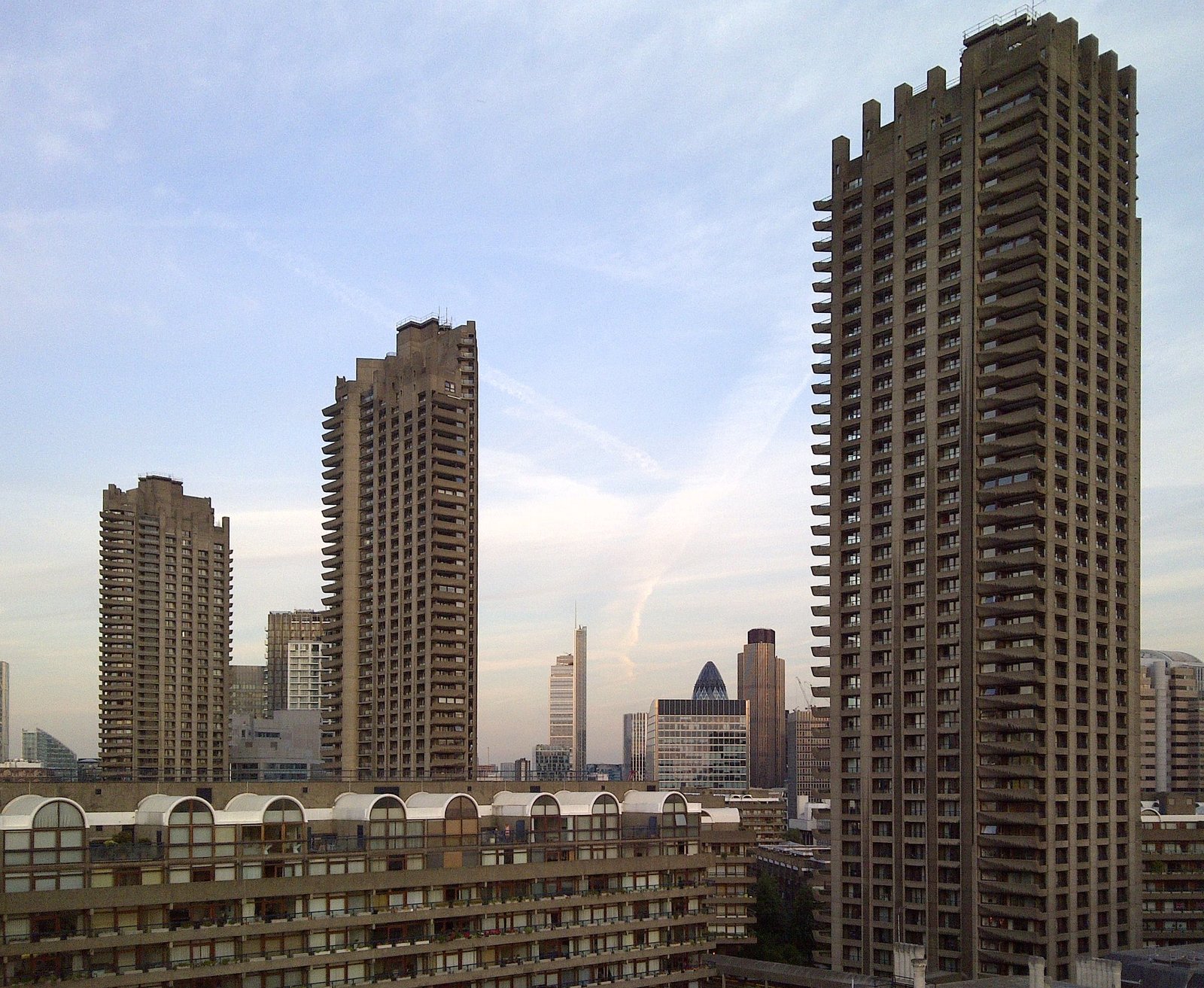
A landmark residential complex of around 2,000 homes, the Barbican Estate stands as a defining example of British brutalist architecture in the heart of London’s financial district.
At a glance
Built on land devastated by World War II bombing, the Barbican Estate transformed a scarred urban landscape into an ambitious mixed-use community. Its Grade II listing recognizes the architectural significance of this post-war vision. The complex integrates housing with major cultural institutions, creating a self-contained neighbourhood 1.4 miles north-east of Charing Cross.
History
The estate was conceived for middle and upper-middle-class professionals seeking modern urban living in the City of London. It rose from bombed terrain, representing a bold reconstruction strategy. The complex evolved to include the Barbican Centre, the Museum of London, the Guildhall School of Music and Drama, a public library, and educational facilities, forming an integrated cultural and residential hub.
What you see
The Barbican Estate exemplifies British brutalism through its bold massing, exposed concrete, and sculptural forms. Approximately 2,000 flats, maisonettes and houses create a dense, vertically-organized community. The complex includes a public library and YMCA (now closed). Milton Court, which once housed a fire station, medical facilities and flats, was demolished to make way for The Heron, a new apartment tower that also serves the Guildhall School of Music and Drama.
Cultural significance
The Barbican Estate represents a defining moment in post-war British urbanism and architectural ambition. Its Grade II listing status reflects its importance as a brutalist landmark and pioneering mixed-use community. The integration of housing, culture and education established a model for comprehensive urban regeneration that influenced subsequent development thinking across Europe.
Key facts
- Location: City of London, United Kingdom
- Coordinates: 51.519°N, 0.094°W
- Type: Residential estate and cultural complex
- Number of dwellings: Approximately 2,000 flats, maisonettes and houses
- Architectural style: British brutalism
- Listed status: Grade II (whole complex, excluding demolished Milton Court)
Practical information & getting there
The Barbican Estate is located in central London, 1.4 miles north-east of Charing Cross. Public access to the grounds is permitted, though many buildings serve residential or institutional purposes. The adjacent Barbican Centre hosts public exhibitions, performances and events. The Museum of London is nearby. You can reach the area via Barbican Underground Station on the Metropolitan, Circle and Hammersmith & City lines.
Sources & resources
Find it on the map
See this place and what’s around it →📷 Become a Cultural Heritage Online photographer
Share your photos of places: they stay published under your name as the author. The more they're seen, the more you get noticed — and soon a contest will reward the most appreciated photos.
Log in or sign up free to add a photoIs this page about you?
This page is read by travellers and heritage enthusiasts who find it on Google. Tell us how you are connected to this place and we will take it from there.