
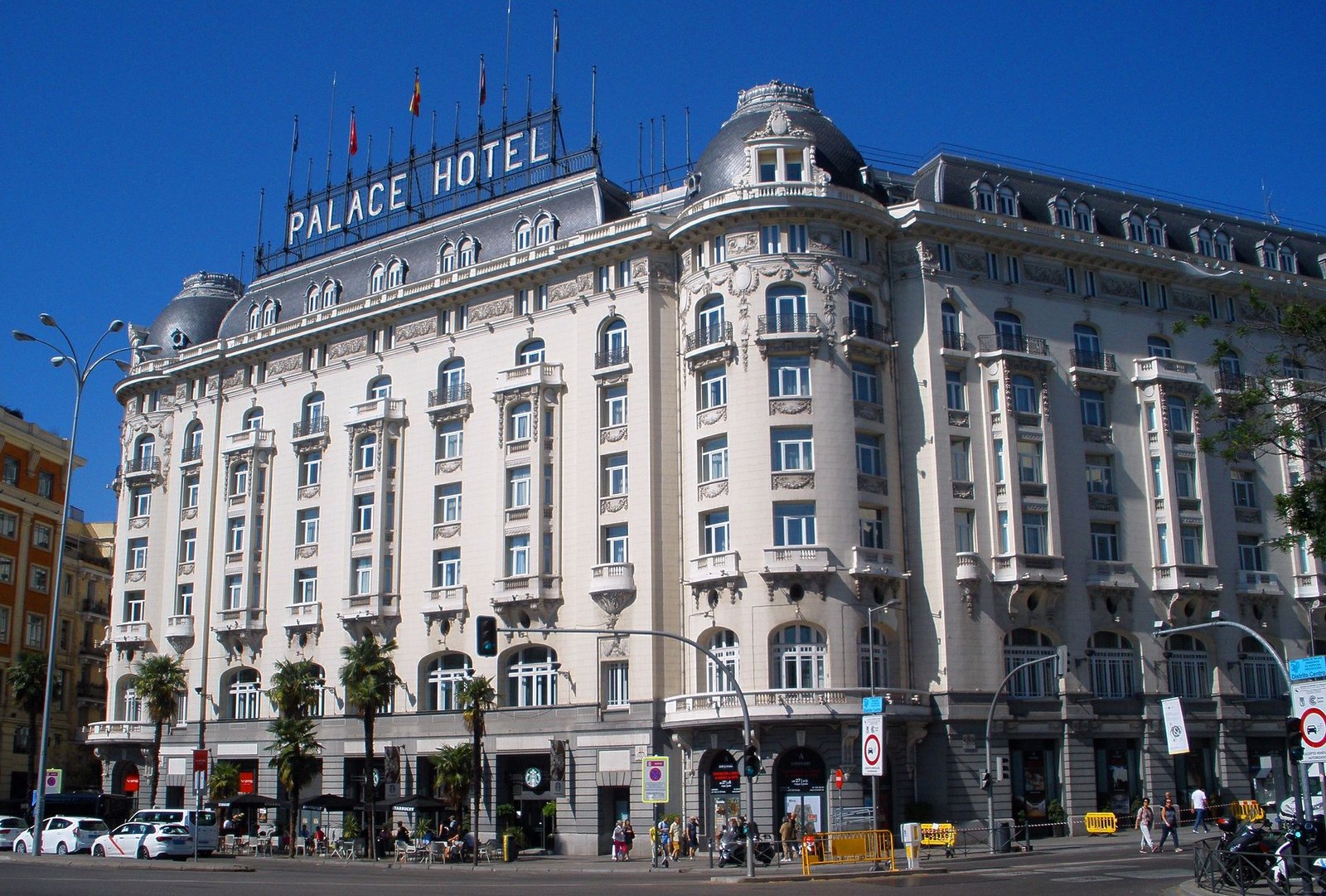
A king asked for it, a Belgian hotelier built it in a year and a half, and Madrid got the largest hotel in Europe — poured in reinforced concrete over the grounds of a demolished ducal palace.
At a glance
The Palace was Alfonso XIII’s idea before it was anyone’s investment: the king wanted Madrid to receive Europe as Paris and Vienna did, and personally encouraged the Belgian hotelier Georges Marquet to build the answer. The site was the garden of the demolished Palacio de Medinaceli, between the parliament and the Neptune fountain. Eduard Ferrés i Puig designed it, the Brussels firm Léon Monnoyer et Fils engineered one of Madrid’s first reinforced-concrete frames, and the hotel opened on 12 October 1912 after roughly eighteen months of work. It has never been anything but a grand hotel since, and its winter-garden rotunda under a Maumejean stained-glass dome remains one of the city’s great interiors.
Key facts
- Built: excavation from March 1911, first stone 9 July 1911, opened 12 October 1912.
- Architect: Eduard Ferrés i Puig (1872–1928), the Catalan who also introduced reinforced concrete to Catalonia; the definitive project passed through the Belgian side of the operation, with municipal architect Manuel Álvarez Naya overseeing the works.
- Structure: engineered by Léon Monnoyer et Fils of Brussels — one of the first reinforced-concrete buildings in Madrid, which is what made the eighteen-month schedule possible.
- Scale at opening: the largest hotel in Europe — sources put the room count between 470 and 800 — with a bathroom and telephone in every room, at a time when even the Ritz across the fountain shared facilities.
- The dome: the octagonal hall became an oval winter garden under an iron-and-glass cupola with stained glass by the Maumejean house.
- Protection: declared Bien de Interés Cultural, monument category, by Decreto 56/1999; the setting now sits within the UNESCO-listed Paseo del Prado landscape.
- Today: The Westin Palace, under Marriott International.
History
Madrid entered the twentieth century short of beds fit for a state visit, and Alfonso XIII took the matter personally. Georges Marquet, the Belgian who ran casinos and grand hotels from Ostend to San Sebastián, took the king’s suggestion and assembled a Franco-Belgian operation to deliver it: a competition in 1910 brought in the Catalan architect Eduard Ferrés i Puig, the Monnoyer firm shaped and engineered the final project, and the Medinaceli garden was cleared from March 1911. The pace was deliberate and new to Spain — concrete pillars rated for enormous loads, eight-metre beam spans, floors rising in months rather than years. The bill, around fifteen to sixteen million pesetas, was compared at the time to the contract for the first stretch of the Gran Vía.
What opened on 12 October 1912 rewrote the city’s standards in a single stroke: every room with its own bathroom, telephone and central heating, in a building bigger than any hotel in Europe. Two years later the city council named it Madrid’s best new building. The Palace became the second pole of the capital’s social geography, facing the Ritz across the Neptune fountain — the Ritz smaller and more exclusive, the Palace vast, political and worldly, with the parliament fifty metres from its door.
The Civil War put the building to graver use. After September 1936 it briefly housed the Soviet embassy, then served as a military hospital — Hospital Base no. 1 — with a blood bank working under the stained-glass dome. Restored to its trade after the war, it resumed the role it has never since given up. The state recognised the building formally in 1999, declaring it a Bien de Interés Cultural in the monument category, and in 2021 the boulevard it stands on entered the UNESCO World Heritage list as part of the Paseo del Prado and Buen Retiro cultural landscape.
What you see
From the Neptune fountain the Palace reads as a Parisian transplant: a stone facade in a Louis XVI key, a full block long, rising through a classical base, body and crown to mansard slate roofs with corner turrets. The composition is calculated for its triangular site — the building presents formal fronts to the Plaza de las Cortes, the Plaza de Cánovas del Castillo and the Carrera de San Jerónimo at once, so there is no back to catch it from.
The set piece is inside and freely visible: La Rotonda, the oval winter garden at the heart of the plan, ringed by paired columns and lit through the Maumejean dome, whose glass throws a warm, aquarium-coloured light over the room at midday. It was designed as the hotel’s public living room and still works as one — the sensation of standing under it, with the traffic of the Paseo inaudible, is the closest Madrid comes to stepping into 1912.
Practical information
- The building operates as a five-star hotel; the common areas — the hall and La Rotonda — can be visited as a café or bar guest.
- Breakfast or an evening drink under the dome is the practical way to see the Maumejean glass at leisure.
- The best exterior view is from the Neptune fountain, taking the Palace and the Ritz in a single Belle Époque panorama.
- The Prado, the Thyssen and the parliament are all within three hundred metres.
Getting there
The hotel fills the block at Plaza de las Cortes 7, on the Carrera de San Jerónimo where it meets the Paseo del Prado. Coordinates: 40.415454, -3.695802 (Google Maps). Banco de España and Sevilla metro stations (line 2) are each about five minutes on foot; Atocha station is a ten-minute walk down the Paseo.
Nearby
- Mandarin Oriental Ritz, its 1910 rival across the Neptune fountain.
- Prado Museum, two minutes down the Paseo.
- Paseo del Prado and Buen Retiro, the UNESCO landscape the hotel now belongs to.
Sources
- Madrid Ciudadanía y Patrimonio — the BIC declaration (Decreto 56/1999), architects, the Monnoyer concrete frame, the Maumejean dome, the building’s composition.
- Historia Urbana de Madrid — the Medinaceli site, the construction timeline and engineering, the cost, the Civil War hospital and Soviet embassy.
- Wikipedia (ES), Hotel Palace — opening date, largest-in-Europe standing, room amenities, current operator.
- Eduard Ferrés i Puig — the architect’s dates and career.
- Coordinates verified against OpenStreetMap Nominatim for Plaza de las Cortes 7, Madrid.
Find it on the map
See this place and what’s around it →📷 Become a Cultural Heritage Online photographer
Share your photos of places: they stay published under your name as the author. The more they're seen, the more you get noticed — and soon a contest will reward the most appreciated photos.
Log in or sign up free to add a photoIs this page about you?
This page is read by travellers and heritage enthusiasts who find it on Google. Tell us how you are connected to this place and we will take it from there.