
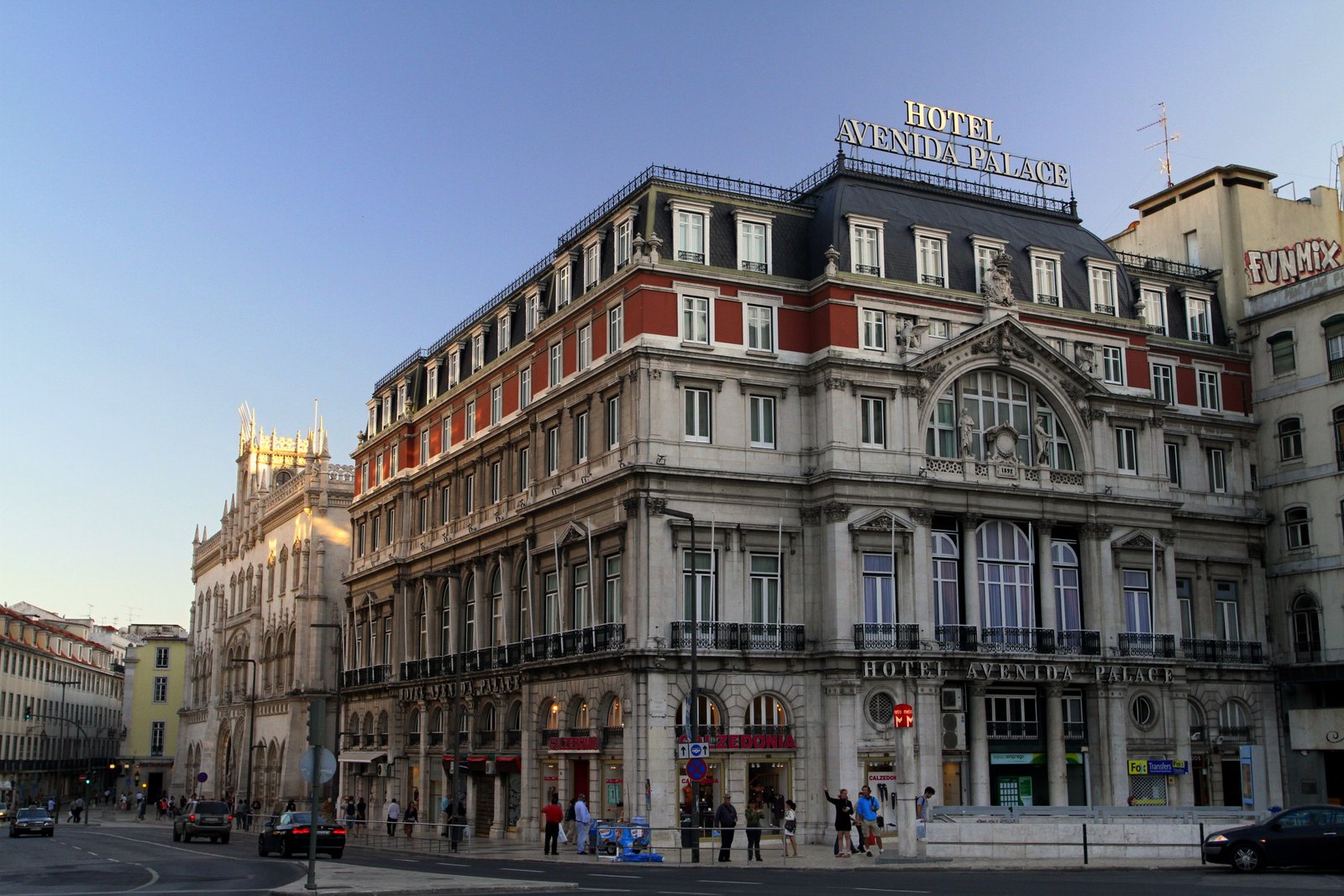
A railway company built it beside its own station, and a locked door on the fourth floor once led straight to the platforms. Spies, a banned prince and Salazar all used the Avenida Palace in their own ways.
At a glance
The Avenida Palace began as an annex. When José Luís Monteiro was building Rossio station for the Real Companhia dos Caminhos de Ferro Portugueses, the company asked him for an administrative building next door; the sleeping-car company Wagons-Lits persuaded them to make it a grand station hotel instead, in the manner of the European capitals. Freed from the neo-Manueline language imposed on the station, Monteiro composed a French Second Empire block, Beaux-Arts to its bones, and the Grande Hotel Internacional opened on 10 October 1892 — renamed Avenida Palace a year later. It is still a hotel, with 82 rooms and its Belle Époque interiors intact.
Key facts
- Opened: 10 October 1892, as the Grande Hotel Internacional, under director Edmundo Eloy; renamed Avenida Palace in 1893.
- Architect: José Luís Monteiro (1848–1942), Paris-trained at the École des Beaux-Arts, architect of Rossio station next door; construction supervised by the engineer David Cohen.
- Style: French Second Empire — the hotel’s history notes the main facade’s great window deliberately echoing the iron architecture of the Gare du Nord.
- Fittings at opening: furniture from Maple of London, a hydraulic lift, heating and ventilation in every room, bathrooms in nearly all — luxuries in 1892 Lisbon.
- The door: a discreet, normally locked fourth-floor passage connected the hotel to Rossio station’s platforms — used by anonymity-seeking guests, and, by a former employee’s account, by Salazar.
- Renovations: a two-year remodelling from 1964 by the Carlos Ramos practice; the Salão Palace created under Lucien Donnat in 1998.
- Today: 82 rooms and 20 suites at Rua 1º de Dezembro 123, between Rossio square and the Restauradores.
History
Rossio station opened in 1890 with a hotel-sized question attached: what to do with the annex. Wagons-Lits, the company that ran Europe’s sleeping cars, saw the answer — a station palace like those of Paris or Vienna, positioned where Lisbon’s political and café life already gathered, with the Café Martinho across the way. The original design connected station and Restauradores square through an interior gallery, later removed; until 1912 the main entrance faced the Restauradores. The decoration aimed at Versailles and the clientele matched it: the exiled prince Miguel of Braganza checked in under the false name “Count of Mutzgen” in January 1901, defying a law that promised death to returning members of his line.
The hotel kept finding itself beside history. When the monarchy fell in October 1910, the diplomatic corps watched the shooting between Rotunda and Rossio from its windows, and the building took stray rounds. Diaghilev’s Ballets Russes stayed in 1917, and Almada Negreiros came to the hotel to salute them with a manifesto. In December 1918 President Sidónio Pais was shot at Rossio station while making his way toward the hotel. In 1925 the master forger Alves Reis — then awash in irregularly issued five-hundred-escudo notes — moved in. Emperor Hirohito of Japan honeymooned here in 1937.
The Second World War made the Avenida Palace legend permanent. Neutral Lisbon filled with agents of every side, and Time Out’s history of the house records that British intelligence considered it one of the German spies’ favoured lodgings — while the locked fourth-floor door to the station platforms let anyone worth watching arrive unseen. The political class never left: Salazar’s ministers frequented the salons, Cardinal Mindszenty slept here, and François Mitterrand made it his Lisbon address. The Carlos Ramos remodelling of 1964–66 renewed the fabric without breaking the style, and the hotel passed its centenary still in the business it was built for.
What you see
Outside, the hotel is a lesson in reading two buildings at once: Monteiro’s station next door performs a romantic neo-Manueline fantasy, while his hotel answers in fluent Parisian — mansard roofs, classical mouldings, and the great glazed window the hotel’s chronicle links to the Gare du Nord. The square in front had been dressed for the occasion: the two bronze fountains of Rossio, cast in France, arrived in 1889 while the hotel was rising.
Inside, the sequence of salons is the point. The lobby’s stained-glass ceiling pours coloured light over marble columns and red brocade; the marble stair climbs six storeys as it did when guests arrived from the platforms; the 130-square-metre Salão Nobre on the second floor, in blue and gold, has worked as a film set for The Count of Monte Cristo and Chain Reaction. The oak-lined restaurant still looks straight up the Avenida da Liberdade — the avenue the hotel renamed itself after.
Practical information
- The building operates as a five-star hotel; the salons and stained-glass lobby are seen as a guest or a visitor to the bar.
- The exterior pairs best with Rossio station: stand on Praça dos Restauradores and take in both facades by the same architect in two different languages.
- The Salão Nobre and Salão Palace host events; the bar beside the Salão Palace is the easiest way in.
- Late-afternoon light works on the west-facing front toward the Restauradores.
Getting there
The hotel stands at Rua 1º de Dezembro 123, wedged between Rossio square and Praça dos Restauradores. Coordinates: 38.714763, -9.141098 (Google Maps). Rossio and Restauradores metro stations are both under three minutes on foot, and the trains still run from Monteiro’s station next door — though the fourth-floor door is no longer in service.
Nearby
- Rossio Railway Station, Monteiro’s neo-Manueline twin next door.
- Elevador de Santa Justa, three streets south.
- Café A Brasileira, up the hill in Chiado.
Sources
- Hotel Avenida Palace, A nossa história — adapted from the Câmara Municipal de Lisboa collection Lisboa Porta a Porta (vol. 10): the Wagons-Lits proposal, opening date and first director, the 1901 incognito prince, the fourth-floor door, the 1964 and 1998 remodellings.
- Time Out Lisboa, “O grande hotel dos espiões” — the 1892 opening, the 1912 entrance change, British intelligence on the German spies, the station corridor.
- Historic Hotels Then & Now — Monteiro’s Paris portfolio, the 1998 renovation, the espionage era.
- José Luís Monteiro — the architect’s dates and Beaux-Arts training.
- Coordinates verified against OpenStreetMap Nominatim for Rua 1º de Dezembro 123, Lisbon.
Find it on the map
See this place and what’s around it →📷 Become a Cultural Heritage Online photographer
Share your photos of places: they stay published under your name as the author. The more they're seen, the more you get noticed — and soon a contest will reward the most appreciated photos.
Log in or sign up free to add a photoIs this page about you?
This page is read by travellers and heritage enthusiasts who find it on Google. Tell us how you are connected to this place and we will take it from there.