
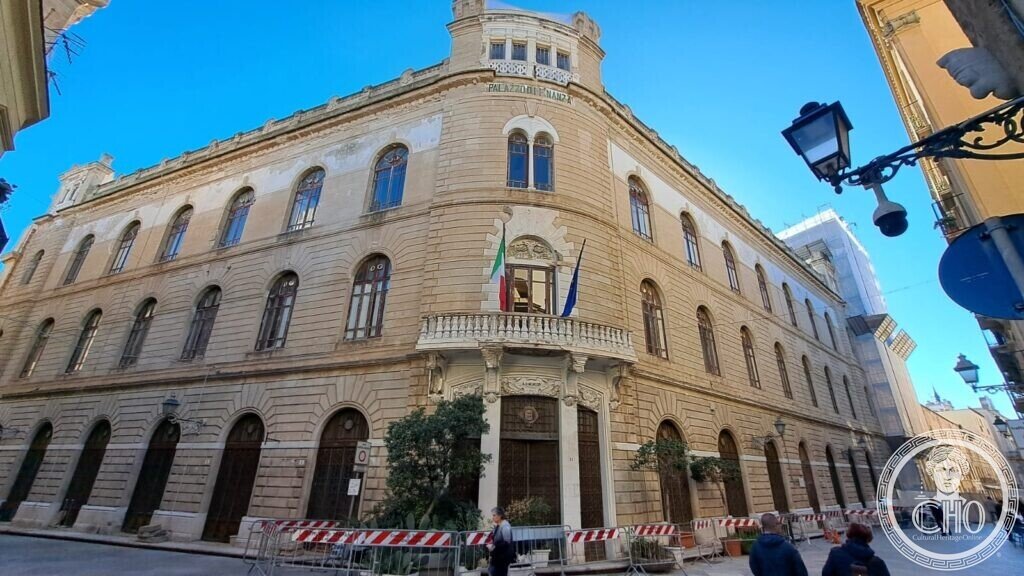
The building states its own facts: PALAZZO DI FINANZA painted across the attic, A.D. MCMXXIV carved over the corner door. Almost everything else about it has faded — including its use.
At a glance
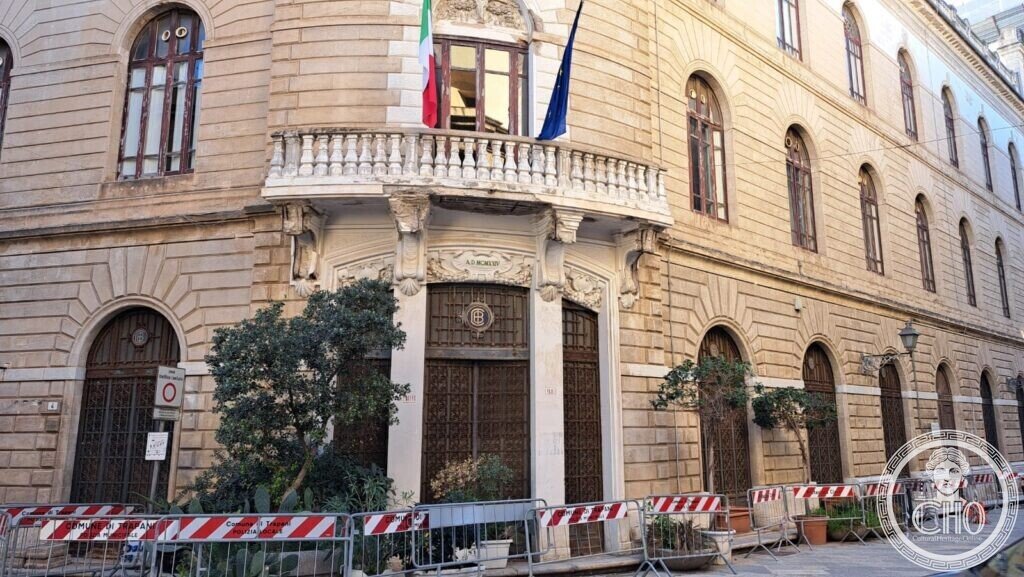
The palace of the state financial offices fills a long block of via Torrearsa at the corner of via Garibaldi, in the heart of nineteenth-century Trapani. It is a work of the early 1920s — the date 1924 is cut into the cartouche above the corner entrance — built in the dignified eclectic manner of Italian public administration before rationalism arrived: rusticated ashlar, two floors of arched windows, a rounded corner crowned by a little loggia, and a stone balcony over the entrance where the flags still fly. Today the building is in visibly poor repair, its base ringed by the barriers of the Comune.
Key facts
- Completed: 1924 — A.D. MCMXXIV, carved above the corner door
- Purpose: seat of the state financial administration («Palazzo di Finanza», as the attic inscription reads)
- Manner: late-eclectic public architecture — rustication, arched openings, corner loggia — a generation before Trapani’s rationalist buildings
- Today: largely disused, after brief spells hosting exhibitions; safety barriers along the street fronts
- Location: Via Torrearsa 98, corner via Garibaldi, 91100 Trapani — 38.0166 N, 12.5100 E
History
Trapani grew fast between the 1880s and the 1920s, and the state grew with it: customs, taxes and registries needed a palace, and they received one worthy of a provincial capital, finished — as its own stone says — in 1924. It belongs to the last season of pre-modernist public building in the city, immediately before the Fascist decade filled Trapani with a different architecture: the post office, the Casa del Mutilato, the new avenues.
The financial offices eventually moved to modern quarters, and the palace slipped into the half-life familiar to big state buildings in southern historic centres: occasional use — art exhibitions were held in its halls for a time — then closure. Local reporting describes it bluntly as falling to pieces. The tricolour and the European flag still hang from the corner balcony, and the Comune’s barriers along the pavement say the rest.
What you see
The corner is the show: a rounded prow rising the full height of the building, finished with a small arched loggia above the cornice, and carrying the stone balcony on carved brackets over the entrance. Under the balcony, a Baroque-flavoured cartouche holds the date. The long elevations run in even bays — rusticated ground floor with round-arched openings behind iron grilles, two upper floors of arched windows in moulded stone frames — and across the attic, in fading painted letters, PALAZZO DI FINANZA. Decay is part of what you see: washed-out render above, streaked stone below, and the pale patches where the sea air has been at work for decades.
Cultural significance
Between Trapani’s Liberty villas and its rationalist Thirties stands this in-between generation of state architecture, seldom photographed and quietly disappearing through neglect rather than demolition. The palace is its best surviving piece in the city centre — and, standing two streets from the Casa del Mutilato of 1937, it lets a visitor read fifteen years of Italian public architecture in a five-minute walk.
A note on what is not settled
An attribution of the design to an engineer named Luigi Baffa circulates in automatically generated summaries online. The only documented engineer of that name (Galatina 1894 – Lecce 1933) spent his career in Puglia, and we have found no source connecting him to this building; the attribution is not repeated here. Readers with archival evidence — a project record, a period publication, a plaque — are invited to write to us.
Practical information
- The building is not open to visitors; the exterior is fully visible from via Torrearsa and via Garibaldi.
- Morning light favours the corner; the attic inscription reads best from across the crossing.
Getting there
Via Torrearsa is the spine of Trapani’s grid, running from the port to the seafront: the palace is midway, five minutes on foot from the station quarter and two streets east of the Casa del Mutilato.
Sources
- The building itself: attic inscription «PALAZZO DI FINANZA» and the carved date «A.D. MCMXXIV» over the corner entrance (documented in the photographs on this page)
- Trapani e dintorni — «Opere pubbliche a Trapani nel ventennio» (the palace’s later uses and present condition)
Find it on the map
See this place and what’s around it →Record researched and written by Stefano Vigolo for Cultural Heritage Online, 2026.
📷 Become a Cultural Heritage Online photographer
Share your photos of places: they stay published under your name as the author. The more they're seen, the more you get noticed — and soon a contest will reward the most appreciated photos.
Log in or sign up free to add a photoIs this page about you?
This page is read by travellers and heritage enthusiasts who find it on Google. Tell us how you are connected to this place and we will take it from there.