
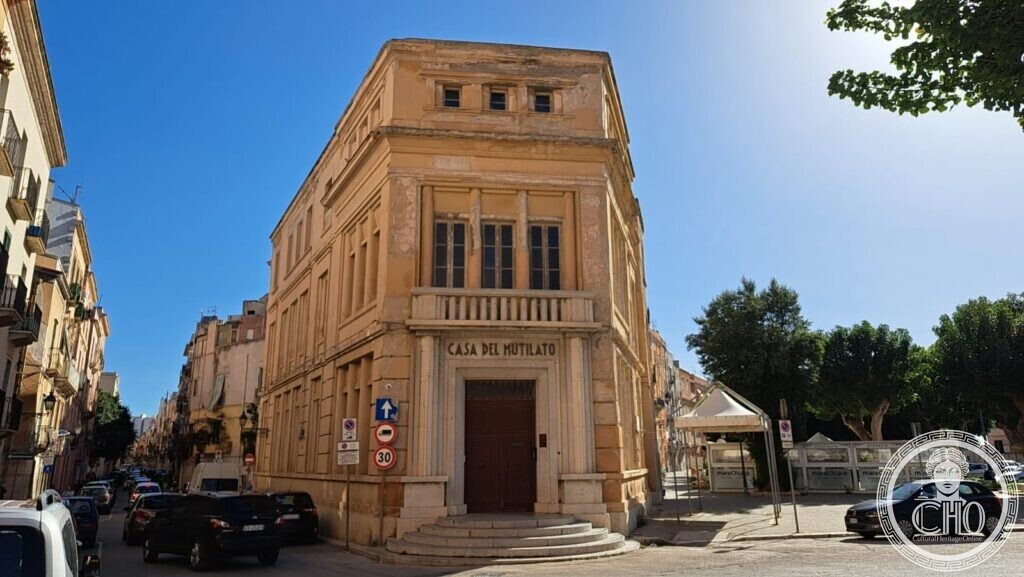
Mussolini saluted from this balcony in August 1937, and the Luce photographers were there. The building has outlived the salute, the institution and its own upkeep.
At a glance
The Casa del Mutilato stands at the corner of viale Duca d’Aosta and piazza Generale Scio, a few steps from Trapani’s seafront villa. The architect Giuseppe Eugenio Genovese designed it in the 1930s as the provincial seat of the association of war-disabled veterans, one of the network of such houses built across Italy in those years. Inaugurated during Mussolini’s Sicilian tour of August 1937, it later served as a medical guard station and stands today closed and visibly decaying — a piece of interwar Trapani waiting for a use.
Key facts
- Architect: Giuseppe Eugenio Genovese — named as designer in the caption of the Istituto Luce photographs
- Inaugurated: August 1937, during Mussolini’s tour of Sicily; the Luce negatives of 16–17 August show him saluting from the balcony
- Purpose: provincial house of the National Association of War-Disabled (ANMIG)
- Later use: municipal medical guard station; now closed
- Condition: render peeling, structure intact to the eye; not open to visitors
- Location: Piazza Generale Scio 1, 91100 Trapani — 38.0167 N, 12.5024 E
History
The Case del Mutilato were a national programme: every provincial capital was to give the mutilated veterans of the First World War a house of their own, part welfare office, part memorial, part stage. Trapani’s, designed by Giuseppe Eugenio Genovese, went up in the 1930s within the broader reshaping of the city between the wars — the same season that produced its post office and the public buildings along the new avenues.
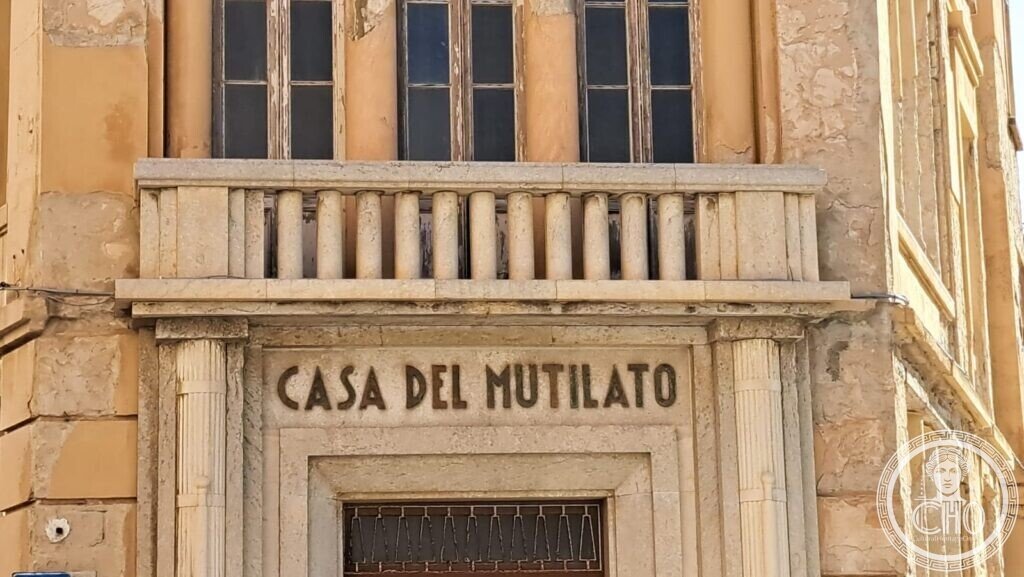
Its moment of national visibility came in August 1937, when Mussolini toured Sicily. The Istituto Luce photographers recorded him on the balcony above the entrance, right arm raised over the carved letters CASA DEL MUTILATO — one negative of a sequence taken in Trapani on 16 and 17 August 1937 that is still in the Luce archive, and that names Genovese as the building’s architect in its caption.
After the war the veterans’ association dwindled with its members, and the building passed to homelier duties: for years Trapani knew it as the seat of the guardia medica. That use too has ended. The rooms are closed, the render is flaking from the seaward walls, and the building — like its Roman mother house, the Casa Madre dei Mutilati by Piacentini — poses the standing Italian question of what to do with the well-built architecture of a discredited regime.
What you see
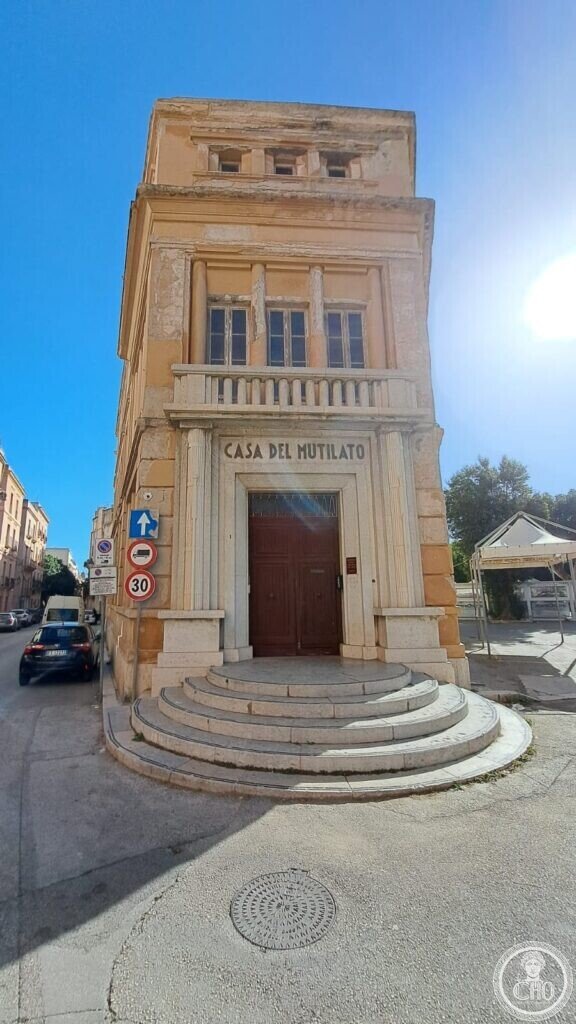
The building takes the corner like a ship’s prow: a tower-like block of giant fluted pilasters, a balcony carried on massive corbels with a balustrade of stubby columns, and the name cut in tall Deco letters into the stone frame of the portal. A curve of pale stone steps spills from the door to the pavement. The side elevations drop to three storeys of plainer render with stone-framed triple windows. The palette — ochre render, grey stone — survives under decades of weathering; the closer you look, the more the peeling surfaces read as neglect rather than ruin.
Cultural significance
Trapani’s interwar architecture is less famous than Palermo’s or Ragusa’s, and buildings like this are why it deserves the look: a complete, unaltered Casa del Mutilato, with its iconography intact and its Luce documentation still attached to it. It is also a live case in the debate over Sicily’s fascist-era heritage — too solid to fall, too marked to reuse without thought, too central to ignore.
Practical information
- The building is closed: no interior access.
- The exterior is fully visible from piazza Generale Scio and viale Duca d’Aosta at any hour; the afternoon sun favours the corner front.
- Five minutes on foot from Trapani’s seafront promenade and ten from the port.
Getting there
Trapani is served by Vincenzo Florio airport (Birgi) and by rail from Palermo. The Casa del Mutilato stands at the western edge of the nineteenth-century town, where viale Duca d’Aosta meets the gardens of piazza Vittorio Emanuele.
Sources
- Archivio storico Istituto Luce — Mussolini on the balcony of the Casa del Mutilato, Trapani, negative A00075290, 16–17 August 1937 (caption naming arch. Giuseppe Eugenio Genovese)
- Trapani e dintorni — «Opere pubbliche a Trapani nel ventennio» (the 1937 inauguration, the guardia medica years, the present state)
Find it on the map
See this place and what’s around it →Record researched and written by Stefano Vigolo for Cultural Heritage Online, 2026.
📷 Become a Cultural Heritage Online photographer
Share your photos of places: they stay published under your name as the author. The more they're seen, the more you get noticed — and soon a contest will reward the most appreciated photos.
Log in or sign up free to add a photoIs this page about you?
This page is read by travellers and heritage enthusiasts who find it on Google. Tell us how you are connected to this place and we will take it from there.