
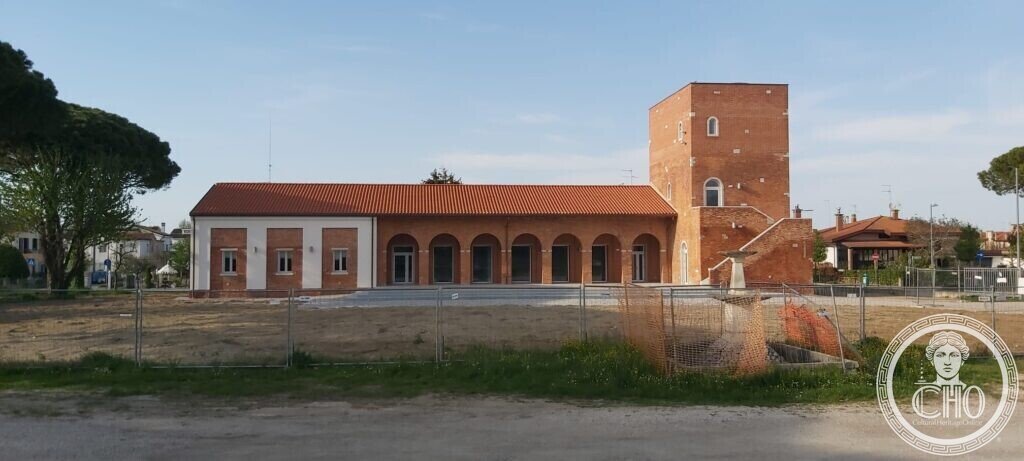
A whole fishing village was built here at the mouth of the Piave and named after a dead admiral. This was its civic centre, and it is the piece that survived.
At a glance
Cortellazzo sits where the Piave reaches the Adriatic, on the eastern edge of Jesolo. In 1939 the regime laid out a purpose-built village for fishermen here and dedicated it to Costanzo Ciano; the Casa del Fascio e del Marinaio was its meeting hall, its offices, its school room and its clinic, all in one long low building with a tower. It stands on via Asmara, a few hundred metres from the river mouth. Restoration work was under way when these photographs were taken in April 2024.
Key facts
- Designer: the engineer Fausto Grisi
- Built: 1939–1940, as part of the Villaggio Costanzo Ciano
- Inauguration: filmed by the Istituto Luce, newsreel released 3 January 1941
- Tower: exposed brick, rectangular plan, about 14 metres high
- Main hall: roughly 14 by 7 metres, with maritime and military fresco cycles by the painter Sante Cancian
- After the war: transferred to State ownership under article 38 of decree 159 of 27 July 1944
- Location: Via Asmara 7, 30016 Cortellazzo, Jesolo (VE) — 45.5365 N, 12.7186 E
History
Costanzo Ciano led a flotilla of torpedo boats into the Austrian positions at the mouth of the Piave in November 1917, and the raid made his name; he was given the title Count of Cortellazzo for it. When he died in 1939 the regime went looking for ways to honour him, and one of them was to build a fishing village on the spot and put his name on it. The project file for the villaggio Costanzo Ciano is held at the Archivio Centrale dello Stato in Rome, registered 12 October 1939 and again 27 December 1941: correspondence, coloured plans, drawings, photographs.
The Casa del Fascio e del Marinaio was the building that made the settlement a place rather than a row of houses. Fausto Grisi gave it a portico of round arches, brick walls, a broad terrace and a tiled roof — the vocabulary of the Venetian lagoon rather than the white geometry that rationalism was producing in the cities. Inside there was a hall of about fourteen metres by seven for meetings and film nights, rooms for the village administration, a place for classes and a medical clinic. Sante Cancian painted fresco cycles of the sea and the war. Costanzo Ciano’s name was cut into Istrian stone on the tower.
The inauguration was filmed. The Luce newsreel, released on 3 January 1941, shows the village, sailors drawn up with flags, a service, and the salutes: Galeazzo Ciano was there for his father, with Adelchi Serena and Giovanni Host-Venturi. Four years later the regime that built it was gone, and the property passed to the Italian State under the 1944 decree on Fascist assets. The building has been on the FAI’s Luoghi del Cuore register since 2022.
What you see
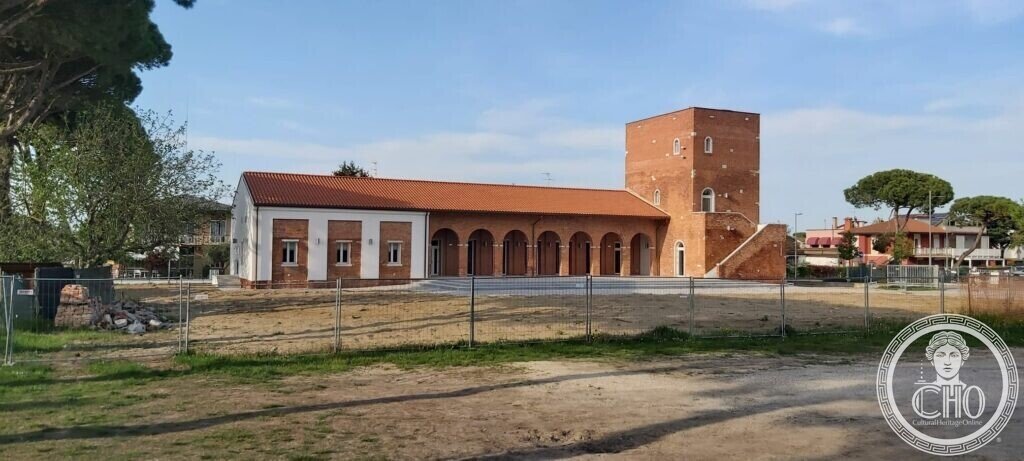
A long single-storey range runs across the site, half of it faced in exposed brick and half rendered white with brick pilasters, under a roof of red pantiles. The brick half opens in a row of round-arched bays — a portico deep enough to sit in, which is what a village hall on a windy river mouth needs. At the end the tower rises clear of the roofline: plain brick, rectangular, with narrow arched windows set high, and an external stair climbing to a door at first-floor level.
It does not look like a Casa del Fascio from a city. There is no glass wall, no marble, no axis of power. What Grisi produced reads as a rural Venetian building given a tower, which was the point: the fishermen who were moved here were meant to recognise it. In April 2024 the walls were newly repointed and the ground around it was still a building site behind wire fencing.
Cultural significance
The new towns of the Fascist period are usually discussed through the big ones — Sabaudia, Latina, Carbonia. Cortellazzo is the small version of the same operation, run on a coastline instead of a drained marsh, and it shows how the model worked at village scale: a name borrowed from a war hero, a plan drawn in Rome, a hall that housed the party and the clinic and the classroom together. It also shows what happens afterwards. The state inherited it, the seaside around it turned into holiday Jesolo, and the building that was meant to organise a community is now something a community campaigns to save.
Practical information
- The building has been under restoration; check locally before travelling for interior access.
- The exterior, the portico and the tower are visible from the street and the open ground around them.
- The mouth of the Piave and the village grid of the 1939 settlement are a short walk away.
Getting there
Cortellazzo is at the eastern end of Jesolo, about 40 km from Venice by road; buses from Jesolo Lido serve the village. The nearest airport is Venice Marco Polo. Coming along the coast, the road crosses the Piave immediately west of the village.
Sources
- Archivio Centrale dello Stato — Progetto villaggio Costanzo Ciano a Cortellazzo, 1939–1941
- Archivio storico Istituto Luce — newsreel C010602, 3 January 1941, the inauguration of the village
- FAI — Casa del Fascio e del Marinaio (survey record: Fausto Grisi, dimensions, frescoes by Sante Cancian, post-war transfer to the State)
Find it on the map
See this place and what’s around it →Record researched and written by Stefano Vigolo for Cultural Heritage Online, 2026.
📷 Become a Cultural Heritage Online photographer
Share your photos of places: they stay published under your name as the author. The more they're seen, the more you get noticed — and soon a contest will reward the most appreciated photos.
Log in or sign up free to add a photoIs this page about you?
This page is read by travellers and heritage enthusiasts who find it on Google. Tell us how you are connected to this place and we will take it from there.