

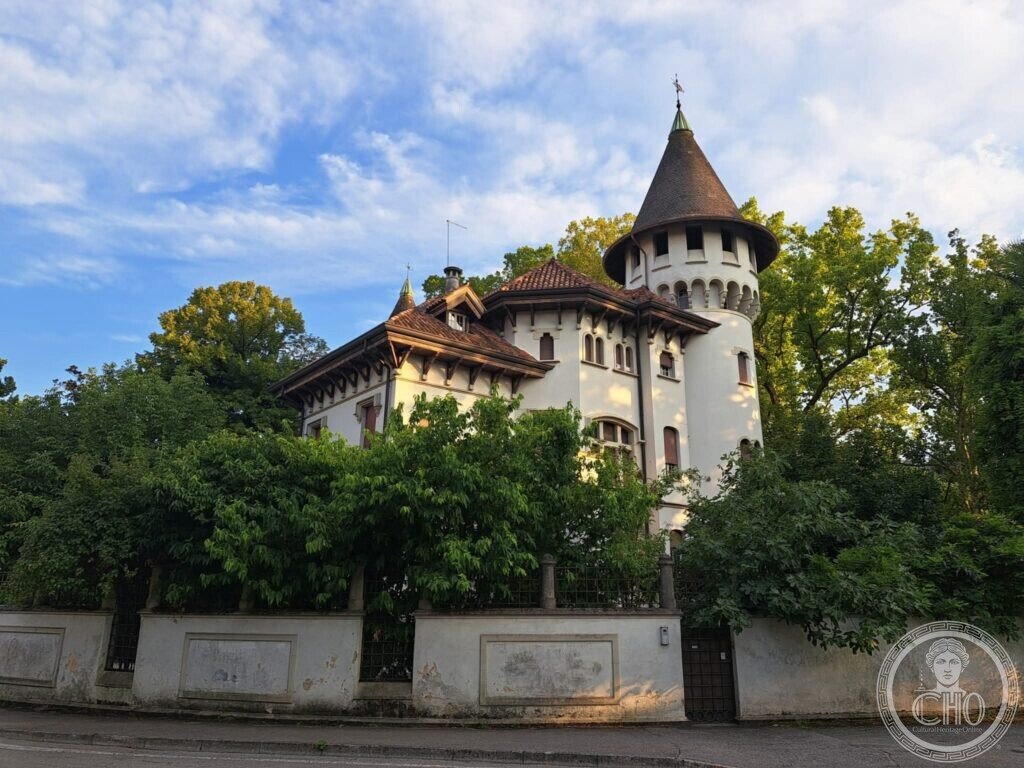
A turreted castle that has never been a castle. Treviso calls it the fairy-tale castle, and also the Russian one — and cannot quite agree on who built it.
At a glance
The building stands just outside the historic centre of Treviso, against the city walls near Porta Calvi, looking over the water of the Fosse towards San Nicolò. Locally it goes by several names — castello di Porta Calvi, the castello delle favole (fairy-tale castle), the “Russian castle”, and Villa Amelia. It is a private residence and is not open to visitors, but the towers and the boundary wall are fully visible from the street.
History
Despite the battlements, the house is a modern building: local reporting places its construction in the years after the First World War, when Treviso was rebuilding from the bombardments that had struck the city. The writer Giovanni Comisso, a Trevisan, counted it among the showy residences that the newly wealthy raised in those years — a remark that has followed the building ever since.
For most of the twentieth century it belonged to the Cellini family; the owner was nicknamed il russo, the Russian, which is the likeliest origin of the name the city still uses. After his death the property passed to his heirs, Tiziana and Maria Cristina Cellini, and came onto the market; in 2010 it was bought by Enzo Stefanelli and Patrizia Compiano for a reported four million euro.
In the mid-1970s the house served as a film location for Dimmi che fai tutto per me, directed by Pasquale Festa Campanile, with Johnny Dorelli and Pamela Villoresi.
What you see
From the road the building reads as a compact neo-medieval fantasy: a cylindrical tower under a conical roof, a run of corbels carried round beneath the eaves, paired windows, and pinnacles above the roofline — the full vocabulary of the castle, assembled in reinforced-concrete-era Italy. A high boundary wall closes the property towards the street, so the tower and the upper storeys are what a passer-by takes in.
Cultural significance
The house belongs to a European habit of the first decades of the twentieth century: private clients who, with Art Nouveau and then the interwar styles available to them, chose instead to build a castle. Milan has its Castello Cova of 1910–1915; Treviso has this. What makes the Porta Calvi house unusual is that its meaning was contested from the start — Comisso read it as a monument to new money, while the city, then and now, has treated it as a piece of scenery it is fond of.
Key facts
- Also known as: castello delle favole, “Russian castle”, Villa Amelia
- Built: first years after the First World War
- Style: neo-medieval revival
- Owners: Cellini family; sold in 2010 to Enzo Stefanelli and Patrizia Compiano
- Film location: Dimmi che fai tutto per me (Pasquale Festa Campanile, mid-1970s)
- Access: private residence, not open to the public; visible from the street
- Address: Porta Calvi 48, 31100 Treviso — 45.6635 N, 12.2370 E
A note on what is not settled
Two accounts of the building’s origin circulate, and we have not been able to reconcile them from published sources. Local newspaper reporting attributes it to the Cellini family, whose owner carried the nickname “the Russian”. A second account, found in photo-archive captions rather than in documentary sources, has it built by a Russian citizen, Gregorio Lewin, for his wife, the pianist Amelia Appiani — which would explain the name Villa Amelia. An attribution of the design to the architect Remo Milani also circulates online; we have found no source for it, and it is not repeated here. Readers with documentary evidence — a deed, a plaque, a municipal archive record — are invited to write to us.
Practical information & getting there
Porta Calvi sits on the southern side of Treviso’s walled centre, a short walk from the station and from the church of San Nicolò. The walk along the walls and the Fosse is the reason to come: the castle appears from the water side, above its wall, and is best seen in the morning.
Sources & resources
Find it on the map
See this place and what’s around it →Record researched and written by Stefano Vigolo for Cultural Heritage Online, 2026.
📷 Become a Cultural Heritage Online photographer
Share your photos of places: they stay published under your name as the author. The more they're seen, the more you get noticed — and soon a contest will reward the most appreciated photos.
Log in or sign up free to add a photoIs this page about you?
This page is read by travellers and heritage enthusiasts who find it on Google. Tell us how you are connected to this place and we will take it from there.