
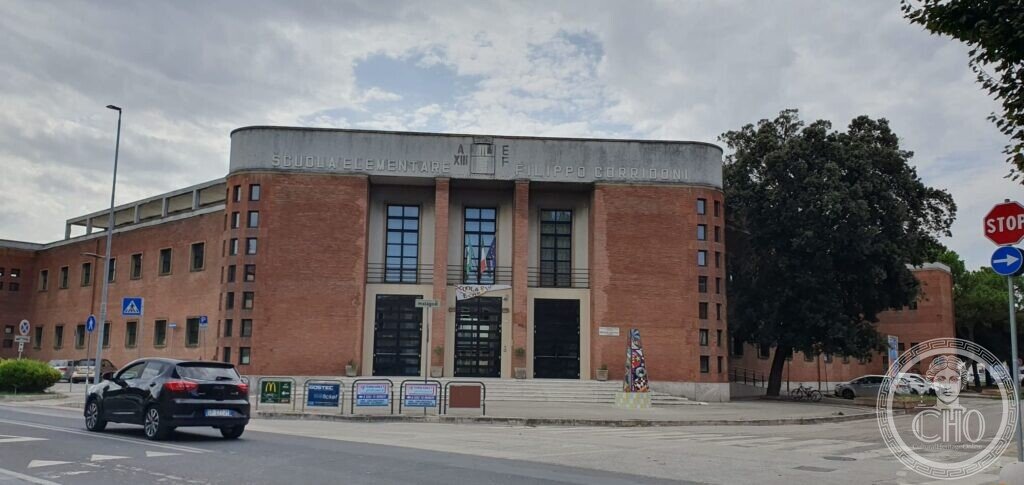
Children still walk into this school every morning under a carved fasces and a date counted in years of the Fascist era. Nobody has taken it down.
At a glance
The school stands on viale Gramsci, at the corner of via Malagodi, a few minutes south of the walled centre of Fano. Mario De Renzi designed it for the town council between 1932 and 1935, and it opened for the 1935/36 school year. It is one of the strongest pieces of rationalist architecture in the Marche, and it has never stopped doing the job it was built for: it is a working primary school, so the inside is not open to visitors. The front, which is the point, is fully visible from the street.
Key facts
- Architect: Mario De Renzi (1897–1967)
- Designed and built: 1932–1935, for the Comune di Fano
- Opened: 1935/36 school year
- Plan: V-shaped, two symmetrical wings — originally one for boys’ classrooms, one for girls’
- Published in its own time: Architettura, February 1936, in an article by Plinio Marconi
- Today: still a state primary school; exterior visible from the street
- Location: Viale Antonio Gramsci 3, 61032 Fano (PU) — 43.8402 N, 13.0180 E
History
Mario De Renzi was one of the architects who carried Italian rationalism into public building, and Fano caught him at the point where his work was getting sharper. The commission came from the town council; the drawings occupied him from 1932, and the school opened for the 1935/36 year. The archive of his practice holds thirty-three photographic reproductions of the project.
The building was noticed immediately. Plinio Marconi devoted eleven pages to it in Architettura in February 1936; Gaetano Minnucci put it in his survey Scuole the same year, and Agnoldomenico Pica in Nuova architettura italiana. Thirty-five years later Bruno Zevi returned to it in Cronache di architettura, and Maria Luisa Neri gave it its place in her 1992 monograph on De Renzi. For a school in a provincial town on the Adriatic, that is an unusual amount of attention.
The name belongs to Filippo Corridoni (1887–1915), the revolutionary syndicalist from the Macerata province who was killed leading his company at the Trincea delle Frasche on the Carso. He had been a strike organiser in Milan and an interventionist in 1914. In 1925 Mussolini had his silver medal upgraded to gold, and the regime spent the following years claiming him as a forerunner — which is how his name came to be cut into the front of a school built ten years after his death.
What you see
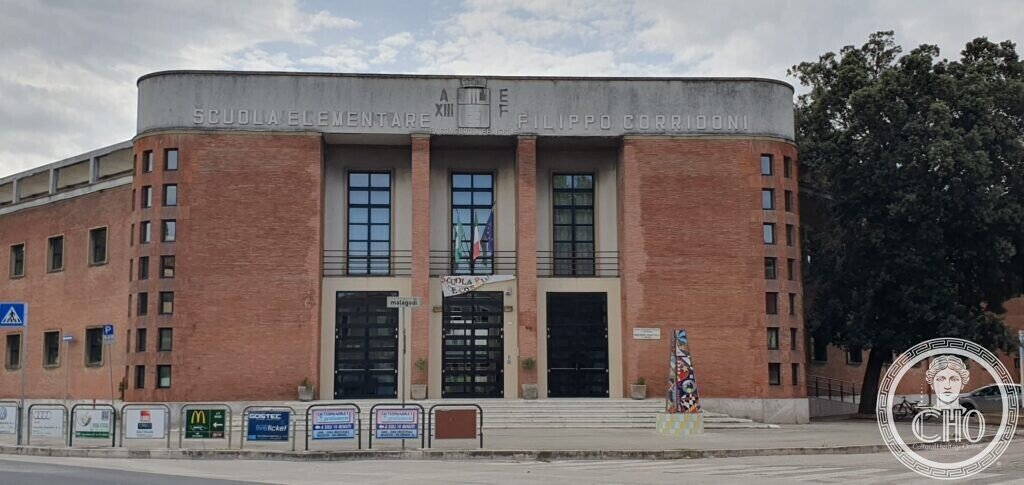
The centre of the building curves. A drum of red brick swings out towards the crossroads, and into it De Renzi cut three tall windows separated by pale rendered piers that run the full height of the front. Above them a grey concrete band carries the name in relief letters: SCUOLA ELEMENTARE FILIPPO CORRIDONI. At the middle of the band, between the two halves of the name, sits a carved fasces, with A XIII to its left and E F to its right — year thirteen of the Fascist era, which ran from late October 1934 to late October 1935. Directly underneath, in smaller letters, is the motto of the city of Fano: EX CONCORDIA FELICITAS.
The wings that fold back from the drum are plainer, and they are where the building shows what it is made of: small square windows set in a tight grid across the curve, deeper windows along the flanks, brick everywhere, no ornament beyond the pattern of the openings themselves. A broad flight of steps rises to three doorways. The effect that period critics kept describing — austere, Roman in its weight, modern in its technique — is still exactly what the corner delivers.
Cultural significance
Italy is full of buildings the regime put up and the republic kept using. Most of them lost their inscriptions: the fasces was chiselled off, the imperial dating scraped away, the dedication replaced. Here nothing was removed. The school works, the letters stay, and the two facts sit on top of each other without apparent friction. That makes the Corridoni a useful place to think about what a country does with the architecture of a dictatorship when the architecture is good and the building is needed — a question the whole Adriatic coast keeps asking, from the fish market in Fano to the fishing villages further north.
Practical information
- Working primary school: the interior is not open to the public.
- The front is on a public street and can be seen at any hour; morning light falls on the inscription.
- Best viewed from the far corner of viale Gramsci, where the curve of the drum reads properly.
- Ten minutes’ walk from the historic centre of Fano.
Getting there
Fano is on the Adriatic railway line between Pesaro and Senigallia, and the station is about fifteen minutes on foot from the school. Coming by car from the A14, the Fano exit puts you on the road that becomes viale Gramsci. The nearest airports are Ancona-Falconara and Rimini.
Sources
- Fondo Mario De Renzi — Scuola elementare Filippo Corridoni, Fano (project record, 1932–1935, with period bibliography)
- Ecomuseo Metaurilia — the inauguration of the Corridoni school
- Treccani, Enciclopedia Italiana — Filippo Corridoni
- Direzione Didattica Fano San Lazzaro — Scuola Primaria F. Corridoni (current use)
- Pl. Marconi, «Scuola elementare a Fano / arch. Mario De Renzi», Architettura, XV, 2, February 1936, pp. 49–59; M.L. Neri, Mario De Renzi. L’architettura come mestiere. 1897–1967, Rome 1992, pp. 108–109
Find it on the map
See this place and what’s around it →Record researched and written by Stefano Vigolo for Cultural Heritage Online, 2026.
📷 Become a Cultural Heritage Online photographer
Share your photos of places: they stay published under your name as the author. The more they're seen, the more you get noticed — and soon a contest will reward the most appreciated photos.
Log in or sign up free to add a photoIs this page about you?
This page is read by travellers and heritage enthusiasts who find it on Google. Tell us how you are connected to this place and we will take it from there.