
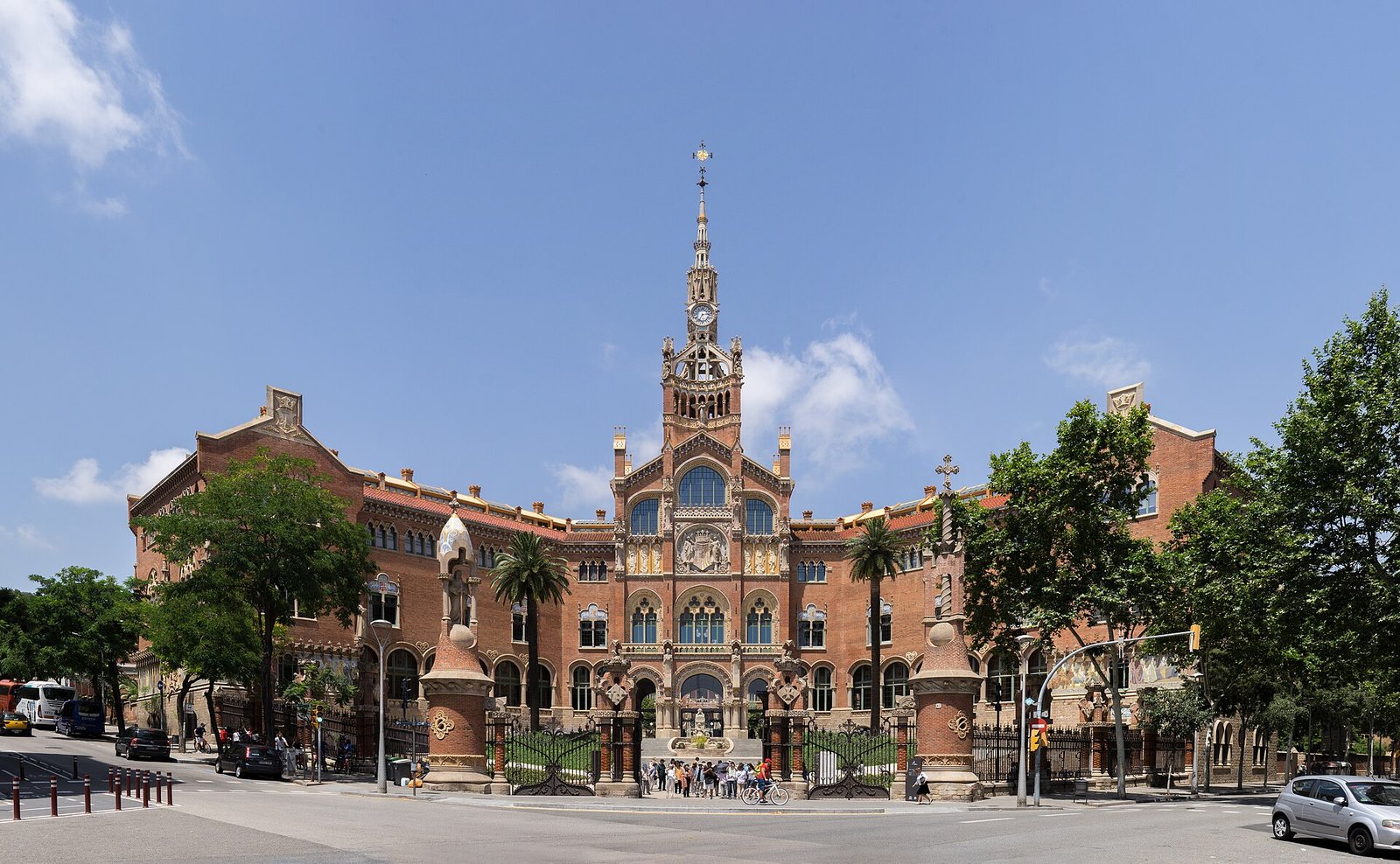
Twenty-seven brick pavilions set among gardens, joined underneath by two kilometres of tunnels. It treated patients for more than eighty years; now, restored, it is open to anyone who wants to walk through it.
At a glance
Sant Pau is what happens when a hospital is designed by the architect who taught Gaudí. Lluís Domènech i Montaner drew it in 1902 with money left by the banker Pau Gil, and instead of one large block he laid out a small city: twenty-seven red-brick pavilions between the Eixample and el Guinardó, standing in gardens, holding the medical and general services, the departments and a church. The reasoning was medical before it was decorative. Separate buildings meant infection travelled less easily; gardens and tall windows meant light and moving air. The ornament — mosaic, sculpture, glazed tile — came on top of that logic, not instead of it.
Key facts
- Architect — Lluís Domènech i Montaner (1849–1923), who taught at the Barcelona School of Architecture from 1875 to 1920; Antoni Gaudí, Josep Puig i Cadafalch and Josep Maria Jujol were among his students
- Built — designed 1902, funded by the bequest of the banker Pau Gil; completed in 1930 by the architect’s son, Pere Domènech i Roura
- Scale — twenty-seven brick pavilions in gardens, linked by about two kilometres of underground corridors so patients could be moved without going outside
- Recognition — inscribed on the UNESCO World Heritage list in 1997, together with the Palau de la Música Catalana
- Hospital until — 2009, after more than eighty years of medical use, when clinical work moved to a new building on the same site
- Now — a visitable Art Nouveau site with a cultural programme; several organisations working in innovation, sustainability, health and culture are resident in the restored pavilions
- Address — Carrer de Sant Antoni Maria Claret 167, 08025 Barcelona
Six hundred years of the same institution
The hospital is older than its buildings. At the start of the fifteenth century Barcelona had six small hospitals, each founded by a religious order or a private citizen and each running short of money. In 1401 the city’s governing council, the Consell de Cent, and the Cathedral Chapter agreed to merge all six into one. Pope Benedict XIII ratified the decision by papal bull on 5 September of that year, and King Martin the Humane laid the first stone of the Hospital de la Santa Creu on 13 February 1401.
Five centuries later the bequest of Pau Gil, a Barcelona banker, paid for a replacement. In 1902 Domènech i Montaner set out the new complex on the edge of the Eixample, where the grid meets el Guinardó. He worked on it for the rest of his life. When he died in 1923 it was unfinished, and his son Pere Domènech i Roura carried it to completion in 1930.
The pavilions served for more than eighty years. In 2009 the hospital moved to new premises, and the Modernista buildings, empty for the first time since they were built, were restored and given over to visitors and to resident organisations. The UNESCO inscription of 1997 had come while they were still full of patients.
What you see
The Administration Pavilion is the front the hospital shows to the city: red brick, a spire with a clock, a sculpted and mosaic frieze carried across the upper storey, and wrought-iron gates between two squat towers. Nothing about it reads as a hospital entrance, which was the intention. Behind it the ground opens out and the logic of the plan becomes visible — separate buildings with garden between them, and paths rather than corridors connecting one department to the next.
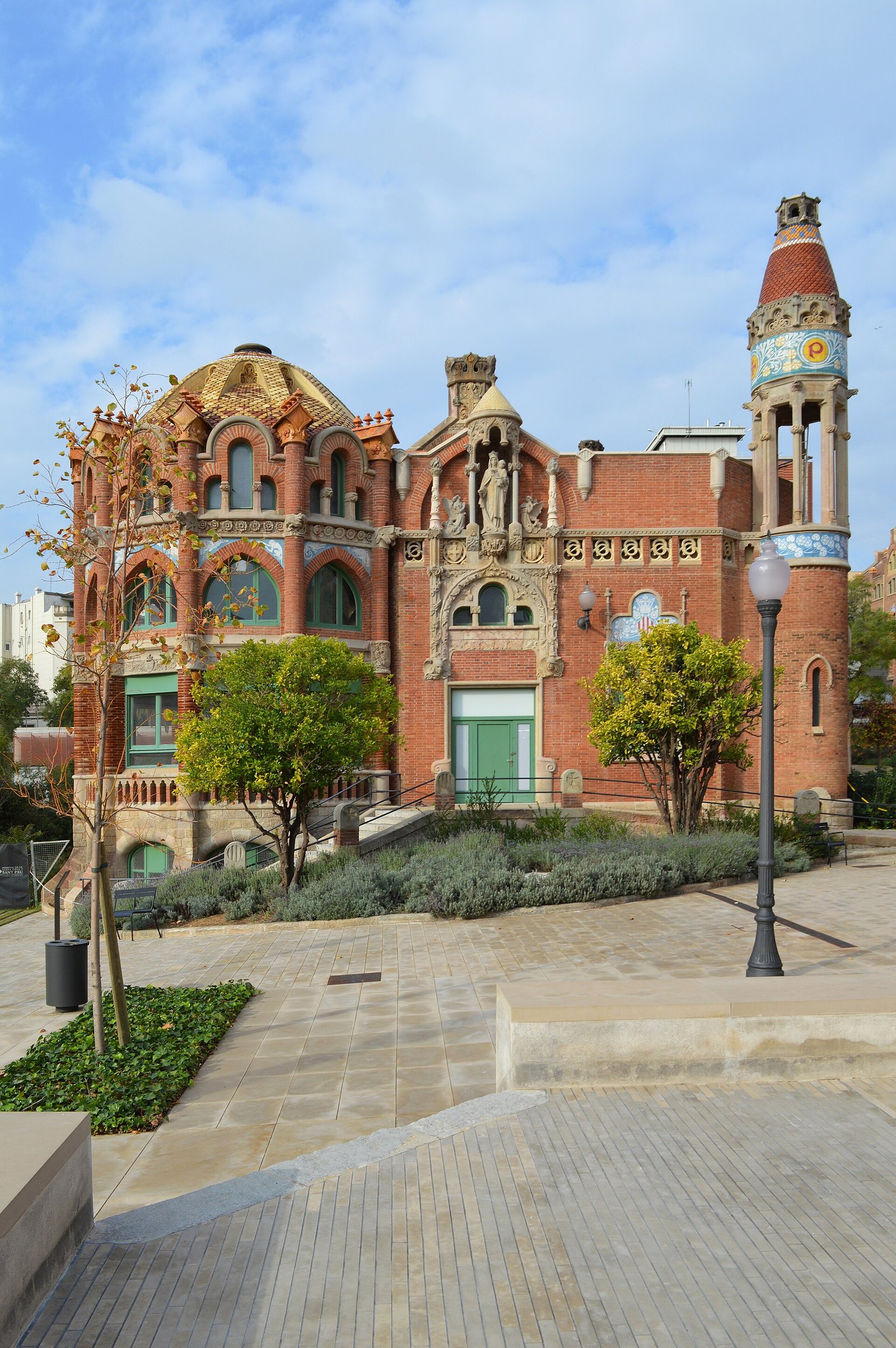
The pavilions are not identical and were never meant to be. Each has its own roofline: a tiled dome on one, a ceramic tower banded in blue and yellow on another, sculpture set over the door of a third. Underneath all of it runs the tunnel network that did the unglamorous work — supplies and patients moving between departments out of the weather and out of sight.
Practical information
- Open — Monday to Sunday, 9:30–18:30 from April to October; 9:30–17:00 from November to March
- Visits — self-guided, guided and audio-guided routes; combined tickets and group bookings available
- Telephone — +34 93 511 78 76 for visits and school groups
- Time to allow — the site is large and mostly open-air; the gardens and the distances between pavilions are part of the visit
- Events — part of the Administration Pavilion is used as a venue for meetings and events
Getting there
The visitor entrance is at Carrer de Sant Antoni Maria Claret 167, on the corner where the Eixample grid gives way to el Guinardó. GPS: 41.4127° N, 2.1743° E — open in Google Maps. The Sagrada Família stands about a kilometre away in a straight line, which makes the two easy to see on the same day and hard to compare on the same terms.
Nearby
- The Sagrada Família, roughly a kilometre south-west
- The Eixample, the nineteenth-century grid that ends where the hospital begins
- El Guinardó, the hillside district behind the hospital, and the viewpoints above it
Sources
- Sant Pau Recinte Modernista — Who are we? (restoration, resident organisations, UNESCO inscription of 1997, the Administration Pavilion as an events venue)
- Sant Pau Recinte Modernista — History (the six medieval hospitals, the merger of 1401, the papal bull of Benedict XIII, the first stone laid by King Martin the Humane)
- Sant Pau Recinte Modernista — Domènech i Montaner (the architect’s dates, his teaching, his students, the completion of the work by Pere Domènech i Roura)
- Generalitat de Catalunya, Patrimoni Cultural — Sant Pau Recinte Modernista (the Pau Gil bequest, the 1902 design, twenty-seven pavilions, the two kilometres of underground corridors, the hygienist principle, the move of 2009, completion in 1930)
- Sant Pau Recinte Modernista — contact page (opening hours, address, telephone)
- OpenStreetMap Nominatim — Carrer de Sant Antoni Maria Claret 167, Barcelona (coordinates)
Find it on the map
See this place and what’s around it →📷 Become a Cultural Heritage Online photographer
Share your photos of places: they stay published under your name as the author. The more they're seen, the more you get noticed — and soon a contest will reward the most appreciated photos.
Log in or sign up free to add a photoIs this page about you?
This page is read by travellers and heritage enthusiasts who find it on Google. Tell us how you are connected to this place and we will take it from there.