
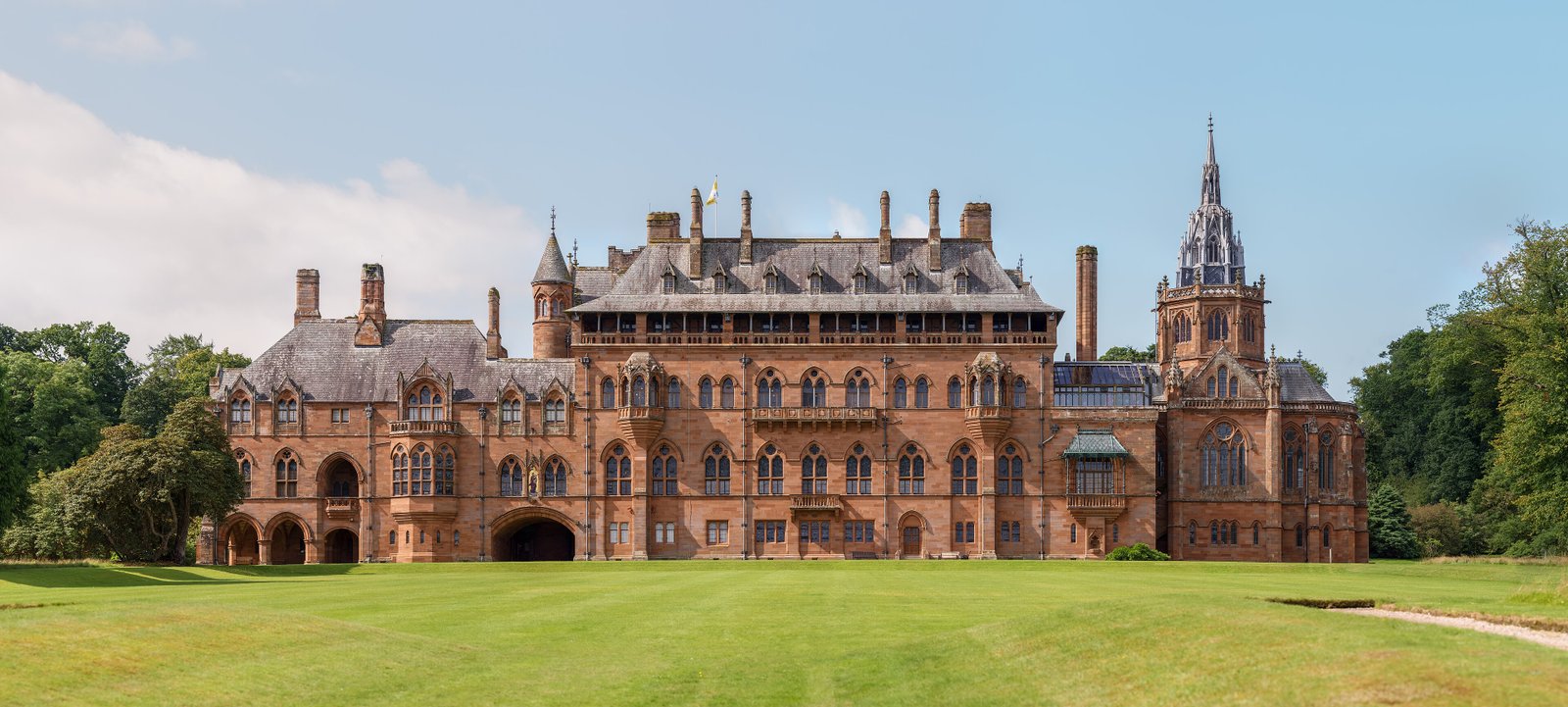
A Gothic Revival masterpiece on Scotland’s Isle of Bute, this country house rose from the ashes of its predecessor to become the ancestral seat of the Marquesses of Bute.
At a glance
Mount Stuart House exemplifies the Gothic Revival tradition through ambitious architectural ambition and lavish detail. Sited on the east coast of the Isle of Bute, it commands views across the Firth of Clyde and remains one of Scotland’s most significant country houses.
History
The house was built in the late 1870s to replace an earlier structure designed by Alexander McGill, which was destroyed by fire in 1877. Sir Robert Rowand Anderson, one of Scotland’s most celebrated architects, undertook the design and construction for John Crichton-Stuart, the 3rd Marquess of Bute.
What you see
Anderson’s design embraces Gothic Revival aesthetics with characteristic pointed arches, intricate stonework, and dramatic proportions. The house demonstrates the architectural vocabulary of romantic medievalism that defined late-Victorian country house building in Britain.
Cultural significance
Mount Stuart House stands as a defining example of how Scotland’s nobility adapted Gothic Revival principles to create grand domestic spaces. The building reflects both the wealth and refined taste of the Bute family, whose patronage shaped Scottish architecture and the arts throughout the nineteenth and twentieth centuries.
Key facts
- Country: United Kingdom
- Region: Isle of Bute, Argyll and Bute, Scotland
- Designed by: Sir Robert Rowand Anderson
- Built: Late 1870s
- Commissioned by: John Crichton-Stuart, 3rd Marquess of Bute
- Architectural style: Gothic Revival
- Listed status: Category A listed building
- Coordinates: 55.79167, −5.01871
Practical information & getting there
Mount Stuart House is located on the east coast of the Isle of Bute. Access to the island is by ferry from Wemyss Bay on the Ayrshire coast. For visiting hours, admission details and current opening information, consult the house’s official website or local Bute tourism resources.
Sources & resources
Find it on the map
See this place and what’s around it →📷 Become a Cultural Heritage Online photographer
Share your photos of places: they stay published under your name as the author. The more they're seen, the more you get noticed — and soon a contest will reward the most appreciated photos.
Log in or sign up free to add a photoIs this page about you?
This page is read by travellers and heritage enthusiasts who find it on Google. Tell us how you are connected to this place and we will take it from there.