
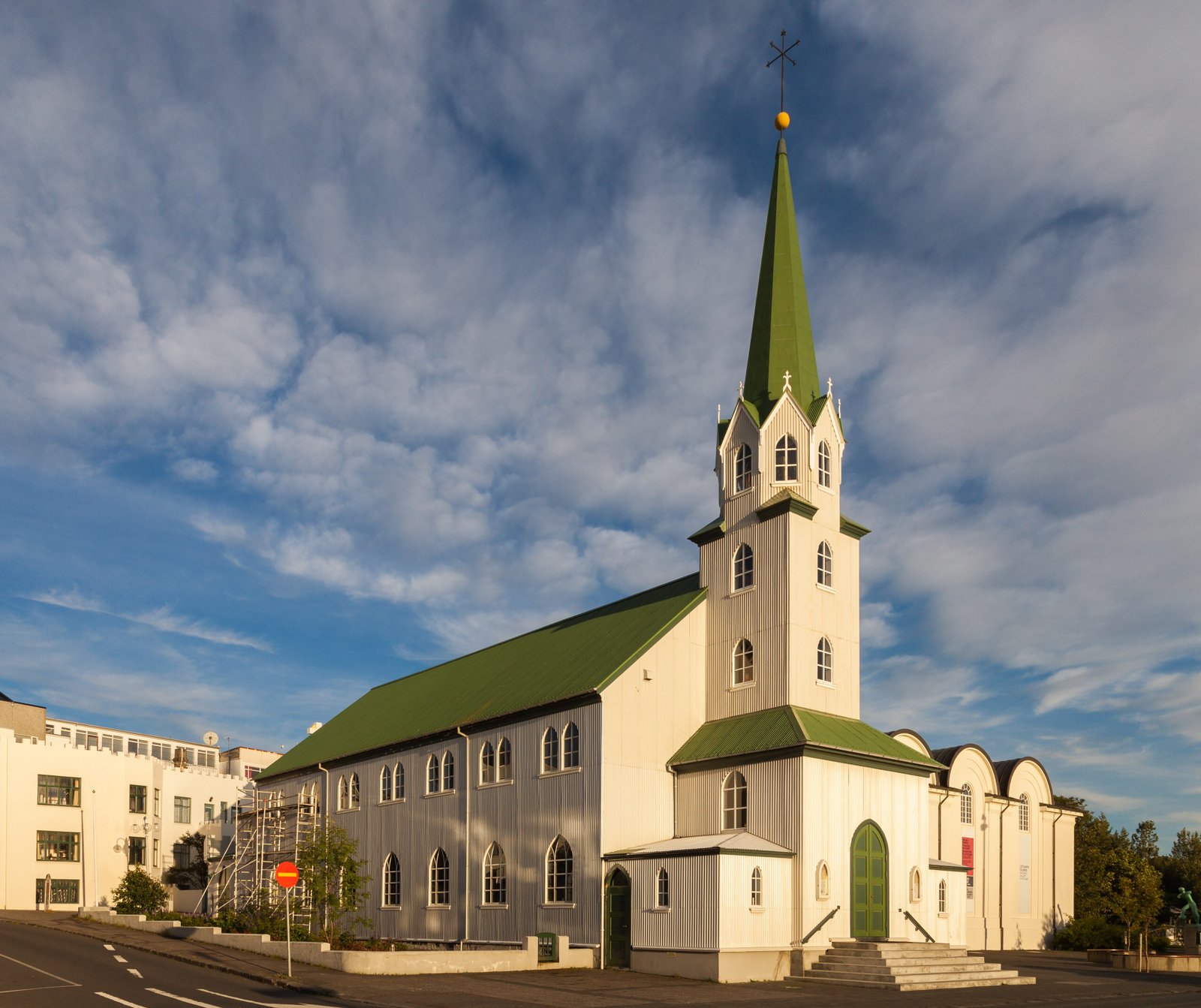
An independent Lutheran congregation established to bring the church closer to the people, this modest Reykjavík chapel stands by the city’s central lake as a testament to early-20th-century religious reform and Iceland’s expanding urban life.
At a glance
Fríkirkjan í Reykjavík is an independent Lutheran church unaffiliated with Iceland’s established Church of Iceland. Located on the east bank of Tjörnin lake in downtown Reykjavík, it represents a distinct movement to democratize worship during a period of rapid urban growth and social change in the capital.
History
The congregation formed in autumn 1899 with an initial membership of 600, which soon expanded. Unlike many church schisms, the break from the national Lutheran body stemmed not from doctrinal disagreement but from organizational concerns—a desire to make worship more accessible to ordinary citizens. The movement followed successful models in Norway and among Icelandic communities across North America.
Reykjavík’s rapid growth created urgent spiritual needs. Craftsmen and tradespeople formed expanding classes; new neighborhoods rose, yet Reykjavík Cathedral remained the city’s sole church. The Free Church answered this demand.
A site east of Tjörnin was selected and the building consecrated on 22 February 1903. Architect Rögnvaldur Ólafsson designed an extension completed just two years later. In 1924, master builder Guðmundur H. Þorláksson oversaw substantial enlargement, including a concrete chancel and forechurch modifications.
What you see
The church’s modest form reflects its practical origins. The original structure received lengthening in 1905 and significant expansion in 1924, when a concrete chancel was appended at the eastern end with adjacent additions framing the entrance. The modest scale suits its democratic mission.
Cultural significance
Fríkirkjan represents an important current in early Icelandic modernization—the belief that religious institutions should serve expanding urban populations equitably. Its establishment reflects broader Icelandic engagement with Scandinavian social reform and transatlantic ideas about lay participation and congregational autonomy.
Key facts
- Country: Iceland
- City: Reykjavík
- Coordinates: 64.14431667, −21.93923056
- Consecrated: 22 February 1903
- Congregation established: Autumn 1899
Practical information & getting there
Fríkirkjan stands on the east shore of Tjörnin lake in central Reykjavík, within easy walking distance of major city landmarks. Specific opening hours and access details should be confirmed with local tourism information before visiting.
Sources & resources
Find it on the map
See this place and what’s around it →📷 Become a Cultural Heritage Online photographer
Share your photos of places: they stay published under your name as the author. The more they're seen, the more you get noticed — and soon a contest will reward the most appreciated photos.
Log in or sign up free to add a photoIs this page about you?
This page is read by travellers and heritage enthusiasts who find it on Google. Tell us how you are connected to this place and we will take it from there.