
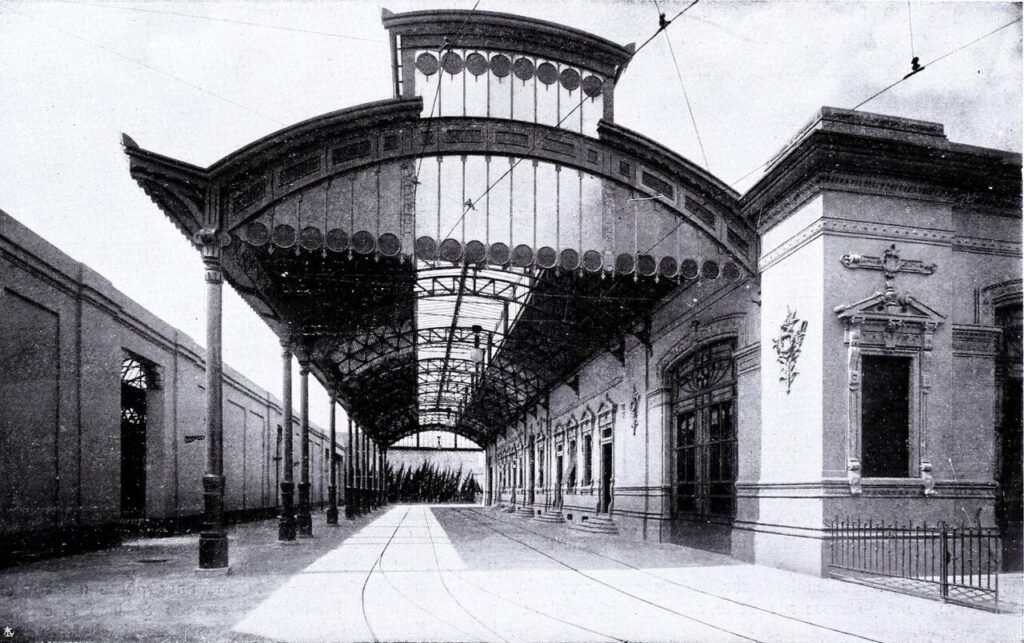
For twenty years Milan sent its dead to the cemetery by tram, and they left from here. The building survived; today it is a spa.
At a glance
The Porta Romana funeral station was raised in 1908 for the special tram service that carried the dead to Milan’s cemeteries. It was designed by the architect Pasquale Tettamanzi with the engineer Francesco Minorini. The building still stands, and after a long series of other uses it now houses a set of thermal baths.
History
Milan had grown fast towards the south, and the existing funeral station in Via Bramante had ended up more than five kilometres from the new quarters of Porta Romana and Porta Vigentina — a hardship in winter and above all for poorer families. Funeral processions bound for the Monumentale also had to cross the narrow streets of the centre and a tangle of tram tracks. The City had therefore long planned a second station in the south of the city to gather the dead and the mourners from the surrounding quarters.
The coffins travelled on trams built for the purpose by Edison, which already ran the city’s electric network. Each convoy had two cars: one for the coffin, the other — with velvet seats, fine upholstery, heating and frosted glass — for the family. With typical Milanese irony the black tram was known until about 1925 as la Gioconda. As motor hearses spread the service became pointless, and the station closed in 1928.
The building was then used as a recreation club for the staff of the city transport company, later as a night club, and finally, after purchase and renovation by a spa operator, it opened to the public as thermal baths in 2009.
What you see
What survives is the low station block with its canopy, built for a very particular sequence: the arrival of the procession, the waiting room, the transfer of the coffin to the tram. The 1907 photograph published in L’Edilizia Moderna shows the canopy as it was completed. The vocabulary is the sober Liberty of Milanese public works of the period, applied to a building type that existed almost nowhere else.
Cultural significance
Funeral tramways were tried in several European cities and abandoned almost everywhere; Milan’s is among the very few whose buildings survive. The station is a document of how a modern city organised death at the moment when electric transport was reorganising everything else — and of how quickly the motor car made that arrangement obsolete.
Key facts
- Architect: Pasquale Tettamanzi, with engineer Francesco Minorini
- Built: 1908; service closed 1928
- Destinations: Musocco (Cimitero Maggiore) and the Monumentale
- Rolling stock: funeral trams built by Edison; nicknamed la Gioconda until about 1925
- Later uses: transport company staff club, night club, thermal baths since 2009
- Coordinates: 45.4517 N, 9.2017 E
Practical information & getting there
Metro M3 Porta Romana or Lodi T.I.B.B., then a short walk. The building is in commercial use as a spa, so the exterior is what a visitor sees without a booking; the canopy is the part that most clearly recalls its first purpose.
Sources & resources
Find it on the map
See this place and what’s around it →📷 Become a Cultural Heritage Online photographer
Share your photos of places: they stay published under your name as the author. The more they're seen, the more you get noticed — and soon a contest will reward the most appreciated photos.
Log in or sign up free to add a photoIs this page about you?
This page is read by travellers and heritage enthusiasts who find it on Google. Tell us how you are connected to this place and we will take it from there.