
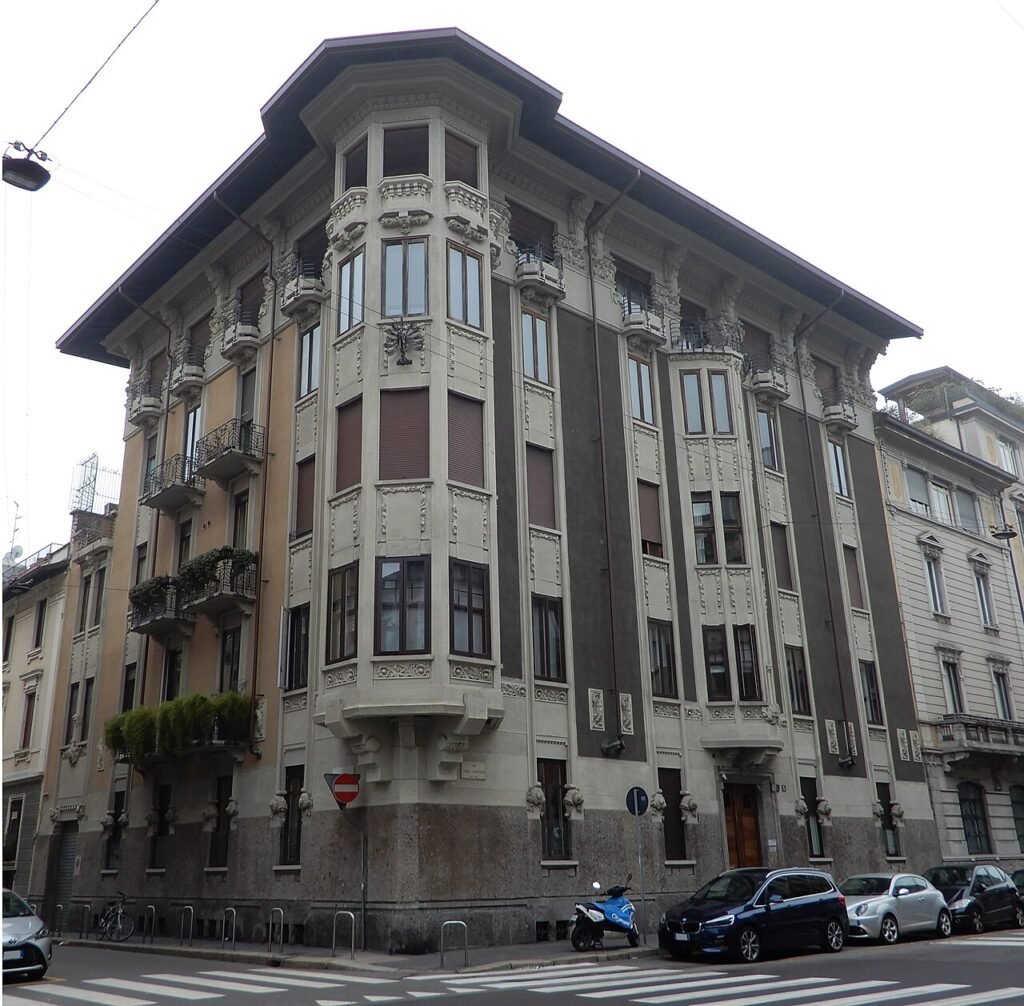
Sixteen snails and ten lobsters in moulded cement climb this corner house — which is why nobody in Milan calls it by its real name.
At a glance
Casa Frisia occupies the corner of Via Guido d’Arezzo 5 and Via Antonio Scarpa, in the Pagano quarter. It was built between 1920 and 1922 to designs by the architect Edmondo Cattò (1891–1947), a former collaborator of Giuseppe Sommaruga, working with the engineer A. Cavezzali. Everyone in the neighbourhood calls it the House of the Snails, or of the Lobsters.
History
By 1920 Liberty was no longer the newest thing in Milan; the city was already turning towards the sober classicism of the Novecento. Cattò, trained in Sommaruga’s orbit, built here in a late version of the style that keeps its decorative appetite while stiffening its lines — the transition towards Art Déco caught in a single building. The house has been restored in recent years.
Note that a different building in Milan also carries the Frisia name: Casa Frisia at Via Ozanam 4, designed by Giuseppe Boni in 1908–1909. The two are not related.
What you see
The building rises four floors above a raised ground floor on a corner plot. A triangular bay window above the entrance and an octagonal corner turret give it vertical thrust. The decoration is in moulded cement, and it is unlike anything else in the city: sixteen large snails set at the sides of the eight glazed bays, and ten lobsters placed in the frames created between one window and the next, among floral and animal motifs. The heavy cornice rests on brackets carrying floral decoration that starts from the small balconies of the top level.
Cultural significance
The house closes the Milanese Liberty story rather than opening it. It shows what happened to the style once its inventors had moved on: the ornament survives, grows stranger and more literal, and the composition begins to harden into the geometry of the 1920s. It is also, simply, the most memorable facade in a quarter full of good ones.
Key facts
- Architect: Edmondo Cattò (1891–1947), with engineer A. Cavezzali
- Built: 1920–1922
- Style: late Liberty moving towards Art Déco
- Decoration: 16 snails and 10 lobsters in moulded cement
- Address: Via Guido d’Arezzo 5, corner of Via Antonio Scarpa, Milan
- Coordinates: 45.4681 N, 9.1631 E
Practical information & getting there
Metro M1 Pagano, three minutes on foot. Private apartment building; the facade is the visit, and the corner is best read from the far pavement of Via Antonio Scarpa, where both fronts are visible at once.
Sources & resources
Find it on the map
See this place and what’s around it →📷 Become a Cultural Heritage Online photographer
Share your photos of places: they stay published under your name as the author. The more they're seen, the more you get noticed — and soon a contest will reward the most appreciated photos.
Log in or sign up free to add a photoIs this page about you?
This page is read by travellers and heritage enthusiasts who find it on Google. Tell us how you are connected to this place and we will take it from there.