
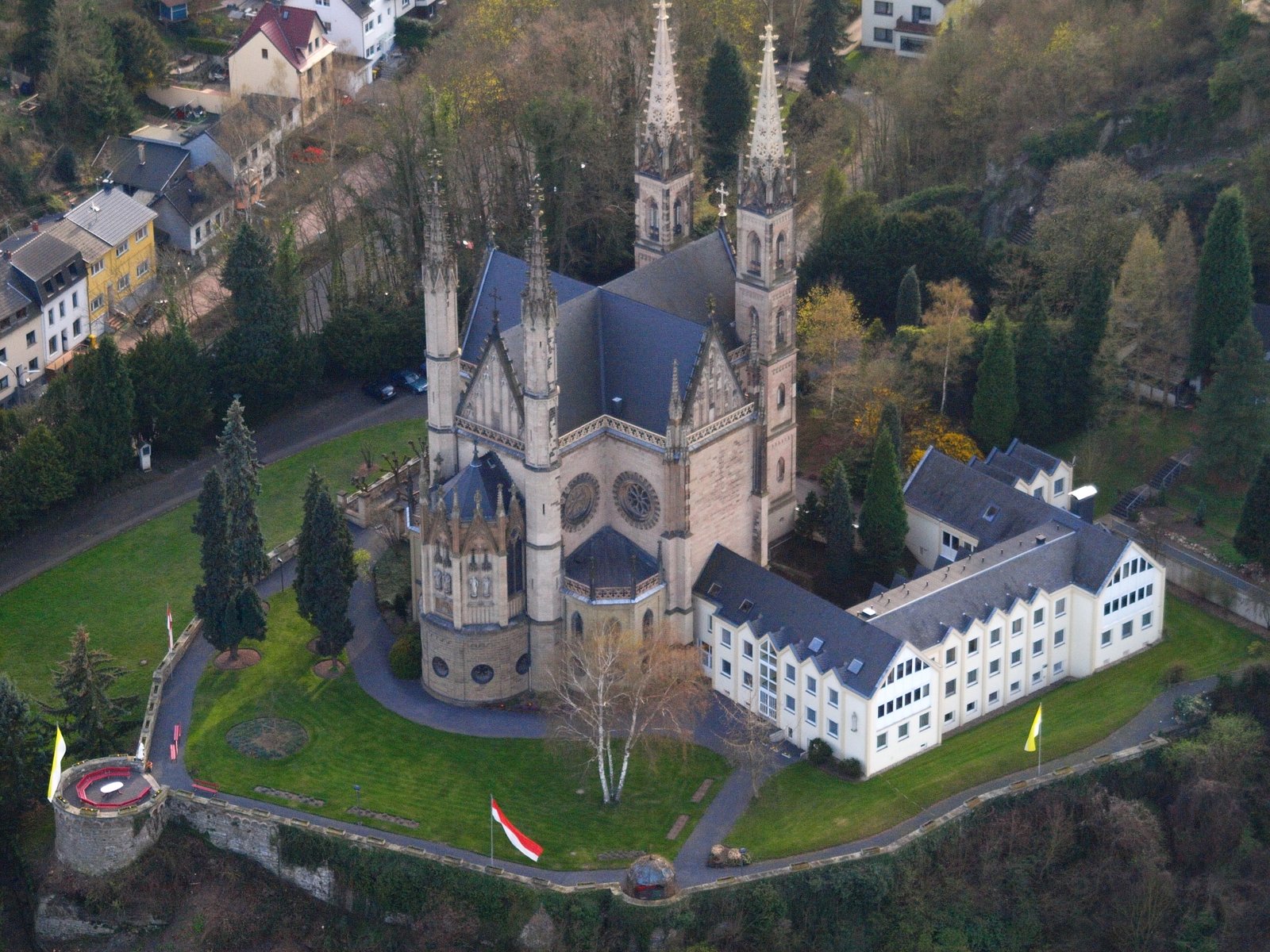
Perched above the Rhine valley on the Apollinarisberg, this Neo-Gothic church crowns a sacred mountain whose religious significance stretches back to the 5th century. It houses the sarcophagus of Saint Apollinaris of Ravenna, drawing pilgrims for over six centuries.
At a glance
A 19th-century Neo-Gothic church built atop layers of medieval piety. The Apollinariskirche occupies ground where a Roman temple once stood, followed by a Frankish chapel dedicated to Saint Martin, then a Romanesque church. Today it serves as both a parish church and pilgrimage destination above the town of Remagen.
History
The Apollinarisberg was known as the Martinsberg during the 5th and 6th centuries, presumably named after a Frankish chapel dedicated to Saint Martin, patron of the Franks. By the 9th century, a Romanesque church replaced this chapel on the same site.
In 1110, the Benedictines of Michaelsberg Abbey, at the initiative of Remagen’s residents, established a provost on the mountain. The relics of Saint Apollinaris of Ravenna probably arrived at the end of the 14th century; a recorded pilgrimage to the site dates to 1384. The saint’s sarcophagus became the principal relic, enshrined in a 14th-century crypt.
The present Neo-Gothic church was constructed between 1837 and 1852, replacing the medieval structure while preserving the sacred focus of the mountain.
What you see
The church represents 19th-century Neo-Gothic architecture, built from 1837 to 1852 on a site layered with religious history. Below the main church lies the 14th-century crypt, where Saint Apollinaris’s sarcophagus remains the dominant liturgical focal point.
Cultural significance
The Apollinariskirche embodies the continuity of sacred space in European Christianity. From Roman temple to Frankish chapel to medieval monastery provostry to 19th-century pilgrimage church, the mountain testifies to how Christianity absorbed and reinterpreted earlier holy sites. The cult of Saint Apollinaris, established here by the 14th century, maintained the mountain as a destination for faith and devotion across the centuries.
Key facts
- Location: Remagen, Germany
- Coordinates: 50.58°N, 7.22°E
- Main relic: Sarcophagus of Saint Apollinaris of Ravenna (14th-century crypt)
- Current structure: Neo-Gothic church, built 1837–1852
- Earlier phases: Romanesque church (9th century); Frankish chapel (5th–6th century); Roman temple (site)
Practical information & getting there
The Apollinariskirche stands on the Apollinarisberg above Remagen, a town on the Rhine in North Rhine-Westphalia. Remagen is accessible by road and rail; the church sits atop the hill overlooking the town. Specific visiting hours and services should be verified locally.
Sources & resources
Find it on the map
See this place and what’s around it →📷 Become a Cultural Heritage Online photographer
Share your photos of places: they stay published under your name as the author. The more they're seen, the more you get noticed — and soon a contest will reward the most appreciated photos.
Log in or sign up free to add a photoIs this page about you?
This page is read by travellers and heritage enthusiasts who find it on Google. Tell us how you are connected to this place and we will take it from there.