
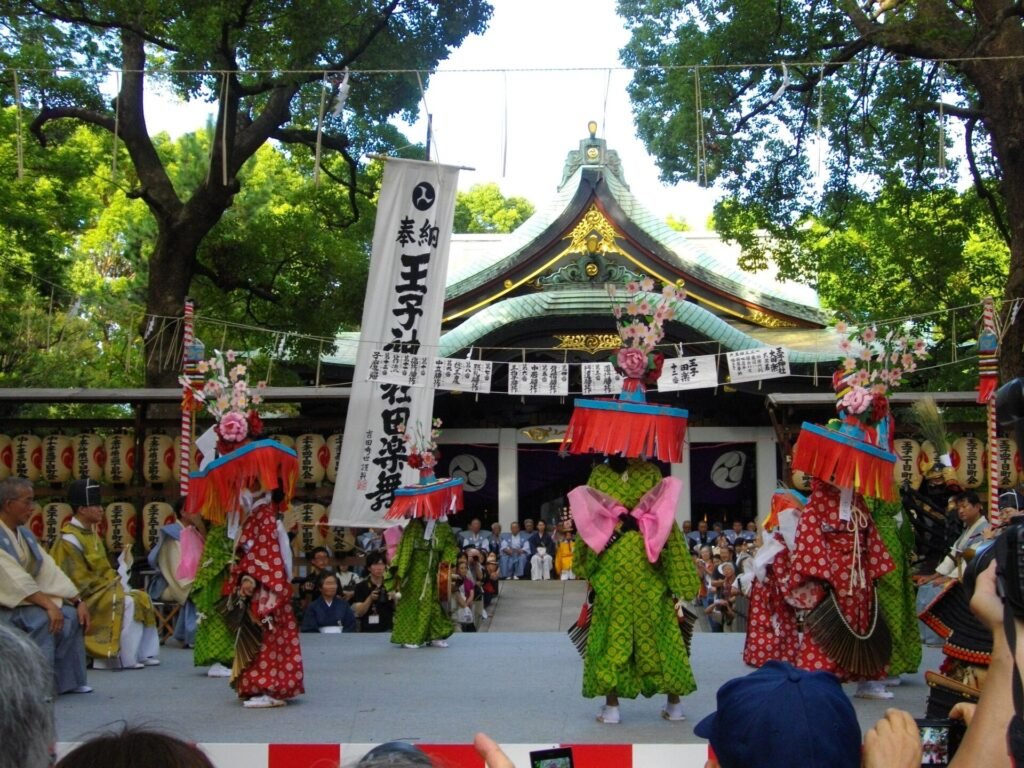
A rhythmic harvest dance rooted in Shinto ritual, dengaku emerged from rice-planting ceremonies in rural Japan and evolved into a sophisticated performing art. Dancers strike wooden clappers in synchronized patterns, their movements a living echo of gratitude for the harvest.
At a glance
Dengaku comprises two distinct traditions: musical accompaniment to rice planting observances, and dances developed alongside sangaku theater. Performed by villagers at New Year or during the planting season in early summer, dengaku was rural and ritualistic—until the 14th century, when playwright and actor Kan’ami brought it to the cities and incorporated it into Noh theater. The practice is deeply rooted in Shinto, Japan’s native religion, and ritualistic elements remain woven through its form.
Origins & history
Dengaku began as a folk practice accompanying agricultural cycles, documented in detail in the Eiga Monogatari. When introduced to the aristocracy, it flourished through the end of the Heian period (794–1185) and became the main performing art of the Kamakura period (1185–1333). It remained central to Muromachi-period performance (1336–1573). By the end of the Muromachi period, dengaku had been eclipsed by sarugaku, the theatrical form that incorporated dengaku’s ritualistic Shinto elements to create Noh theater. Today it barely survives as a folk performing art.
The practice
The sasara—a wooden percussive clapper—is dengaku’s primary instrument, struck in rhythmic patterns by performers who move with controlled energy. Other instruments accompany the practice as well. Dancers wear traditional dress and perform synchronized movements that embody both devotion and joy, their bodies and voices moving together in patterns refined over centuries. The performance is a full sensory experience: the sharp crack of wood on wood, the chanting of voices, the coordinated shuffle of feet.
Cultural significance
Dengaku represents the fusion of agricultural tradition, Shinto spirituality, and theatrical innovation. Its journey from village rice fields to urban stages illustrates how folk practice can transform without losing its essential character. The performance remains a statement of human gratitude for the harvest and a meditation on the cyclical nature of life and cultivation.
Key facts
- Country: Japan
- Anchor community: Nachikatsuura
- Coordinates: 33.63684, 135.93835
- UNESCO Intangible Cultural Heritage inscription: 2016
- UNESCO reference number: 00413
- Primary instrument: sasara (wooden clapper)
Where to experience it
Nachikatsuura, on Japan’s Kii Peninsula, is the heartland of this practice. Nachi no Dengaku is held at the Nachi fire festival, where the tradition continues to be performed in its sacred context. Visitors to the region may encounter dengaku as part of local festival celebrations and Shinto observances.
Sources & resources
Find it on the map
See this place and what’s around it →📷 Diventa un fotografo di Cultural Heritage Online
Condividi le tue foto dei luoghi: restano pubblicate con la tua firma come autore. Più vengono viste, più ti fai conoscere — e presto un concorso premierà le foto più apprezzate.
Accedi o registrati gratis per aggiungere una foto