
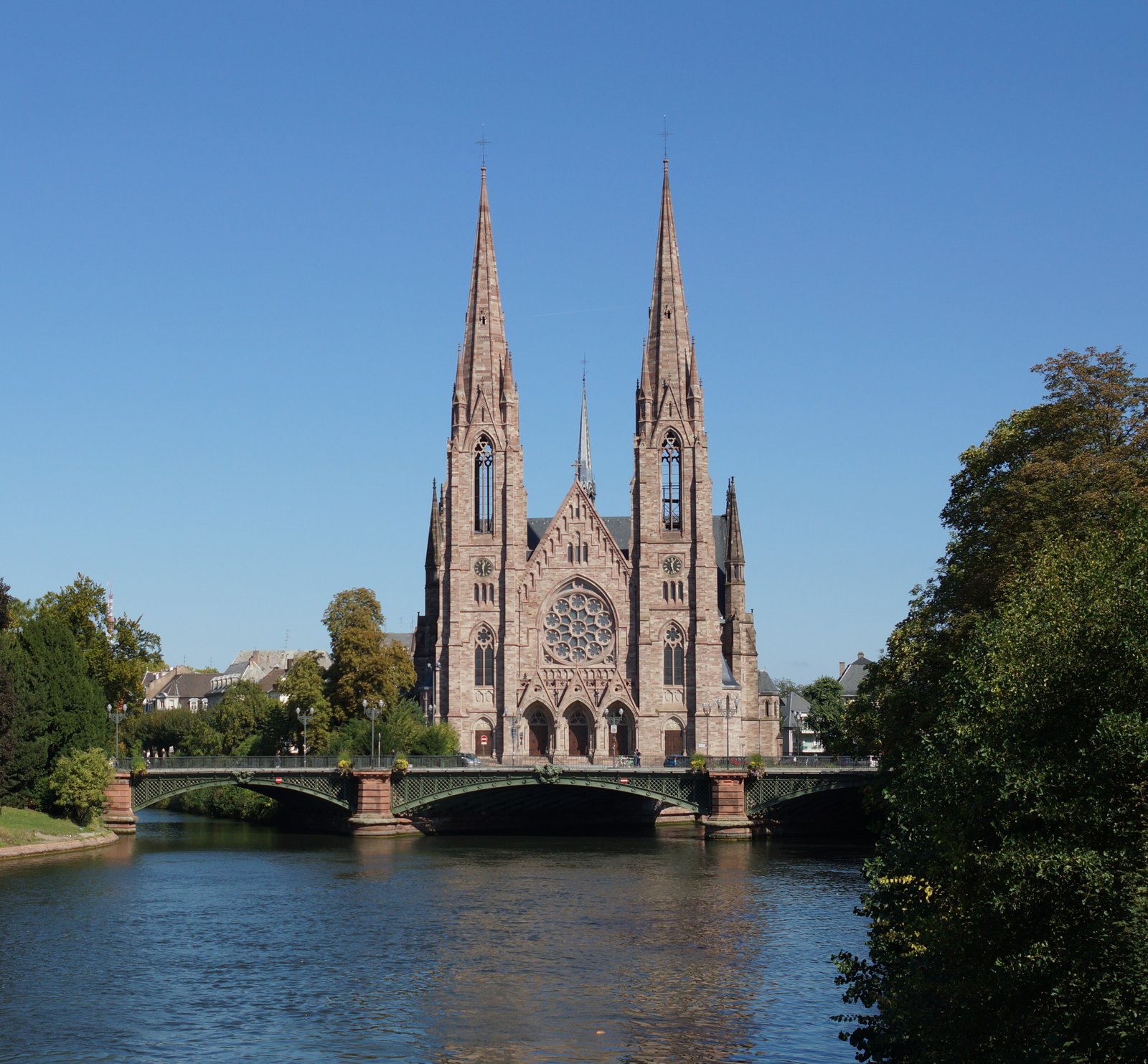
A commanding Gothic Revival landmark built for the Imperial German garrison, this Strasbourg church displays audacious proportions—19 portals, three rose windows, and spires reaching 249 feet—designed to receive emperors and commanders alike.
At a glance
St. Paul’s Church stands on an island in the Ill River at Strasbourg’s southern edge, its twin spires visible across the city. Constructed between 1892 and 1897 during German rule, it was conceived as a Protestant chapel for military elites. Today it serves the Reformed Church of Alsace and Lorraine.
History
The church emerged during Reichsland Elsass-Lothringen (1870–1918), when Strasbourg formed part of the German Empire. Architect Louis Muller designed it to accommodate officers of all ranks—and potentially the Emperor himself—reflecting the political architecture of occupation.
In 1919, after Alsace’s return to France, the church transferred to the Protestant Reformed Church, becoming its second parish in Strasbourg. World War II bombing raids damaged furnishings and stained glass in August 1944; a devastating hailstorm in 1958 destroyed remaining windows and nearby botanical structures.
What you see
Muller drew inspiration from the Elisabeth Church of Marburg but departed boldly. Three elaborate rose windows—adapted from St. Thomas’ Church designs—dominate the façade. The 66-foot nave was originally planned as a Latin cross with four bays, but foundation difficulties and cost overruns prompted redesign into a compact Greek cross.
Twin spires ascend 249 feet, commanding the riverine landscape. Most remarkably, 19 portals and entrances grant access throughout the building, vastly exceeding Strasbourg Cathedral’s seven doors. This profusion served a singular purpose: rapid ingress for dignitaries and military ranks without congestion.
The 1897 tribune organ remains the church’s masterpiece—one of Alsace’s largest instruments by pipe count and case size. Modified in 1934 and restored multiple times, it holds status as a Monument historique. A second transept organ was added in 1976.
Cultural significance
St. Paul’s Church embodies a contested moment in Alsatian history. Built as a symbol of German imperial authority, it became a French Protestant space within a generation. The architecture itself negotiates competing demands: military ceremony, ecclesiastical function, and architectural ambition.
Its organs represent exceptional craftsmanship and remain among France’s most important musical instruments.
Key facts
- Location: Strasbourg, France
- Coordinates: 48.5864, 7.7597
- Construction: 1892–1897
- Architect: Louis Muller (1842–1898)
- Spire height: 76 metres (249 feet)
- Notable features: 19 portals; three rose windows; 1897 pipe organ (one of Alsace’s largest)
Practical information & getting there
The church occupies an island site in the Ill River at Strasbourg’s southern extremity, making it accessible by foot from the city centre. Current opening hours and visitor facilities are best confirmed directly with the Reformed Church of Alsace and Lorraine.
Sources & resources
Find it on the map
See this place and what’s around it →📷 Become a Cultural Heritage Online photographer
Share your photos of places: they stay published under your name as the author. The more they're seen, the more you get noticed — and soon a contest will reward the most appreciated photos.
Log in or sign up free to add a photoIs this page about you?
This page is read by travellers and heritage enthusiasts who find it on Google. Tell us how you are connected to this place and we will take it from there.