
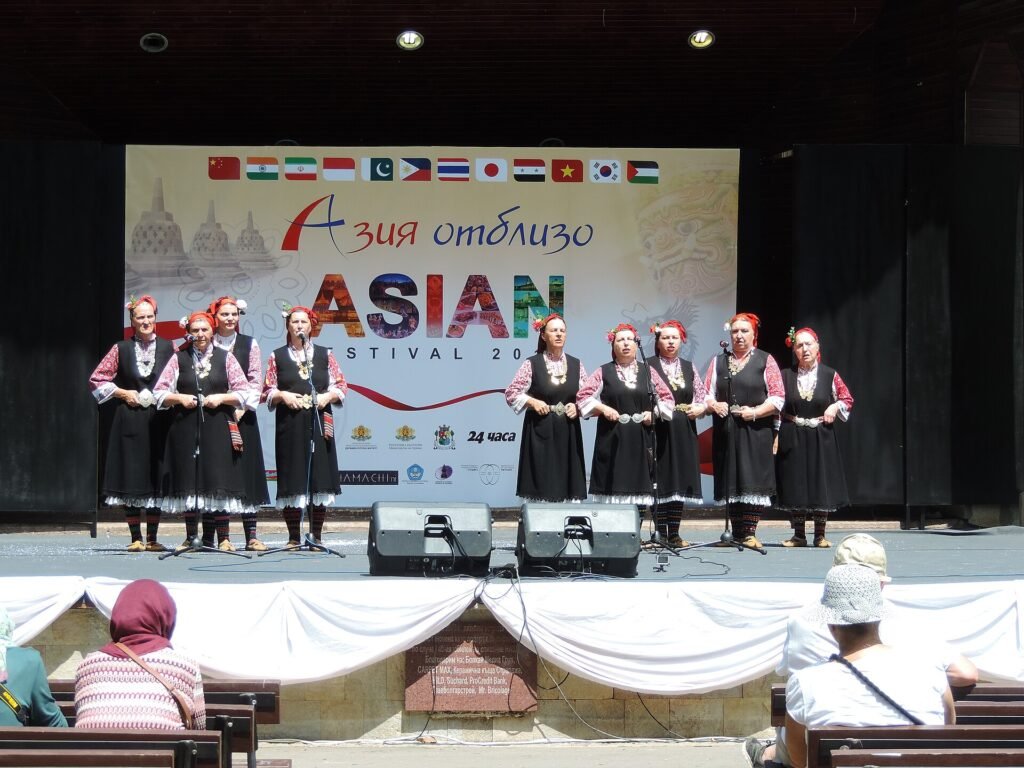
An ensemble of elderly and multi-generational women from Bulgaria’s Shopluk region preserves archaic three-part polyphony, ritual dances, and springtime ceremonies rooted in pre-Christian tradition.
In UNESCO’s words
The traditional dances and polyphonic singing found in the Shoplouk region of Bulgaria are still performed by a group of elderly women, the Bistritsa Babi. This tradition includes diaphony, or what is known as shoppe polyphony, ancient forms of the horo chain dance and the ritual practice of lazarouvane, an initiation ceremony for young women. Diaphony is a specific type of polyphonic singing in which one or two voices build the melody consisting of izvikva meaning “to shout out” and bouchi krivo meaning “crooked rumbled roars”, while other singers hold a monotone drone that is doubled or trebled to produce a more sonorous sound that accompanies the lead singers.The dancers, dressed in traditional costumes, hold each other by the waist or belt and dance in a circle, stepping lightly and moving counter-clockwise. A number of variations are performed within this structure, depending on the song and ancient ritual purposes. Although the social function of the polyphonic singing has changed over the twentieth century, as it is now primarily performed on stage, the Bistritsa Babi are regarded as an important component of the region’s cultural life, promoting traditional expressions among the younger generations. The women are among the few remaining representatives of traditional polyphony and the village of Bistritsa is one of the last areas in Bulgaria in which this cultural expression has been maintained over the centuries. Due to its location near the capital Sofia, which offers a range of cultural attractions, young people’s interest in communitybased traditions is declining. Over the years, the rich repertoire of songs and dances has been reduced to include only the most popular highlights to be performed on stage.
Official description, UNESCO Intangible Cultural Heritage List — Bistritsa Babi, archaic polyphony, dances and rituals from the Shoplouk region
At a glance
The traditional dances and polyphonic singing of the Shoplouk region are performed by the Bistritsa Babi, a group of elderly women. The tradition centres on diaphony, a form of polyphonic singing where one or two lead voices carry the melody through techniques called izvikva and bouchi krivo, while other singers provide a doubled or trebled monotone drone. The performers also dance in ancient horo chain formations, moving counter-clockwise in circles while holding each other by the waist or belt, and practise lazarouvane, an initiation ceremony for young women.
Origins & history
The group emerged from the Bistritsa Chetvorka (Foursome), a male quartet founded around 1935. Pairs of women were recruited as vocal accompanists, eventually forming their own ensemble. Recognized for artistic excellence across Europe, Bistritsa Babi received the European Folk Art Award in 1978 and were declared a Masterpiece of the Intangible Heritage of Humanity in 2005.
The practice
Elderly women of the Bistritsa Babi perform while dressed in traditional costumes. The lead singers carry the melody using izvikva (shouting out) and bouchi krivo (crooked rumbled roars), while accompanying singers hold a monotone drone that is doubled or trebled for fuller sound. Dancers step lightly in counter-clockwise circles, holding each other by the waist or belt. Different variations of dance and song are performed depending on the particular song and its ancient ritual purposes. The group also practises lazarouvane, the initiation ceremony for young women.
Cultural significance
The Bistritsa Babi are regarded as an important part of the region's cultural life and among the few remaining representatives of traditional polyphony in Bulgaria. They promote traditional expressions to younger generations. However, interest in community-based traditions is declining due to the proximity of Sofia and its cultural attractions, and the rich repertoire of songs and dances has been reduced to only the most popular pieces for stage performance.
Key facts
- Country: Bulgaria
- Inscribed: 2008
- UNESCO list: Representative List of the Intangible Cultural Heritage of Humanity
- UNESCO reference: 00095
- UNESCO vocabulary: Dance; Polyphonic singing; Vocal music
- Map: Bistritsa — the locality named in UNESCO’s official description of this element
Where to experience it
The Shoplouk region of Bulgaria, particularly the village of Bistritsa, remains the primary home of this tradition. The Bistritsa Babi continue to perform these ancient dances and polyphonic songs, keeping the practice alive as one of the last areas in Bulgaria where this cultural expression has endured. While the social context has shifted toward stage performances, visitors interested in traditional polyphony and the horo chain dance can seek out local cultural events and organizations in the region to learn about performance opportunities and the communities stewarding this heritage.
Sources & resources
- UNESCO — official element page: Bistritsa Babi, archaic polyphony, dances and rituals from the Shoplouk region
- UNESCO — open data record: Intangible Heritage List, reference 00095
- UNESCO — official video: UNESCO film on this element — embedded on this page
- UNESCO — official photograph: The Bistritsa Babi – Archaic Polyphony, Dances and Rituals from the Shoplouk Region in Bulgaria — Prof. M. Santova
- Reference — Wikipedia (secondary): Bistritsa Babi — consulted as a secondary reference, not as confirmation
- Cultural Heritage Online: Our archive and city guides
Find it on the map
See this place and what’s around it →📷 Become a Cultural Heritage Online photographer
Share your photos of places: they stay published under your name as the author. The more they're seen, the more you get noticed — and soon a contest will reward the most appreciated photos.
Log in or sign up free to add a photo