
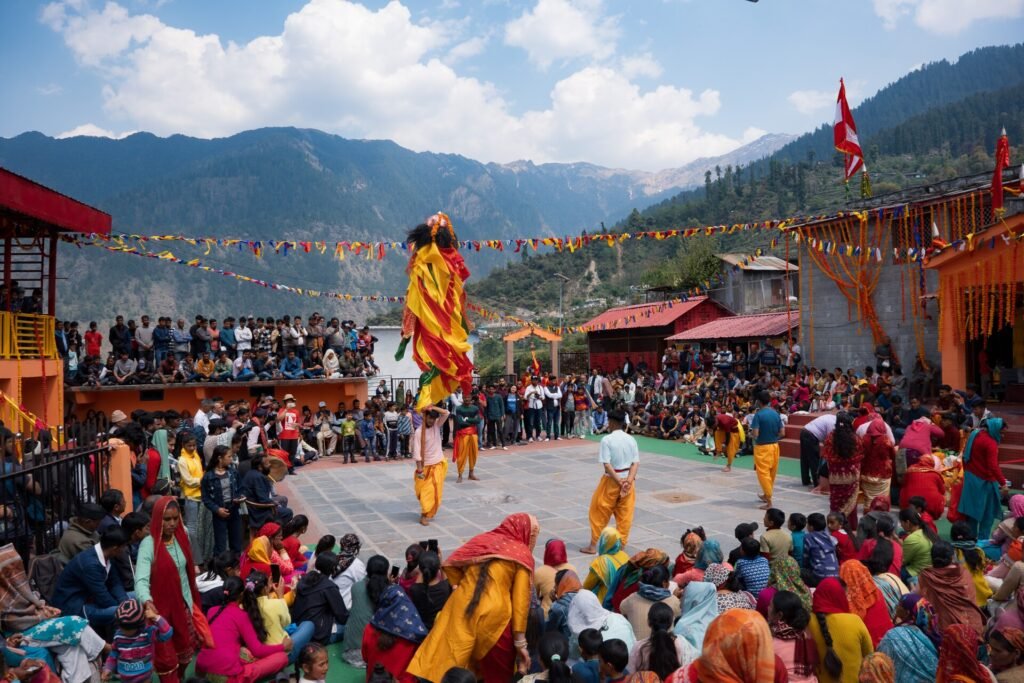
A masked ritual theatre of the Garhwal Himalayas, Ramman is performed as a sacred offering to village deities, transforming courtyard temples into spaces of spiritual communion and ancestral remembrance.
In UNESCO’s words
Every year in late April, the twin villages of Saloor-Dungra in the state of Uttarakhand (northern India) are marked by Ramman, a religious festival in honour of the tutelary god, Bhumiyal Devta, a local divinity whose temple houses most of the festivities. This event is made up of highly complex rituals: the recitation of a version of the epic of Rama and various legends, and the performance of songs and masked dances. The festival is organized by villagers, and each caste and occupational group has a distinct role. For example, youth and the elders perform, the Brahmans lead the prayers and perform the rituals, and the Bhandaris – representing locals of the Kshatriya caste – are alone entitled to wear one of the most sacred masks, that of the half-man, half-lion Hindu deity, Narasimha. The family that hosts Bhumiyal Devta during the year must adhere to a strict daily routine. Combining theatre, music, historical reconstructions, and traditional oral and written tales, the Ramman is a multiform cultural event that reflects the environmental, spiritual and cultural concept of the community, recounting its founding myths and strengthening its sense of self-worth. In order to ensure that it remains viable, the community’s priorities are to promote its transmission and to obtain its recognition beyond the geographical area in which it is practised.
Official description, UNESCO Intangible Cultural Heritage List — Ramman, religious festival and ritual theatre of the Garhwal Himalayas, India
At a glance
Ramman is a religious festival held every year in late April in the twin villages of Saloor-Dungra in Uttarakhand. The event honours Bhumiyal Devta, a local deity, through complex rituals that combine recitations of the Rama epic and local legends with songs and masked dances. It brings together theatre, music, and oral tradition in a multiform cultural event that expresses the community's spiritual and cultural values.
Origins & history
Ramman belongs to an ancient religious tradition of the Garhwali people, woven into the spiritual life of mountain communities for generations. Multiple versions exist across villages, each tied to local pantheons and seasonal cycles. The masked form in Saloor-Dungra stands singular—a practice preserved and transmitted within that village alone, making it irreplaceable within its cultural geography.
The practice
Each year, villagers organize Ramman with distinct roles assigned by caste and occupation. Youth and elders perform, Brahmans lead prayers and conduct rituals, and the Bhandaris—of the Kshatriya caste—alone wear the most sacred mask, that of Narasimha, the half-man, half-lion deity. The family hosting Bhumiyal Devta during the year must follow a strict daily routine. Performances include recitations, songs, and masked dances centred on the local temple.
Cultural significance
Ramman reflects the community's environmental, spiritual and cultural understanding, recounting founding myths and strengthening collective identity. For the bearers of this tradition, the festival transmits essential knowledge and reinforces social bonds across generations. The community prioritizes ensuring the practice remains viable by promoting its transmission to younger members and gaining recognition beyond the villages where it is currently practised.
Key facts
- Country: India
- Inscribed: 2009
- UNESCO list: Representative List of the Intangible Cultural Heritage of Humanity
- UNESCO reference: 00281
- UNESCO vocabulary: Festivals; Hinduism; Theatre
- Map: Saloor-Dungra — the locality named in UNESCO’s official description of this element
Where to experience it
Every year in late April, the twin villages of Saloor-Dungra in Uttarakhand witness the Ramman festival, a sacred religious observance honouring the tutelary god Bhumiyal Devta. The festival unfolds at the god's temple, where villagers gather to perform complex rituals including recitations of the Rama epic, songs, and masked dances. Each caste and occupational group participates in distinct roles, with the Bhandaris alone permitted to wear the sacred Narasimha mask. This multiform event, combining theatre, music, and traditional oral narratives, strengthens the community's spiritual identity and sense of self-worth. Visitors may encounter Ramman as an authentic religious celebration rooted in the village's founding myths and environmental spirituality.
Sources & resources
- UNESCO — official element page: Ramman, religious festival and ritual theatre of the Garhwal Himalayas, India
- UNESCO — open data record: Intangible Heritage List, reference 00281
- UNESCO — official video: UNESCO film on this element — embedded on this page
- UNESCO — official photograph: Photograph of this element — Arvind Mudgil — IGNCA, Ministry of Culture
- Reference — Wikipedia (secondary): Ramman (festival) — consulted as a secondary reference, not as confirmation
- Cultural Heritage Online: Our archive and city guides

Find it on the map
See this place and what’s around it →📷 Become a Cultural Heritage Online photographer
Share your photos of places: they stay published under your name as the author. The more they're seen, the more you get noticed — and soon a contest will reward the most appreciated photos.
Log in or sign up free to add a photo