
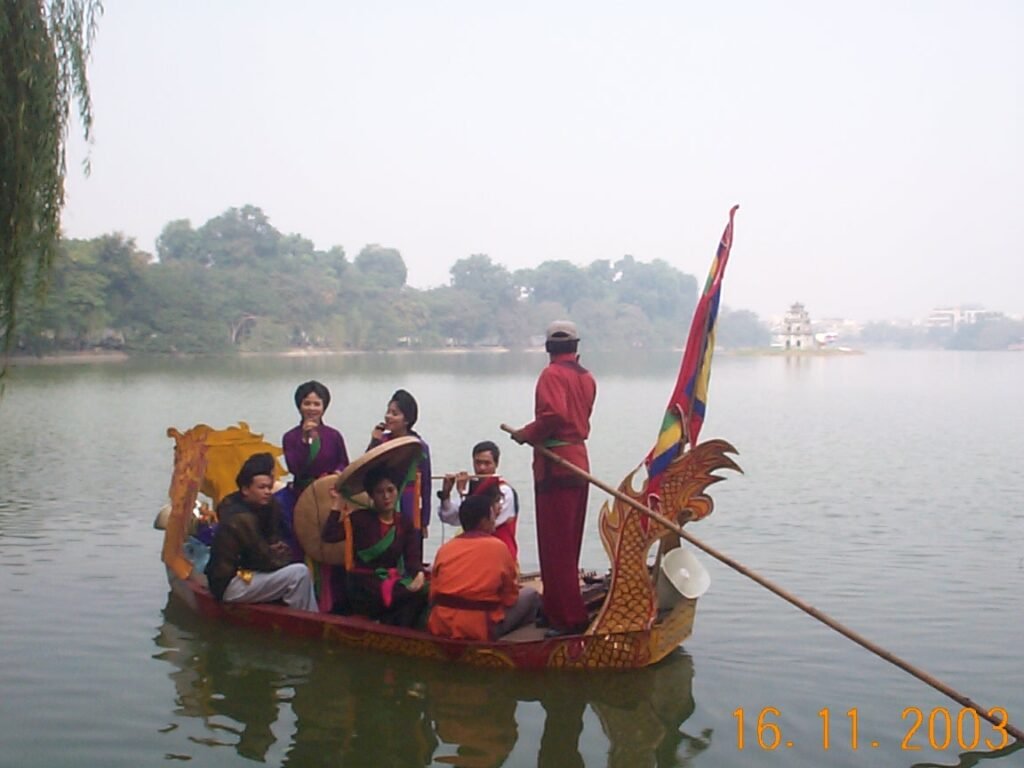
An antiphonal singing tradition where groups of female and male singers exchange musical challenges and responses, rooted in spring festivals and steeped in themes of love and youth.
At a glance
Quan họ is a Vietnamese folk music style built on call-and-response exchanges between pairs of female and male singers. The practice flourishes during spring festivals, especially those following Tết Nguyên Đán (the Vietnamese New Year), where singers perform elaborate musical dialogues drawn from a vast repertoire of melodies and verses.
Origins & history
Quan họ originated in Bắc Ninh Province and was first recorded in the 13th century. Traditionally tied to spring celebrations, the singing historically began on the evening before festivals; today it typically occurs on the main festival day itself.
The practice has evolved with accompaniment. While singers once performed unaccompanied, it is now common for traditional Vietnamese instruments or modern ones such as electric keyboards to support the voices.
The practice
A quan họ performance begins when a pair of female singers issues a “challenge phrase” (câu ra) from the established song repertoire. A pair of male singers then responds by selecting and singing a “matching phrase” (câu đối), which repeats the melody of the challenge. The order then reverses—the men sing their own challenge with a different melody, and the women respond.
Thousands of different songs have been recorded and written in score form, creating an expansive tradition. A simpler variant, trống quân singing, allows spoken responses and is performed by boys and girls at village festivals.
Cultural significance
Quan họ embodies the social and emotional life of young adults in Vietnamese communities. Love and sentimentality—expressed through clever textual and melodic exchanges—remain central themes. The practice reinforces community bonds during seasonal festivals and demonstrates the sophistication of oral transmission and collective memory.
Key facts
- UNESCO Intangible Cultural Heritage, 2009 (reference 00183)
- Anchor community: Bắc Ninh Province, Vietnam
- First documented: 13th century
- Format: antiphonal singing; female-male paired exchanges
- Occasions: spring festivals, Tết Nguyên Đán celebrations
- Accompaniment: traditionally unaccompanied; now often accompanied by traditional or modern instruments
Where to experience it
Quan họ thrives in Bắc Ninh Province, particularly during spring festival seasons following the Vietnamese New Year. The practice remains central to village celebrations throughout the region, where community members gather to sing and exchange verses.
Sources & resources
Find it on the map
See this place and what’s around it →📷 Become a Cultural Heritage Online photographer
Share your photos of places: they stay published under your name as the author. The more they're seen, the more you get noticed — and soon a contest will reward the most appreciated photos.
Log in or sign up free to add a photo