
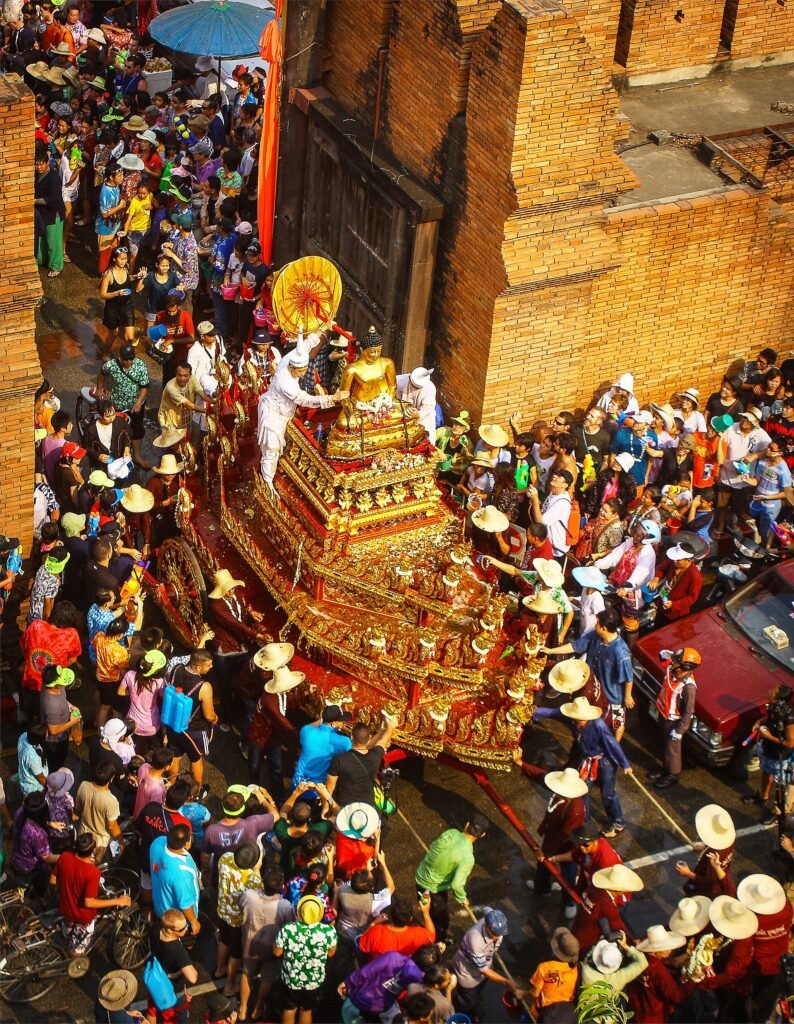
Thailand’s traditional New Year festival, celebrated each April with ritual water purification and communal celebration, now recognized as intangible cultural heritage.
At a glance
Songkran is Thailand’s most significant annual celebration, marking the traditional New Year according to the Theravada Buddhist calendar. Held annually on 13 April, with observance extending through 15 April, it aligns with related New Year festivals across South and Southeast Asia and the Hindu calendar. The festival centers on public water cleansing rituals that have made it recognizable worldwide, though its deeper meaning remains rooted in spiritual renewal and community blessing.
Origins & history
Songkran was Thailand’s official New Year celebration until administrative reforms reshaped the national calendar. In 1888, the official New Year shifted to 1 April, then moved again to 1 January in 1940. Despite these bureaucratic changes, Songkran persists as a national holiday, maintaining continuity with pre-modern Thai timekeeping and Buddhist liturgical tradition. The festival’s observance reflects deeper cultural attachments that no decree could displace.
The practice
Songkran celebrations are centered on water as both practical and symbolic medium. Public water fights—throwing water, splashing, and drenching participants—form the festival’s most visible element, understood as ritual cleansing rather than mere play. Communities gather in streets, temples, and homes to participate in these water exchanges, which purify both individuals and shared spaces. The festival welcomes broad participation, from families to strangers, creating temporary bonds of renewal and blessing.
Cultural significance
Songkran embodies Thai Buddhist concepts of purification and renewal, marking both calendar transition and spiritual reckoning. The water ritual cleanses accumulated misfortune and prepares individuals and communities for the year ahead. The festival also reinforces social cohesion across generations and geographic boundaries, drawing international visitors while remaining rooted in local practice. Its recent UNESCO recognition acknowledges the festival’s importance to Thai cultural continuity.
Key facts
- Country: Thailand
- Anchor community: Chiang Mai
- Celebrated annually: 13–15 April
- UNESCO Intangible Cultural Heritage: 2024 (reference 01719)
- Coordinates (Chiang Mai): 18.79097, 98.99412
Where to experience it
Songkran is celebrated throughout Thailand, with Chiang Mai serving as a major heartland of the tradition. The festival’s observance is national and communal—celebrations occur in temples, streets, neighborhoods, and homes across the country during the April festival period. You can participate in water blessings, temple visits, and community gatherings that form the festival’s core wherever you find yourself in Thailand during these dates.
Sources & resources
Find it on the map
See this place and what’s around it →📷 Become a Cultural Heritage Online photographer
Share your photos of places: they stay published under your name as the author. The more they're seen, the more you get noticed — and soon a contest will reward the most appreciated photos.
Log in or sign up free to add a photo