
A mid-winter festival of fire and light rooted in ancient Persia, Sadeh marks the triumph over darkness fifty days before the spring equinox.
In UNESCO’s words
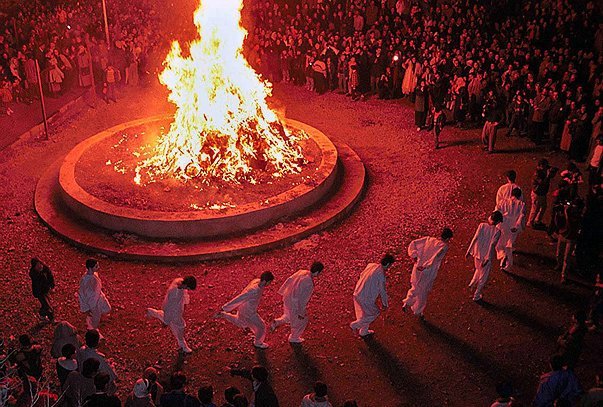
Sadeh, or Sada, is a celebration held annually on 30 January. In the folk calendar, it marks the day when farmlands are prepared for their next spring plantation and when people celebrate the end of the coldest winter days, with 50 days and 50 nights remaining to spring. Accordingly, ‘Sadeh’ means ‘one hundred’. The element enjoys diverse manifestations in Iran and Tajikistan. It involves singing, dancing and praying around a fire and offering blessings and dry or fresh fruits. The day also marks the traditional start of agricultural work for the new season, with farmers sprinkling fertilizer in their lands and gardeners pruning their trees and bushes. After the Sadeh celebration, people in the villages meet outdoors to collectively clean water-streams and pools and to repair bridges. In both countries, the practice, including the preparation of traditional dishes, is transmitted through participation, observation and storytelling. Media, social networks, scientific works, articles, conferences and symposiums also contribute to the transmission of Sadeh. The practice unites people from different cultural, ethnic and religious backgrounds, providing an opportunity for peaceful interactions around agricultural and food traditions and promoting diversity and the continuation of oral expressions and memory.
Official description, UNESCO Intangible Cultural Heritage List — Sadeh/Sada celebration
At a glance
Sadeh is an annual celebration held on 30 January that marks a turning point in the agricultural and seasonal calendar. The name means 'one hundred', referring to the fifty days and fifty nights remaining until spring. The day recognises both the end of the coldest winter period and the moment when farmlands are prepared for the next planting season. Celebrations involve singing, dancing, and praying around a fire, along with offerings of blessings and fresh or dried fruits.
Origins & history
The practice is embedded in the folk calendar as a long-standing tradition. Over time, Sadeh has been transmitted across generations through participation, observation, and storytelling within communities. In recent years, media, social networks, scholarly works, articles, conferences, and symposiums have also played a role in passing on knowledge of the celebration and its meanings.
The practice
Sadeh celebrations bring people together around a fire to sing, dance, and pray. The day also marks the practical start of agricultural work: farmers sprinkle fertilizer on their lands while gardeners prune trees and bushes. Following the celebration, villagers gather outdoors to clean water streams and pools and repair bridges collectively. Preparation of traditional dishes forms part of the observance, transmitted through direct participation and shared practice.
Cultural significance
Sadeh unites people from different cultural, ethnic, and religious backgrounds, creating opportunities for peaceful interaction centred on agricultural and food traditions. The celebration promotes diversity while sustaining oral expressions and community memory. Through this shared practice, the tradition reinforces social bonds and demonstrates the continuation of collective knowledge across generations in both Iran and Tajikistan.
Key facts
- Country: Iran (Islamic Republic of), Tajikistan
- Inscribed: 2023
- UNESCO list: Representative List of the Intangible Cultural Heritage of Humanity
- UNESCO reference: 01713
- UNESCO vocabulary: Calendars; Seasonal ritual; Social participation
- Map: not shown — UNESCO’s official description of this element names no locality, and a living tradition is practised across a community, not at one address.
- Related World Heritage site: Meidan Emam, Esfahan, Masjed-e Jāmé of Isfahan, Tajik National Park (Mountains of the Pamirs), Historic City of Yazd (a different UNESCO designation, not the place of the tradition)
Where to experience it
Sadeh is celebrated throughout Iran and in Tajikistan on 30 January, when communities gather around fires to sing, dance, and pray together. Visitors can witness the tradition in villages across both countries, where families and neighbours kindle fires, offer blessings and fruits, and prepare traditional dishes. The celebration extends beyond the evening as farmers and gardeners begin their seasonal work, sprinkling fertilizer and pruning trees. In the days following, villagers meet outdoors to collectively clean water streams and repair bridges, making Sadeh a time when diverse communities unite around shared agricultural and food practices.
Sources & resources
- UNESCO — official element page: Sadeh/Sada celebration
- UNESCO — open data record: Intangible Heritage List, reference 01713
- UNESCO — official video: UNESCO film on this element — embedded on this page
- UNESCO — official photograph: Sadeh celebration in Taft (Yazd), Zoroastrian women play a traditional instrument (Daf), circling around the fire of Sadeh — Abbas Tahvildar — Iran’s Cultural Heritage, Handicrafts and Tourism Organization (ICHHTO), 2020
- Reference — Wikipedia (secondary): Sadeh — consulted as a secondary reference, not as confirmation
- Cultural Heritage Online: Our archive and city guides

Sources
- S1 — Boyce, Mary. A History of Zoroastrianism: Volume I. Brill, 1996. ISBN 978-90-04-10474-7.
- S2 — Foltz, Richard. Religions of Iran: From Prehistory to the Present. Oneworld Publications, 2013. ISBN 978-1-78074-308-0.
Spotted an error? Write to editorial@culturalheritageonline.com and we correct it the same day.