
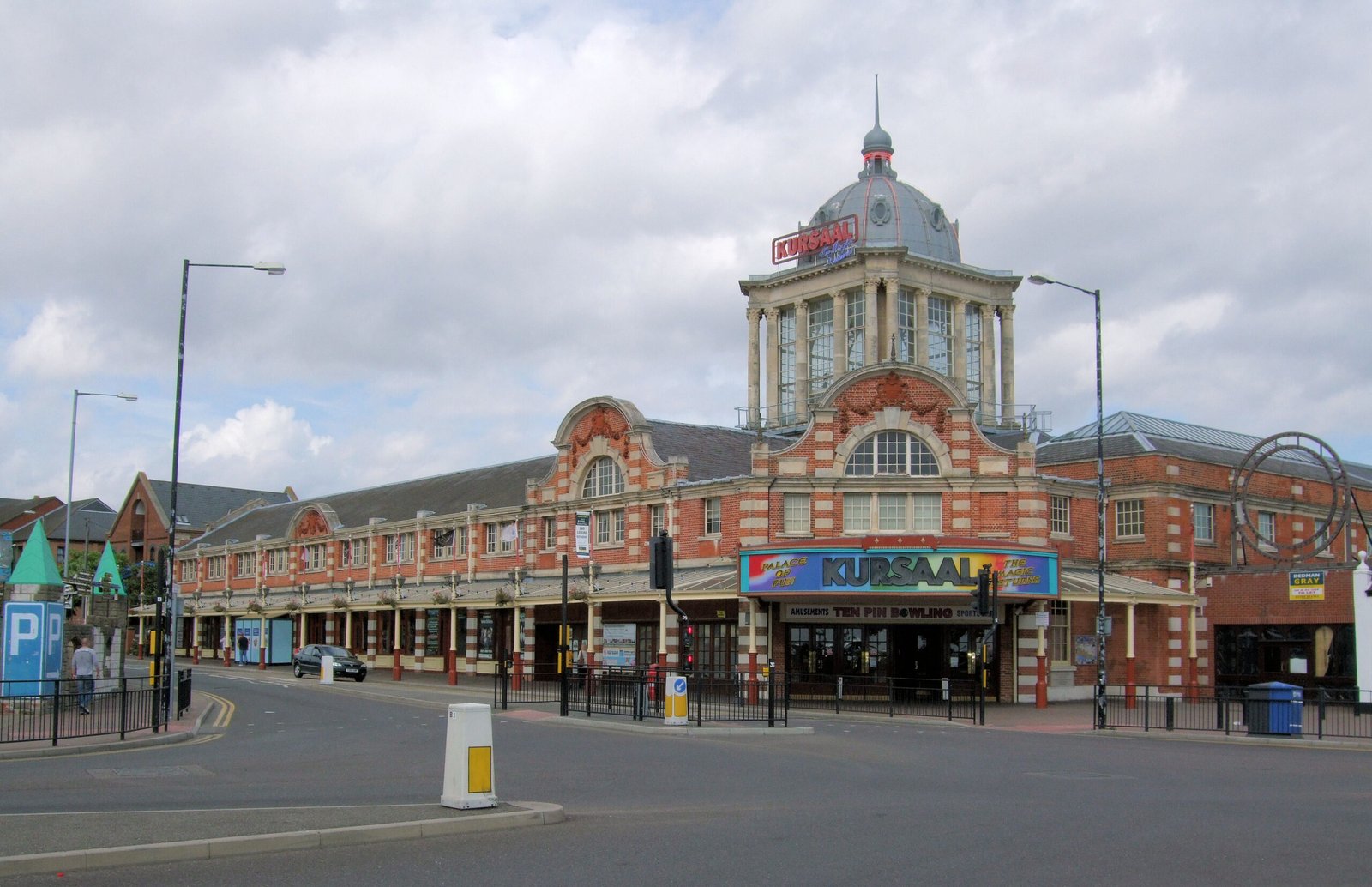
Beneath George Campbell Sherrin’s dome, the Kursaal opened in July 1901 as the grand gateway to what is described as part of one of the world’s first purpose-built amusement parks — Southend’s pleasure palace, still standing where the fun began.
At a glance
The Kursaal anchors the eastern seafront of Southend-on-Sea with the most recognisable silhouette in town: a domed corner pavilion designed by the British architect George Campbell Sherrin (1843–1909). Opened in July 1901 as the Kursaal Palace, it served as the grand entrance to amusement grounds first laid out as Marine Park in 1894 — a complex described as part of one of the world’s first purpose-built amusement parks. The building is Grade II listed, and its dome was chosen for a Royal Mail special stamp in 2011. After a century of reinventions, most of the building today stands quiet, awaiting its next act.
Key facts
- Opened: July 1901, as the Kursaal Palace
- Architects: George Campbell Sherrin and John Clarke (entrance pavilion)
- Status: Grade II listed building
- Name: from the German Kursaal, literally “cure hall”
- Recognition: featured on a Royal Mail special stamp, 2011
- Coordinates: 51.533111, 0.724816
- Today: largely vacant; a lease agreement announced in March 2026 points to a future leisure reopening
History
The story begins in 1894 with Marine Park, a seaside pleasure ground on Southend’s eastern shore. In July 1901 its owners opened the Kursaal Palace: a grand entrance pavilion containing a circus, ballroom, arcade, dining hall and billiard room, crowned by Sherrin’s dome. The grounds behind it grew into a full amusement park — among the world’s first conceived and built as such.
The decades brought constant reinvention. The park traded briefly as Luna Park in 1910–11 before the American showman Clifton Jay Morehouse bought it in 1912. Southend United F.C. played home matches on the Kursaal grounds from 1919 to 1934; greyhound racing had a short run in 1927–28. The outdoor amusements closed in 1973, and in 1986 the Kursaal shut altogether. A 1998 redevelopment brought a bowling alley and casino, but the revival faded: the casino closed in 2020, and by then most tenants had gone. The Victorian Society placed the building on its “at risk” list in May 2024; in March 2026 a lease deal with an amusements operator was announced, with a leisure reopening intended.
What you see
From the Esplanade, the Kursaal reads as one composition: the corner pavilion with its distinctive dome, the arched entrance below, and the long brick frontage that once funnelled crowds toward the rides. Sherrin and Clarke designed the pavilion to be seen from the sea and the promenade alike — civic confidence dressed as entertainment. The interior is not currently open to visitors, so the architecture is best appreciated from the seafront, where the dome still commands the skyline as it has since 1901.
Practical information
The Kursaal is not currently open as an attraction; a convenience store occupies part of the ground floor. The building and dome can be viewed at any time from the seafront. Reopening plans connected to the March 2026 lease agreement are worth checking in local press before a visit.
Getting there
The Kursaal stands on the eastern seafront of Southend-on-Sea, Essex, on the Eastern Esplanade. Southend is roughly an hour from central London by rail, and the seafront is a straightforward walk from the town centre.
Nearby
A short walk west along the seafront leads to Southend Pier, the longest pleasure pier in the world — the town’s other great survivor from its resort heyday. The Esplanade between the two carries the amusement-arcade energy the Kursaal once concentrated under a single dome.
Sources
- Kursaal (Southend-on-Sea) — Wikipedia
- Wikidata Q6446511 (Grade II heritage designation, coordinates)
- Josephine Kane, The Architecture of Pleasure: British Amusement Parks 1900–1939 (2016)
- Historic England, National Heritage List for England (Grade II listing)
- The Victorian Society, buildings-at-risk listing, May 2024
- Cultural Heritage Online
Find it on the map
See this place and what’s around it →📷 Become a Cultural Heritage Online photographer
Share your photos of places: they stay published under your name as the author. The more they're seen, the more you get noticed — and soon a contest will reward the most appreciated photos.
Log in or sign up free to add a photoIs this page about you?
This page is read by travellers and heritage enthusiasts who find it on Google. Tell us how you are connected to this place and we will take it from there.