
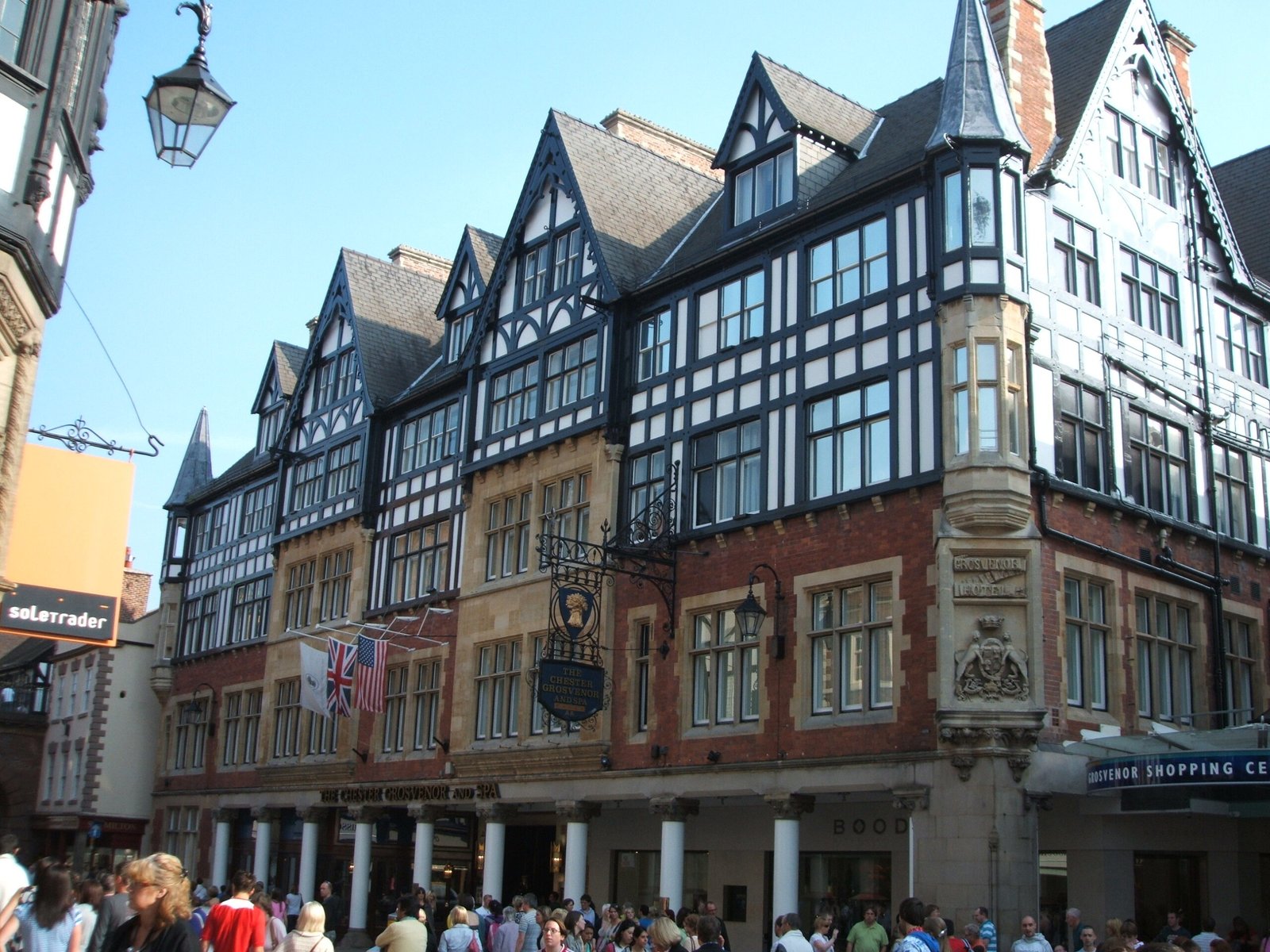
A landmark of Chester’s Victorian black-and-white revival, the Grosvenor rose in the 1860s for the family that became the Dukes of Westminster — a timber-gabled hotel at the top of Eastgate Street.
At a glance
The Chester Grosvenor is a five-star hotel on Eastgate Street, at the centre of the walled city and a few steps from the Eastgate Clock. Its frontage belongs to Chester’s Victorian black-and-white revival: brick and stone below, carved oak framing and white plaster panels above, rising into gables and slender corner turrets. Named for the Grosvenor family — Marquesses, later Dukes, of Westminster — the present building was raised in the mid-1860s on a site that had held an inn since at least the eighteenth century. It has been Grade II listed since 1972 and remains one of the most recognisable buildings on Chester’s main shopping street.
Key facts
- Location: Eastgate Street, in the heart of Chester’s walled centre, Cheshire
- Built: 1863–66, replacing the earlier Royal, then Grosvenor, Hotel
- Architect: designed by Thomas Mainwaring Penson (1818–1864); completed after his death by the practice of R. K. Penson & Ritchie
- Commissioned by: Richard Grosvenor, 2nd Marquess of Westminster
- Style: Victorian black-and-white (half-timbered) revival, or “magpie” — pioneered in Chester by Penson
- Protection: Grade II listed (designated 10 January 1972; Historic England entry 1376248)
- Today: five-star hotel and spa; formerly home to the Michelin-starred Simon Radley at The Chester Grosvenor
History
An inn has stood on this corner of Eastgate Street for centuries. The earliest recorded, the Golden Talbot, was already called “ancient” when a Chester newspaper mentioned it in 1751. In 1784 the politician John Crewe pulled it down and built the Royal Hotel, which became a base for the Grosvenors’ political opponents. That changed in 1815, when Robert Grosvenor — Earl Grosvenor, later the 1st Marquess of Westminster — bought the hotel outright and gave it the family name.
Half a century on, his son Richard Grosvenor, 2nd Marquess of Westminster, judged the old hotel no longer grand enough. It was demolished in 1863 and rebuilt over the following years, reaching completion in 1865–66. The commission went to Thomas Mainwaring Penson (1818–1864), the Chester architect credited with reviving the city’s timber-framed “black-and-white” manner in the 1850s. Penson died in 1864, before the work was finished; it was completed by the practice of his elder brother, Richard Kyrke Penson, with A. Ritchie. The Grosvenor is best described, then, as designed by Penson and finished to his firm’s account.
The hotel became one set-piece in a wider Victorian fashion. Through the second half of the nineteenth century, architects — Penson first, then John Douglas — dressed Chester’s main streets in mock-Tudor gables and dark oak framing, a half-invented townscape that has since come to define how visitors picture the city.
What you see
The frontage reads in two registers. The lower floors are solid: brown brick with stone dressings, carrying the galleried walkway of the Rows at first-floor level. Above, the building turns theatrical — four storeys of close-set oak studwork and white plaster, framed by projecting gabled bays, with slim corner turrets, or tourelles, at each end and steep grey-slate roofs behind. This is timber revival as display rather than structure, the black-and-white patterning applied for effect across seven window-bays.
The hotel stands at the head of Eastgate Street, the Roman and medieval line of Chester’s main thoroughfare, a short walk from the sandstone city walls that still ring the centre. Just to the east rises the Eastgate itself, crowned by the ornate Eastgate Clock — an openwork iron turret clock built to mark Queen Victoria’s 1897 Diamond Jubilee and erected in 1899 and one of the most photographed clocks in England. From the hotel’s upper gables the walls, the clock and the two-tier Rows are all in view.
Practical information
- Function: a working five-star hotel and spa — interiors are for guests and restaurant or spa bookings; the facade is free to view from the street
- Where: Eastgate Street, Chester CH1 1LT, on the pedestrianised main street
- Time needed: a few minutes for the facade; longer if you follow the city walls and the Rows around it
- Before you go: the hotel is reported to be closing during 2026 for building-safety works — check the operator’s own site before planning a stay or a meal; the Grade II listed building itself remains part of Eastgate Street
Getting there
Chester railway station is about a ten-minute walk from Eastgate Street, north-east of the walled centre. The city is well connected by train, with frequent direct services from Liverpool and Manchester and links to London Euston via Crewe. Eastgate Street itself is pedestrianised, so drivers should use one of the city-centre car parks; the near-complete ring of walls then makes the whole historic core easy to cover on foot.
Nearby
- Eastgate Clock — the iron turret clock on the East Gate, a minute’s walk away
- Chester city walls — the near-complete Roman and medieval circuit around the old town
- The Rows — Chester’s two-level medieval galleried shopping streets, which run past the hotel
- Chester Cathedral — the former Benedictine abbey church, a few minutes north
Sources
- Historic England, List Entry 1376248 (Grosvenor Hotel, Chester): https://historicengland.org.uk/listing/the-list/list-entry/1376248
- Wikipedia, The Chester Grosvenor Hotel: https://en.wikipedia.org/wiki/The_Chester_Grosvenor_Hotel
- Wikipedia, Thomas Mainwaring Penson: https://en.wikipedia.org/wiki/Thomas_Mainwaring_Penson
- Chester Standard, history of the Chester Grosvenor: https://www.chesterstandard.co.uk/news/25954566.history-chester-grosvenor-news-refurbishment/
- Wikipedia, Eastgate, Chester (Eastgate Clock): https://en.wikipedia.org/wiki/Eastgate,_Chester
Find it on the map
See this place and what’s around it →📷 Become a Cultural Heritage Online photographer
Share your photos of places: they stay published under your name as the author. The more they're seen, the more you get noticed — and soon a contest will reward the most appreciated photos.
Log in or sign up free to add a photoIs this page about you?
This page is read by travellers and heritage enthusiasts who find it on Google. Tell us how you are connected to this place and we will take it from there.