
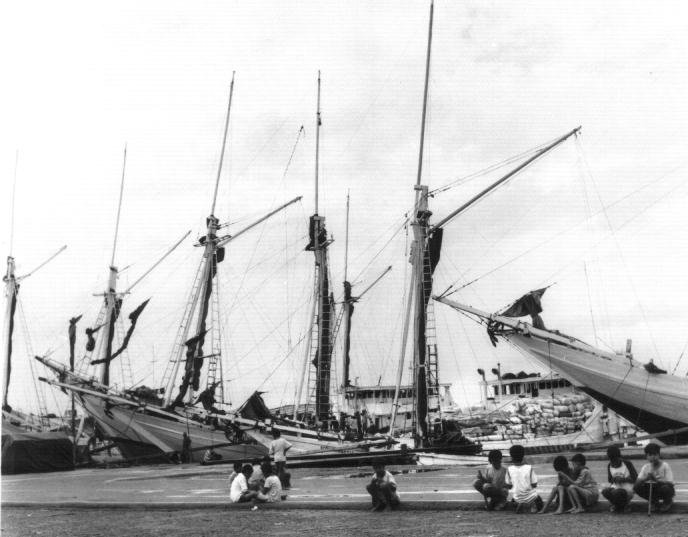
The art of constructing wooden sailing vessels with a distinctive two-masted rig, historically built by the Konjo-speaking people of South Sulawesi and used across the seas by Buginese and Makassarese traders.
At a glance
Pinisi refers to a specific rigging configuration—seven to eight sails arranged on two masts in a gaff-ketch style—rather than a single hull design. The term describes the arrangement of masts, sails and lines that define these wooden vessels. Builders construct the sails to open like curtains along fixed gaffs at the mast centres, a technique distinct from Western sailing traditions.
Origins & history
The Konjo-speaking people of Ara village in Bontobahari district, Bulukumba regency, pioneered pinisi-rigged vessel construction. By the 20th century, Buginese and Makassarese seafarers had adopted pinisi vessels extensively for cargo transport across Indonesian waters. Before motorization transformed the fleet in the 1970s and 1980s, pinisi-rigged ships represented the largest sailing vessels of Indonesia.
The practice
Pinisi builders work with timber to craft wooden hulls and rig elaborate sail systems. Each vessel carries seven or eight sails distributed across two masts, with distinctive standing gaffs—fixed spars from which canvas unfurls horizontally rather than rising vertically. The configuration demands skilled knot-work, canvas cutting and joinery.
Today the term ‘pinisi’ often names most traditional Indonesian wooden ships, though it originally specified only the rig. The spelling ‘phinisi’ emerged in the 1980s as an attempt to capture Indonesian pronunciation; the motorized vessel Phinisi Nusantara sailed from Indonesia to Vancouver’s Expo 86 in 1986, cementing the term’s international recognition.
Cultural significance
Pinisi boatbuilding embodies generations of maritime knowledge among South Sulawesi’s seafaring communities. The practice preserved Indonesian trading networks and connected distant islands across centuries. Boatbuilders inherited techniques passed down through families and villages, encoding practical wisdom about timber, weather, currents and cargo in every vessel.
Key facts
- Primary location: Makassar region, South Sulawesi, Indonesia
- Anchor community: Konjo-speaking people of Ara village, Bontobahari
- Rig configuration: Two masts with seven to eight sails on standing gaffs
- Primary users: Buginese and Makassarese seafarers
- UNESCO inscription: 2017 (Reference 01197)
Where to experience it
Makassar and South Sulawesi remain the heartland of pinisi boatbuilding tradition. Visitors seeking to encounter the practice should connect with local boatbuilding communities and maritime heritage organizations in the region; specific workshop locations and visiting arrangements are best confirmed locally.
Sources & resources
- Pinisi — Wikipedia
- Pinisi: Art of Boatbuilding in South Sulawesi — UNESCO Intangible Cultural Heritage
- Cultural Heritage Online
Find it on the map
See this place and what’s around it →📷 Become a Cultural Heritage Online photographer
Share your photos of places: they stay published under your name as the author. The more they're seen, the more you get noticed — and soon a contest will reward the most appreciated photos.
Log in or sign up free to add a photo