
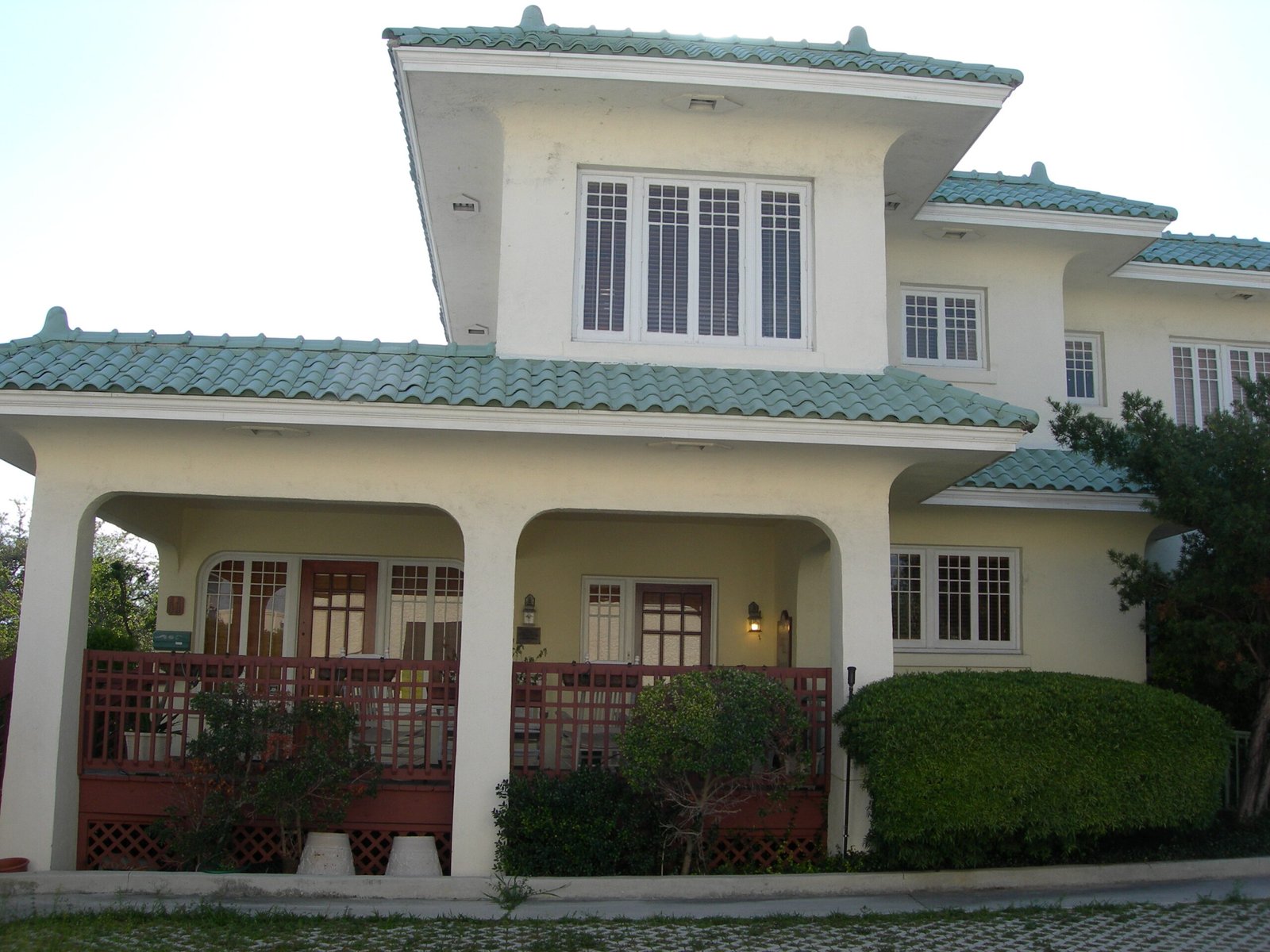
A lumberman’s showplace from the Florida land boom, later saved from demolition by a slow journey across town rather than a wrecking ball.
At a glance
Built around 1925 for lumber merchant Sam Gilliam, this two-story stucco house blends Mediterranean Revival massing with Prairie School restraint. Listed on the National Register of Historic Places in 2001, it now stands at 11 Southwest 15th Street, near the historic Croissant Park Administration Building. Its 3,900 square feet moved intact in 1998, a rare survival story for a boom-era Broward County residence.
History
Sam Gilliam commissioned the house in 1924, at the height of the Florida land boom. He had arrived in Fort Lauderdale in 1913 to manage a Palm Beach lumber company, then founded his own Everglades Lumber Company the following year. The house originally stood at 300 SE 9th Street, a corner lot fitting for a man of Gilliam’s civic standing. It served as a stage for entertaining. By 1998 the original site was slated for redevelopment. Rather than lose the house, its owners offered it free to anyone able to relocate it. The current owners took up that offer, moving the structure across Fort Lauderdale in July 1998 to its present address, where it earned National Register listing in 2001.
What you see
The exterior favors form over ornament. Hollow clay tile walls are covered in stucco, kept plain so that window placement and roofline carry the visual interest. A flat roof hides behind parapets, themselves concealed by pent roofs clad in green barrel tiles. Those pent roofs create deep overhanging eaves, a detail borrowed from the Prairie School vocabulary as much as Mediterranean precedent. Loaf-shaped tile finials mark the roof ridge junctions, a small but distinctive flourish. Inside, the mood shifts entirely toward craftsmanship. Tiger oak floors run beneath inlaid doors and red oak mantles. Wide baseboards and French doors complete rooms built to impress.
Cultural significance
The house documents both an architectural moment and a political one. Gilliam was a rare Republican force in overwhelmingly Democratic Broward County. He served as a delegate to several Republican National Conventions and reportedly arranged a golf outing for president-elect Warren G. Harding. Guests at his parties are said to have included presidents, Herbert Hoover among the possibilities. The house’s design, meant to signal prosperity and taste during the land boom, still communicates that ambition today. Its 1998 relocation adds a second layer of significance, preservation achieved through community initiative rather than institutional funding.
Key facts
- Location: 11 Southwest 15th Street, Fort Lauderdale, Florida
- Built: c. 1925, commissioned 1924, for Sam Gilliam
- Style: Mediterranean Revival and Prairie School elements; also associated with Mission Revival architecture
- Size: approximately 3,900 square feet
- Relocated: moved from 300 SE 9th Street in July 1998
- Heritage status: listed on the National Register of Historic Places, March 29, 2001
Practical information & getting there
The Sam Gilliam House sits in a residential pocket of Fort Lauderdale, adjacent to the historic Croissant Park Administration Building. It functions as a private residence, so approach it as you would any neighborhood street, viewing the exterior respectfully from the sidewalk. No visitor facilities or set hours apply. Fort Lauderdale’s downtown and its other historic sites lie a short drive away, making the house an easy stop if you are already exploring Broward County’s early twentieth-century architecture.
Sources & resources
Find it on the map
See this place and what’s around it →📷 Become a Cultural Heritage Online photographer
Share your photos of places: they stay published under your name as the author. The more they're seen, the more you get noticed — and soon a contest will reward the most appreciated photos.
Log in or sign up free to add a photoIs this page about you?
This page is read by travellers and heritage enthusiasts who find it on Google. Tell us how you are connected to this place and we will take it from there.