
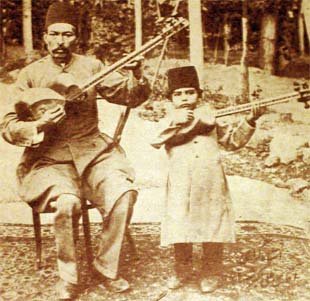
A vast oral repertoire of melodic figures preserved across generations, forming the foundation of Persian classical music.
At a glance
Radif—meaning “order” in Persian—is a collection of old melodies organized into different tonal spaces called dastgāhs. Each dastgāh contains 10 to 30 melodic units called goushehs, distinguished by their note intervals and movement patterns. Rather than a fixed score, the radif exists as living memory: masters internalize it completely through years of repetition, then pass it to students ear-to-ear. Every generation’s interpretation shapes the tradition, sometimes adding new melodies that bear the master’s name.
Origins & history
The two oldest and most widely studied radifs—those of Mirza Hossein-Qoli and Mirza Abdollah—remain in active use by students of Persian music today. These collections preserve melodies from centuries past. Mirza Abdollah’s radif was first published in staff notation in the 1970s by Jean During, working from recordings made by Nour Ali Boroumand; Mirza Hossein-Qoli’s was notated by Dariush Pirniakan in 2001. Yet notation captures only the skeleton: the radif’s true life moves through oral transmission, where each master’s interpretation naturally inflects and evolves the melodic line.
The practice
A radif student sits with a master and listens, repeating phrases until they take root in muscle and memory. The melodic contours follow the rhythms of Persian poetry—symmetric, asymmetric (called lang), or free form—giving the music language-like fluidity. On the tar (a plucked string instrument), the radif can encompass 20 to 40 goushehs per dastgāh. Each gousheh pivots on a central note called the shahed; when the shahed shifts, a new sonic space opens. The vocal radif mirrors these structures melodically, though with different rhythmic properties. Master tar players like Ostad Ali-Akbar Shahnazi—son of Mirza Hossien Gholi—have recorded their performances by heart, creating touchstones for students seeking to minimize drift while honoring interpretation.
Cultural significance
The radif stands as the bedrock of Persian classical music, what oral transmission preserves when notation does not yet exist. Its survival depends entirely on the memory and dedication of each master and the willingness of students to spend years absorbing its essence. Mutations naturally arise through oral transfer—not as failure, but as the living signature of a continuous tradition. Without the radif, Persian music would have no foundation; with it, the tradition remains rooted and infinite.
Key facts
- Country: Iran
- Anchor community: Tehran
- UNESCO Intangible Cultural Heritage: 2009 (reference 00279)
- Core repertoires: Mirza Hossein-Qoli and Mirza Abdollah radifs, still in use
- Primary instrument: Tar
- Learning method: Oral tradition; many years of memorization required
- Structure: Multiple dastgāhs; each contains 10–30 goushehs
Where to experience it
Tehran remains the heartland of radif study and performance. Master musicians teach students in private settings and through music conservatories, maintaining the oral transmission that has defined this practice for generations. To engage with radif, seek out performances by accomplished tar players or vocal artists steeped in the tradition.
Sources & resources
- https://en.wikipedia.org/wiki/Radif_(music)
- https://ich.unesco.org/en/RL/radif-of-iranian-music-00279
- https://culturalheritageonline.com
Find it on the map
See this place and what’s around it →📷 Become a Cultural Heritage Online photographer
Share your photos of places: they stay published under your name as the author. The more they're seen, the more you get noticed — and soon a contest will reward the most appreciated photos.
Log in or sign up free to add a photo