
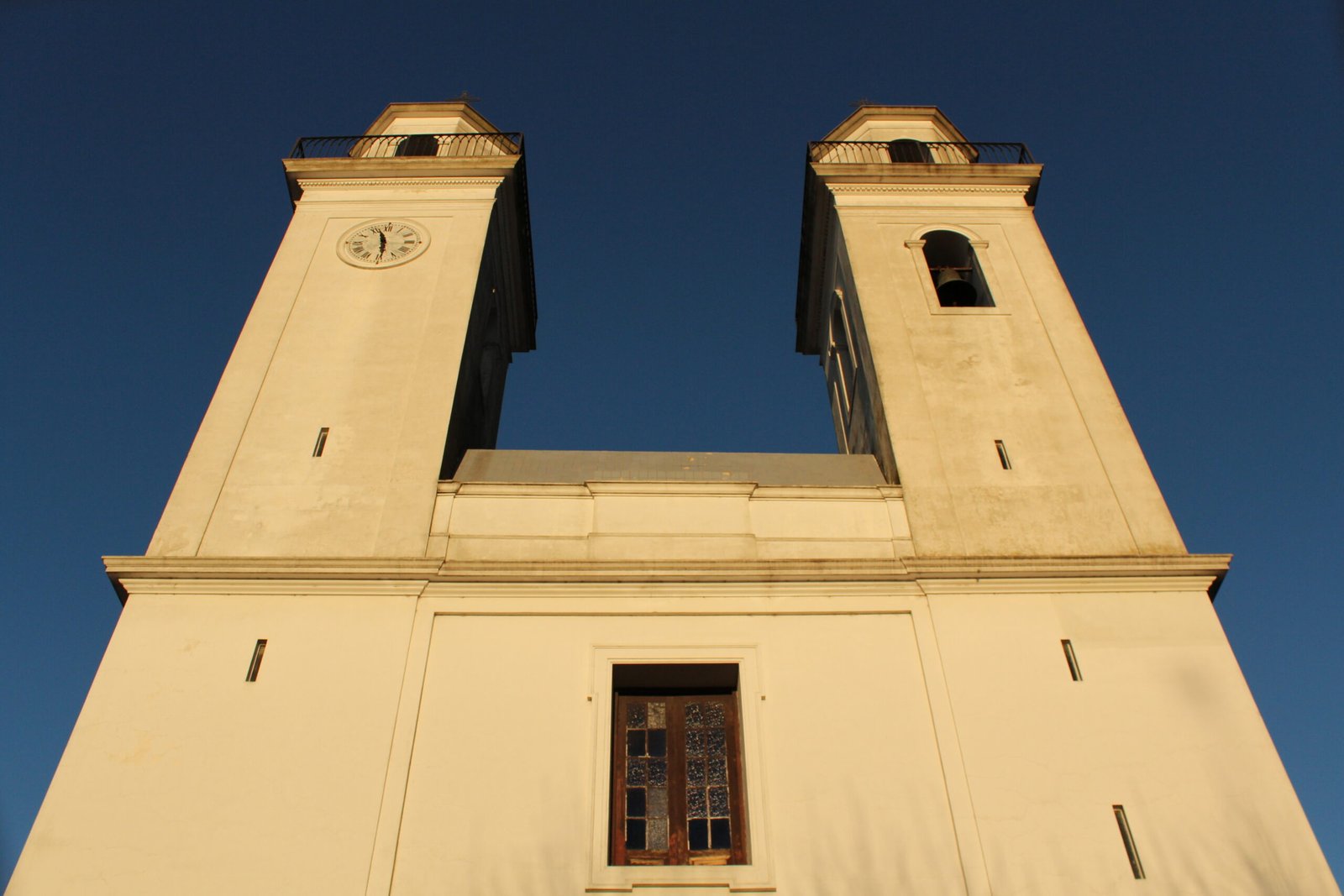
La Basílica del Santísimo Sacramento, la Iglesia Matriz, è nata con la città. Colonia fu fondata dai portoghesi nel 1680 come Nova Colônia do Santíssimo Sacramento, e il 2 febbraio di quell’anno vi si eresse una prima chiesa di paglia e fango; nel 1699 fu ricostruita in pietra e calce. Per questo è spesso considerata la chiesa più antica dell’Uruguay — ma il primato va inteso con cautela: nessuna fonte ufficiale lo afferma senza riserve, e la fabbrica che si vede oggi è in realtà ottocentesca, eretta tra il 1808 e il 1810 su progetto dell’architetto Tomás Toribio, riutilizzando parte della struttura preesistente. La sua storia porta la cicatrice di un disastro insolito: nel 1823, durante la dominazione cisplatina, un fulmine colpì il deposito di polvere da sparo che i portoghesi avevano ricavato sotto la sacrestia, e l’esplosione rase al suolo la sacrestia e distrusse l’altare maggiore. Charles Darwin, di passaggio con il Beagle, annotò la chiesa come «una curiosa rovina», ricordando che l’esplosione ne aveva sventrato due terzi. Fu poi ricostruita tra il 1836 e il 1841. Oggi è sede parrocchiale e basilica minore, di stile coloniale — navata unica coperta da una volta a botte, due campanili gemelli bianchi, uno con l’orologio e uno con la campana — nel cuore del Barrio Histórico, accanto alla Plaza de Armas. Non è iscritta singolarmente all’UNESCO: è uno dei monumenti del Quartiere storico di Colonia del Sacramento, iscritto nel 1995 con il criterio (iv) per la riuscita fusione di stili portoghese, spagnolo e postcoloniale.
About the Basilica
The Basilica of the Holy Sacrament, the Iglesia Matriz of Colonia del Sacramento, was founded with the Portuguese city in 1680 — a first church of straw and mud, rebuilt in stone in 1699. Often called the oldest church in Uruguay, though the present building dates from 1808–1810 (architect Tomás Toribio), it was wrecked in 1823 when lightning struck a powder store beneath the sacristy, and rebuilt in 1836–1841. A colonial church of a single barrel-vaulted nave and twin white bell towers, it stands beside the Plaza de Armas in the cobbled Barrio Histórico, within the Historic Quarter of Colonia del Sacramento, a UNESCO World Heritage Site since 1995.
Key facts
- 1680: the Portuguese found Colonia and raise a first church of straw and mud
- 1699: rebuilt in stone and lime by order of Governor Sebastián de Veiga Cabral
- 1808–1810: the present building erected to the plans of architect Tomás Toribio
- 1823: lightning ignites a powder magazine under the sacristy; the explosion destroys the sacristy and high altar
- 1836–1841: the church rebuilt after the disaster
- 1995: the Historic Quarter of Colonia del Sacramento inscribed by UNESCO, criterion (iv)
History
Colonia del Sacramento was a Portuguese outpost on the Río de la Plata, founded in 1680 and fought over with Spain for a century, and its Iglesia Matriz shares that turbulent life. A first church of straw and mud went up in 1680; it was rebuilt in stone in 1699, and again and again as sieges and time took their toll. The building standing today was raised between 1808 and 1810 to the design of Tomás Toribio, the leading late-colonial architect of the Río de la Plata, reusing much of the older fabric. It is often called the oldest church in Uruguay — a claim best kept in its place, since the fabric is 19th-century.
Its strangest chapter came in 1823. During the Cisplatine occupation, the Portuguese had turned the space beneath the sacristy into a powder magazine; a lightning strike set it off, and the explosion levelled the sacristy and the high altar. Passing through on the voyage of the Beagle, Charles Darwin noted the church as “a curious ruin”, its greater part blown to the foundations by “the united powers of electricity and gunpowder”. It was rebuilt between 1836 and 1841, and today serves again as parish church and minor basilica.
What you see
A sober colonial church, whitewashed, with two symmetrical bell towers rising over the Barrio Histórico — one carrying the clock, the other the bell, each topped by a balustraded belfry. Inside, a single nave runs under a barrel vault on round arches, its walls the Portuguese stone-and-brick masonry of the old town. The church sits just off the Plaza de Armas (Plaza Manuel Lobo), a few steps from the Plaza Mayor and the 1857 lighthouse, in the tangle of cobbled streets that runs down to the Río de la Plata.
Practical information
- Opening hours: open for worship, with regular Mass especially at weekends — check current times before visiting
- Location: Calle Vasconcellos, beside the Plaza de Armas, Barrio Histórico, Colonia del Sacramento, Uruguay
- Status: active Catholic parish church and minor basilica (Diocese of Mercedes)
Getting there
The basilica is in the middle of the walled Barrio Histórico, a short walk from every corner of the old town; Colonia is an hour by ferry across the Río de la Plata from Buenos Aires. GPS: 34.4711°S, 57.8507°W.
Nearby
- Historic Quarter of Colonia del Sacramento — the UNESCO-listed Portuguese colonial old town of cobbled streets and city walls
- Plaza Mayor 25 de Mayo and the Faro — the main square and the 1857 lighthouse, by the ruins of the San Francisco convent
- Calle de los Suspiros — the famous cobbled “Street of Sighs” nearby
Sources
- Conferencia Episcopal del Uruguay — official record: the church of the Holy Sacrament, parish seat and minor basilica, built 1808–1810
- UNESCO World Heritage Centre — “Historic Quarter of the City of Colonia del Sacramento” (ref. 747)
- Charles Darwin, Voyage of the Beagle — eyewitness note on the ruined church
- Colonia tourism records (coloniauy.com, infoturismo19) — cross-checked
- Wikipedia (English and Spanish) — “Basílica del Santísimo Sacramento”, used as a map and cross-checked
Find it on the map
See this place and what’s around it →📷 Become a Cultural Heritage Online photographer
Share your photos of places: they stay published under your name as the author. The more they're seen, the more you get noticed — and soon a contest will reward the most appreciated photos.
Log in or sign up free to add a photo