
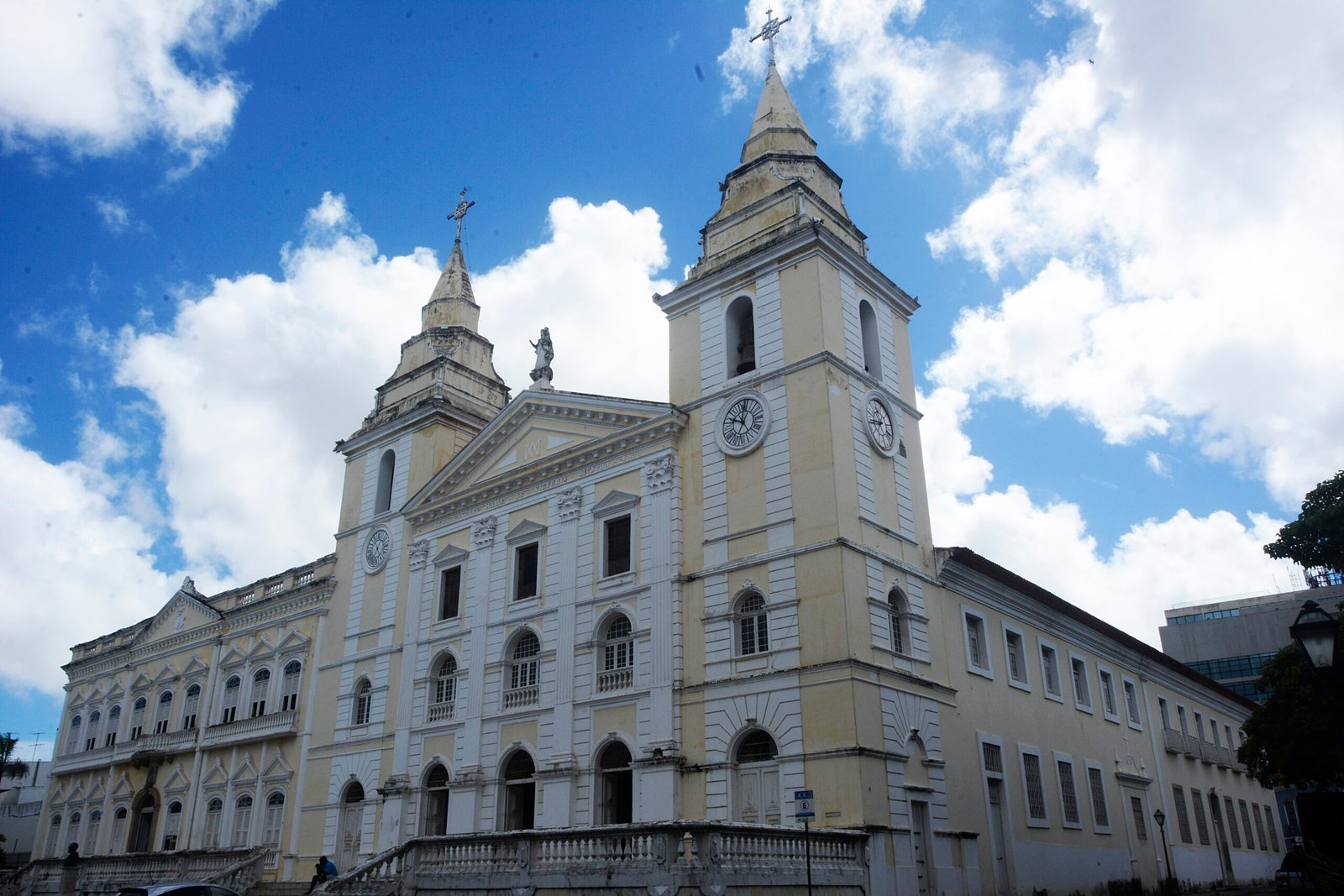
The Cathedral of Our Lady of Victory — the Catedral da Sé of São Luís — was not born a cathedral, nor under that name. It is the former Jesuit church of Our Lady of Light: licensed in 1687, founded in 1690, opened on 30 July 1699. The design was by the Luxembourgish Jesuit Padre João Filipe Bettendorf, who wrote that he had conceived it after Vitruvius, in imitation of Our Lady of Loreto in Lisbon. It became a cathedral in 1761, after the Jesuits were expelled from Brazil. The old parish church that served as the bishop’s seat — built from 1619 and opened in 1622 — was by then a ruin, and it was pulled down. The Jesuit church inherited its title and its dedication to Our Lady of Victory, patron of the city in memory of the Portuguese victory over the French at the battle of Guaxenduba in 1614. The neoclassical and neo-baroque facade seen today is not the Jesuit one: it is the work of the 1922 remodelling, which added the second tower, the colossal pilasters, the triangular pediment and the statue of Our Lady of Victory that crowns it. The treasure, however, is inside, and it is authentic. The high altar is in talha dourada, gilded woodcarving with two orders of solomonic columns, made by the carver Manuel Manços to Bettendorf’s design around 1693. According to the scholarly record of the HPIP, it is the first complete retable in Brazil. Its original gold, later covered over in white and blue, was recovered in the restoration of 1993-96. The cathedral stands on the Praça Dom Pedro II, in the heart of the Historic Centre of São Luís — the city of azulejo-tiled facades, which UNESCO inscribed in 1997 under criteria (iii), (iv) and (v), precisely for its Portuguese colonial ensemble, adapted to the equatorial climate with its tiles.
About the Cathedral
The Cathedral of Our Lady of Victory in São Luís is the former Jesuit church of Nossa Senhora da Luz, inaugurated in 1699 to the design of the Jesuit Padre João Filipe Bettendorf. It became the city’s cathedral in 1761, after the Jesuits were expelled and the old parish cathedral was demolished, inheriting the dedication to Our Lady of Victory. Its neoclassical twin-towered facade is a 1922 remodelling, but inside is the original gilded high altar carved by Manuel Manços around 1693. The cathedral stands within the Historic Centre of São Luís, famous for its azulejo-tiled facades and a UNESCO World Heritage Site since 1997.
Key facts
- 1690–1699: the Jesuit church of Nossa Senhora da Luz built, to Padre Bettendorf’s design; inaugurated 30 July 1699.
- c. 1693: the gilded high altar carved by Manuel Manços — described as the first integral gilded retable in Brazil.
- 1761: becomes the cathedral after the Jesuits’ expulsion, inheriting the dedication to Our Lady of Victory.
- 1922: the neoclassical facade and second tower added in a major remodelling.
- 1993–1996: restoration recovers the altar’s original gold, long hidden under blue-and-white paint.
- 1997: Historic Centre of São Luís inscribed by UNESCO, criteria (iii)(iv)(v).
History
São Luís has had two cathedrals, and it is easy to confuse them. The first, a parish church begun in 1619 and inaugurated in 1622, served the diocese created in 1677 and was demolished around 1763. The building that carries the title today is a different church entirely — the Jesuit church of Nossa Senhora da Luz, built between 1690 and 1699 to the design of Padre João Filipe Bettendorf, who modelled it, he wrote, on Vitruvius and on Our Lady of Loreto in Lisbon. When the Jesuits were expelled from Brazil, their church became the cathedral in 1761 and took on the dedication to Our Lady of Victory, patroness of the city since the Portuguese defeated the French at Guaxenduba in 1614.
What survives of the Jesuit church is inside. The gilded high altar — two orders of twisted columns wrapped in carved, gilded foliage — was made by the carver Manuel Manços around 1693, after Bettendorf’s drawing, and is described by heritage scholars as the first integral gilded retable in Brazil. Its original gold, long buried under later blue-and-white paint, was recovered in the restoration of 1993–96. The exterior tells a later story: the neoclassical facade, the second tower and the crowning statue of Our Lady all date from the remodelling of 1922.
What you see
A cream-and-white neoclassical front on the Praça Dom Pedro II: a triangular pediment topped by a statue of Our Lady of Victory, colossal pilasters, twin bell towers with pyramidal spires and clocks — the second tower a 1922 addition to the single Jesuit one. Step inside for the real survival: the single Baroque nave and the gilded high altar of Manuel Manços, the whole back wall a field of golden carving. Around the cathedral spreads the historic centre for which São Luís is famous — a Portuguese colonial townscape of houses faced in blue-and-white azulejos, the tiles set as protection against the equatorial climate.
Practical information
- Opening hours: open to visitors most days outside services; check current times before visiting.
- Location: Praça Dom Pedro II, Centro Histórico, São Luís, Maranhão, Brazil.
- Status: active cathedral, seat of the Archdiocese of São Luís do Maranhão.
Getting there
The cathedral fronts the Praça Dom Pedro II, beside the Palace of the Lions (state government), at the top of the historic centre near the Praia Grande; the tiled colonial streets fall away toward the waterfront. GPS: 2.5281°S, 44.3043°W.
Nearby
- Historic Centre of São Luís — the UNESCO-listed colonial town with the great ensemble of azulejo-tiled facades in Brazil.
- Palácio dos Leões — the state government palace on the same square, over the old fort.
- Praia Grande — the restored merchant quarter of tiled sobrados below the cathedral.
Sources
- HPIP — Património de Influência Portuguesa (Fundação Calouste Gulbenkian), scholarly record.
- Arquidiocese de São Luís do Maranhão — official cathedral history.
- IPHAN / iPatrimônio — national heritage record.
- UNESCO World Heritage Centre — “Historic Centre of São Luís” (ref. 821).
- Wikipedia (English and Portuguese) and Britannica — “Catedral de São Luís do Maranhão”, used as a map and cross-checked.
Find it on the map
See this place and what’s around it →📷 Become a Cultural Heritage Online photographer
Share your photos of places: they stay published under your name as the author. The more they're seen, the more you get noticed — and soon a contest will reward the most appreciated photos.
Log in or sign up free to add a photo