
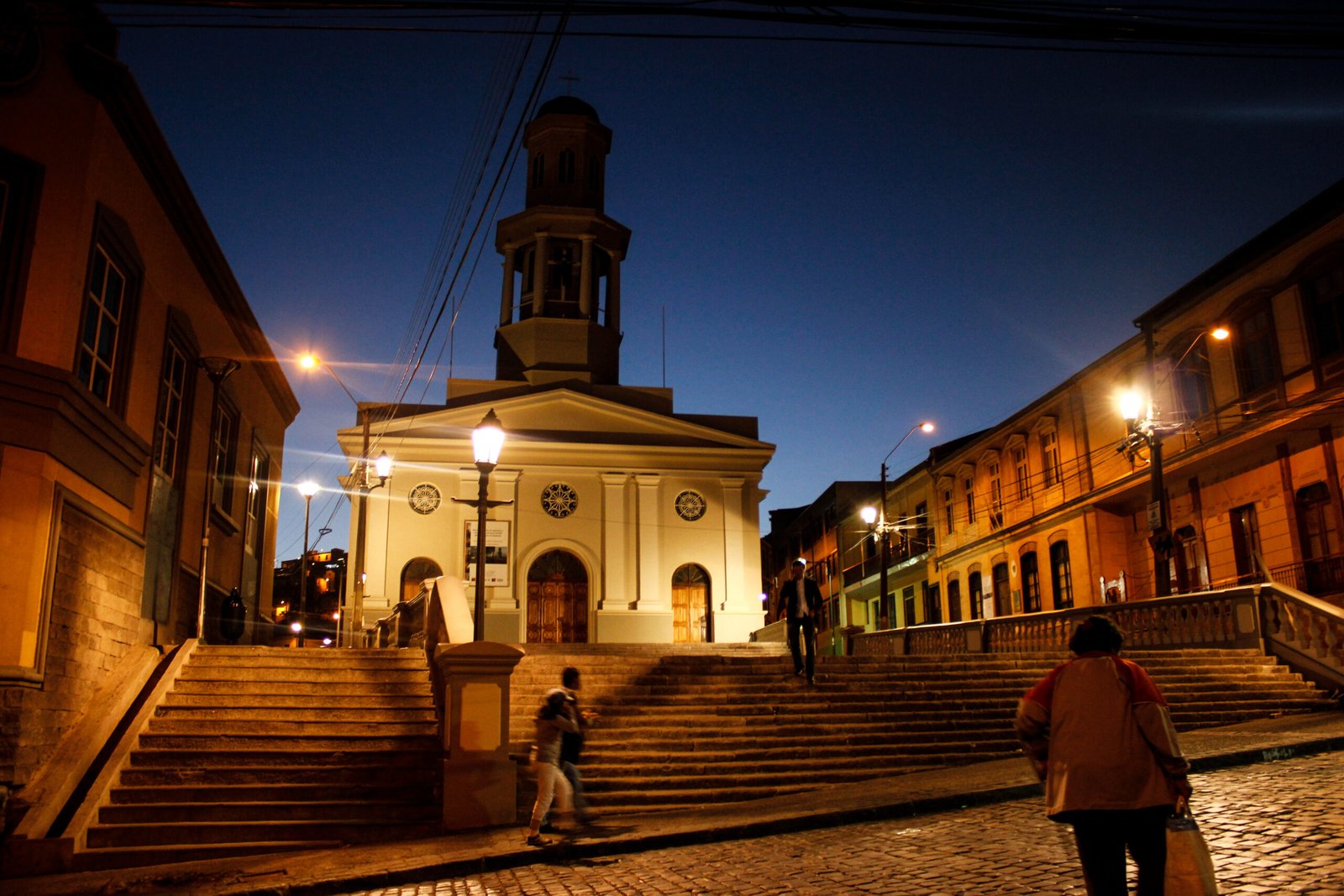
The Iglesia Matriz del Salvador, La Matriz, stands at the foot of Cerro Santo Domingo, in the Barrio Puerto, where Valparaíso began. The first chapel, of straw and mud, was raised in 1559 by Bishop Rodrigo González de Marmolejo. The building seen today, however, is the fourth on the same site, and the point deserves precision: the church is as old as the city in its foundation, but the present fabric dates from 1837-1842, opened in 1842 under the parish priest José Antonio Riobó. Between the first chapel and this one came fires, corsair raids and earthquakes: the one of 1730 destroyed the second church, the one of 1822 damaged the third. It is dedicated to the Salvador del Mundo, chosen in 1868 as patron of the city and of the port. The style combines neoclassicism with the creole architecture of the period: a plan of three naves, thick adobe walls, and an octagonal wooden tower in two stages rising above the triangular pediment. Inside is venerated the Cristo de la Matriz, a crucifix whose origin is wrapped in traditions that contradict one another: some call it a gift of Philip II, some of the corsair Francis Drake, some the work of a Japanese sculptor. It is reported here, precisely, as legend, and it is not to be confused with the Cristo de Mayo, a different image kept in Santiago. Declared a historic monument in 1971, La Matriz is the heart of the Barrio Puerto: on the UNESCO World Heritage List, which since 2003 protects the Historic Quarter of the Seaport City of Valparaíso under criterion (iii), «the church of La Matriz and the Plazuela Santo Domingo» form the first of the five inscribed sectors, the point where the city first grew.
About the Church
The Iglesia Matriz del Salvador, known as La Matriz, stands at the foot of Cerro Santo Domingo in Valparaíso’s Barrio Puerto, on the spot where the port city began. The first chapel here dates to 1559; the present building is the fourth on the site, rebuilt in 1837–1842 after fires, corsair raids and earthquakes. Neoclassical mixed with local colonial building, with three naves and an octagonal wooden tower, it holds the venerated Cristo de la Matriz crucifix. A national monument since 1971, it forms the origin nucleus of the Historic Quarter of the Seaport City of Valparaíso, a UNESCO World Heritage Site since 2003.
Key facts
- 1559: the first chapel of straw and mud raised by Bishop Rodrigo González de Marmolejo — the origin of Valparaíso.
- 1730 & 1822: earthquakes destroy earlier churches on the site.
- 1837–1842: the present, fourth building rebuilt under the priest José Antonio Riobó.
- 1868: the Saviour (El Salvador) chosen as patron of the city and port.
- 1971: declared a National Historic Monument of Chile.
- 2003: the Historic Quarter of Valparaíso inscribed by UNESCO, criterion (iii); La Matriz and Santo Domingo Square form one of its five sectors.
History
Valparaíso grew up around this church. The first chapel — little more than a hut of straw and mud — was raised in 1559 by the first Bishop of Santiago, and it has been rebuilt over and over on the same ground: destroyed and damaged by pirate attacks and by the earthquakes of 1730 and 1822, until the present, fourth church was built between 1837 and 1842 and inaugurated in 1842. It is dedicated to the Saviour, chosen in 1868 as patron of the city and port. What can be said with certainty is that La Matriz marks the origin of the city; the standing building, though, is 19th-century, not colonial.
Inside is the Cristo de la Matriz, a crucified Christ around which tradition has woven several incompatible stories — a gift of Philip II, or of the corsair Francis Drake, carved by a Japanese sculptor, halted at La Matriz by oxen that would go no further. These belong to legend, not documented history, and the image should not be confused with the Cristo de Mayo, a different crucifix in Santiago. Declared a national monument in 1971, La Matriz anchors the Barrio Puerto, the lower, flat part of the city where Valparaíso first took shape.
What you see
A white neoclassical facade of sober lines — three doors under three round oculi and a triangular pediment — crowned by a single octagonal wooden bell tower in two stages, rising over the tiled rooftops. Its plazuela, the Plaza Santo Domingo, serves as the church’s atrium, boxed in by the narrow streets of the Barrio Puerto with the coloured houses of Cerro Santo Domingo climbing behind. Inside, three naves lead to the venerated Cristo de la Matriz.
Practical information
- Opening hours: open for worship, with regular Mass — check current times before visiting.
- Location: Plazuela Santo Domingo, Barrio Puerto, at the foot of Cerro Santo Domingo, Valparaíso, Chile.
- Status: active Catholic parish church (Parroquia La Matriz).
Getting there
La Matriz sits in the lower Barrio Puerto, a short walk from Plaza Sotomayor and the port; Valparaíso is about 120 km northwest of Santiago. GPS: 33.0364°S, 71.6319°W.
Nearby
- Historic Quarter of Valparaíso — the UNESCO-listed seaport city of hills, funiculars and painted houses.
- Barrio Puerto and Plaza Sotomayor — the old port district around the church.
- Cerro Santo Domingo — the hill rising directly behind La Matriz.
Sources
- Consejo de Monumentos Nacionales (Chile) — official monument record for Iglesia La Matriz.
- Servicio Nacional del Patrimonio Cultural — UNESCO site record for the Historic Quarter of Valparaíso.
- UNESCO World Heritage Centre — “Historic Quarter of the Seaport City of Valparaíso” (ref. 959).
- Parroquia La Matriz — parish history.
- Wikipedia (English and Spanish) — “Iglesia de la Matriz”, used as a map and cross-checked.
Find it on the map
See this place and what’s around it →📷 Become a Cultural Heritage Online photographer
Share your photos of places: they stay published under your name as the author. The more they're seen, the more you get noticed — and soon a contest will reward the most appreciated photos.
Log in or sign up free to add a photo