
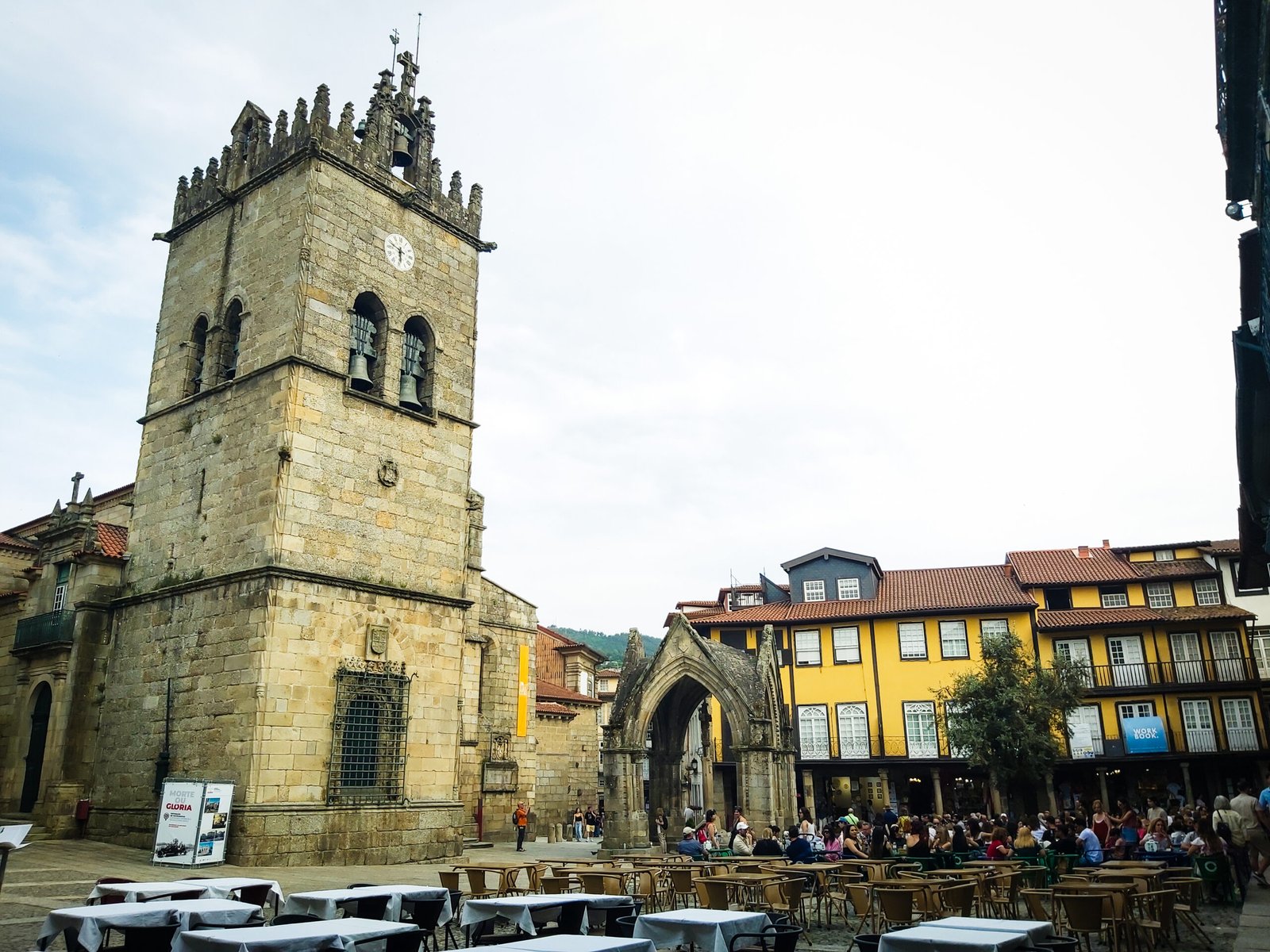
La Insigne e Real Colegiada de Nossa Senhora da Oliveira, la Chiesa di Nostra Signora dell’Olivo, sorge sul Largo da Oliveira, nel cuore di Guimarães — la città comunemente chiamata la culla del Portogallo, patria di Afonso Henriques, primo re. Le sue origini risalgono al monastero fondato dalla contessa Mumadona Dias attorno al 949-950. La chiesa che si vede oggi nasce da un voto: nel 1387 Giovanni I ne finanziò la ricostruzione gotica per sciogliere la promessa fatta a Santa Maria prima della battaglia di Aljubarrota, del 1385; i lavori furono sostanzialmente compiuti entro il 1401 e cessarono nel 1413. La torre manuelina fu completata attorno al 1513-1515. Il nome dell’olivo è legato a una tradizione, e come tale va detta: la leggenda del re visigoto Wamba, che avrebbe accettato la corona solo quando il bastone secco piantato in terra fosse rinverdito — e rinverdì in olivo; e, distinta da questa, la tradizione del 1342, quando accanto a un olivo secco davanti alla chiesa fu posta una croce e l’albero rinverdì, episodio da cui si fa derivare l’invocazione a Nostra Signora dell’Olivo. Davanti alla facciata, sul Largo, sta il Padrão do Salado: un baldacchino gotico in pietra eretto sotto Alfonso IV a commemorare la battaglia del Río Salado del 1340; la croce che ripara è datata 1342, dono del mercante di Guimarães Pedro Esteves. Il chiostro della collegiata ospita dal 1928 il Museo di Alberto Sampaio, con i suoi tesori dell’arte medievale portoghese. La chiesa non è iscritta singolarmente all’UNESCO: è il fulcro del Centro storico di Guimarães, iscritto nel 2001 con i criteri (ii), (iii) e (iv) — il luogo, come recita l’inquadramento UNESCO, legato alla formazione dell’identità e della lingua portoghese nel XII secolo.
About the Church
The Church of Our Lady of the Olive Tree, the collegiate church of Guimarães, stands on the Largo da Oliveira at the heart of the town called the birthplace of Portugal. Its origins go back to a 10th-century monastery founded by Countess Mumadona Dias; the present Gothic church was financed by King João I in 1387 as a vow after the Battle of Aljubarrota, and gained its Manueline tower around 1515. In the square before it stands the Padrão do Salado, a Gothic stone canopy commemorating the 1340 battle. Its cloister holds the Museu de Alberto Sampaio. The church anchors the Historic Centre of Guimarães, a UNESCO World Heritage Site since 2001.
Key facts
- c. 949–950: a monastery founded on the site by Countess Mumadona Dias
- 1387–1413: Gothic rebuild financed by King João I, in fulfilment of a vow made before the Battle of Aljubarrota (1385)
- 1340 / 1342: the Padrão do Salado canopy commemorates the Battle of the Salado; its cross is dated 1342
- c. 1513–1515: the Manueline bell tower completed
- 1910: classified a National Monument; the cloister became the Museu de Alberto Sampaio in 1928
- 2001: Historic Centre of Guimarães inscribed by UNESCO, criteria (ii)(iii)(iv)
History
Guimarães is where Portugal began — the town of Afonso Henriques, its first king — and its collegiate church grew with the country. It rose from a monastery founded around 949 by Countess Mumadona Dias; the Gothic church that stands today was a royal act of thanks, financed by João I from 1387 as the vow he had made to the Virgin before defeating Castile at Aljubarrota in 1385. The work was largely done by 1401, and the Manueline tower crowned it around 1515.
The church’s dedication comes from an olive tree, and the story is told as tradition. One strand is the legend of the Visigothic king Wamba, whose dry staff, thrust into the ground, is said to have flowered into an olive; another is the episode of 1342, when a cross was set beside a withered olive on the square and the tree revived — the origin, tradition holds, of the invocation of Our Lady of the Olive Tree. Fact, not legend, is the Padrão do Salado before the facade: a Gothic canopy raised in the reign of Afonso IV for the 1340 Battle of the Salado, sheltering a cross of 1342 given by a Guimarães merchant.
What you see
A Gothic church of grey granite with a crenellated bell tower — corner pinnacles, a clock, twin arched bell openings and a cross finial — facing the Largo da Oliveira. In the square before it, the Padrão do Salado: an open Gothic canopy of four broken arches on carved columns, under a granite vault, sheltering its stone cross. The collegiate cloister alongside, heavily reworked in the Manueline period over a surviving 12th-century quadrant, now houses the Museu de Alberto Sampaio and its medieval treasures. The Largo itself, lined with Guimarães’ yellow-fronted houses, is the reliable way to know you are there.
Practical information
- Opening hours: open regularly outside services; the Padrão do Salado can be seen at any time on the square — check current times before visiting
- Location: Largo da Oliveira, 4800-443 Guimarães, Portugal
- Status: active parish church; the adjoining cloister houses the Museu de Alberto Sampaio
Getting there
The church stands on the Largo da Oliveira in the centre of Guimarães’ medieval old town, a short walk from the castle and the Paço dos Duques; Guimarães is about 50 km from Porto by road or rail. GPS: 41.4429°N, 8.2924°W.
Nearby
- Historic Centre of Guimarães — the UNESCO-listed old town, “the birthplace of Portugal”
- Museu de Alberto Sampaio — the medieval-art museum in the church’s own cloister
- Castle of Guimarães and Paço dos Duques — the 10th-century castle and the ducal palace above the town
Sources
- Câmara Municipal de Guimarães — official records for the church and the Padrão do Salado
- SIPA / DGPC — Portuguese national heritage database (record 5247)
- Museu de Alberto Sampaio — official museum in the collegiate cloister
- UNESCO World Heritage Centre — “Historic Centre of Guimarães” (ref. 1031)
- Wikipedia (English and Portuguese) — “Igreja de Nossa Senhora da Oliveira”, “Padrão do Salado”, used as a map and cross-checked
Find it on the map
See this place and what’s around it →📷 Become a Cultural Heritage Online photographer
Share your photos of places: they stay published under your name as the author. The more they're seen, the more you get noticed — and soon a contest will reward the most appreciated photos.
Log in or sign up free to add a photo