
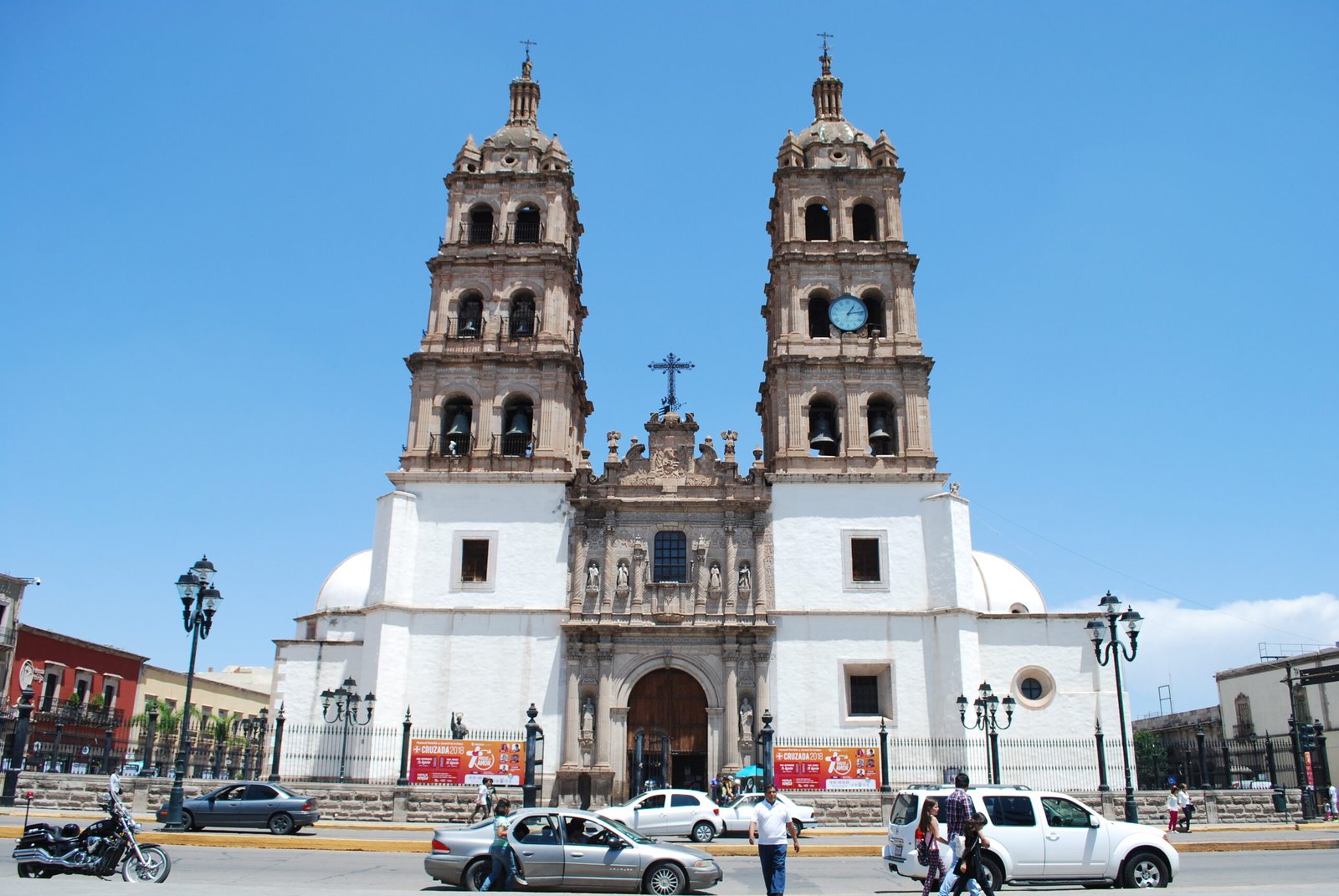
The Cathedral Basilica of the Immaculate Conception presides over the Plaza de Armas of Victoria de Durango, on Avenida 20 de Noviembre. Its building history is a succession of fresh starts. A first parish church of the Assumption dates from 1563, the first year of Governor Francisco de Ibarra. Then came its destruction: by a fire on the eve of Corpus Christi in 1634, according to the prevailing account of the diocese and the civic portal, or by a collapse as early as 1620 according to the INAH catalogue, a divergence recorded here without resolving it. A second building of 1635 was ruined by damp and demolished. Finally the present fabric took shape from about 1695 under Mateo Núñez, whom the sources name in agreement, though with a cautious «hacia», and it never knew a single finishing line: partly completed in 1713, its baroque façades finished between 1760 and 1765 according to INAH, and formally declared complete in its furnishings only in 1844. The official entry of the Sistema de Información Cultural reads «three phases of Novohispanic baroque» in its portals: Solomonic columns and, on the side façades, a plant decoration that, as México Desconocido puts it, «spills over the whole cantera». An episcopal seat since the erection of the diocese of Nueva Vizcaya, decreed by Paul V on 11 October 1620 at the request of Philip III, and an archdiocese since 1891, the church is a minor basilica: the GCatholic register dates the decree to 8 February 1957, a date reported here with its source, as it is not confirmed by official Mexican acts. The interior, three naves flanked by rows of side chapels, preserves the early eighteenth-century choir stalls in carved, estofado and polychrome mahogany, with 25 upper and 18 lower seats; an underground crypt for the burial of bishops and canons, documented by the regional press; and the Galería Episcopal, a museum of sacred art that the official sources of the diocesan network say holds over 500 pieces of the 17th-18th centuries in eight rooms. The historic centre of Durango, 142 blocks declared a monuments zone in 1982 and for UNESCO «the largest concentration of historic monuments in northern Mexico», a judgement that refers to the centre and not to the cathedral alone, has been a component of the UNESCO serial site Camino Real de Tierra Adentro since 1 August 2010. The cathedral is its monumental focus, without being a component in its own right. There remains the legend, and it should be told as such: that of the nun Beatriz who, at the time of the French intervention, climbed the tower every night to wait for a soldier who never returned. The city chronicler tells it, the archdiocese has no trace of her, and the nun-shaped shadow that appears on the tower at night is, as El Universal explains, an effect of the night lighting, best observed from the pedestrian Calle Constitución on full-moon nights.
About the Cathedral
The Cathedral Basilica of the Immaculate Conception presides over the Plaza de Armas of Victoria de Durango, in northern Mexico. The present building took shape from about 1695 under Mateo Núñez, after a 1563 parish church and a damp-ruined 1635 successor; its baroque facades were completed between 1760 and 1765 per INAH, and its portals show three distinct phases of Novohispanic baroque. Seat of a diocese erected in 1620, it anchors the historic centre of Durango, a component of UNESCO’s Camino Real de Tierra Adentro since 2010.
Key facts
- 1563: first parish church of the Assumption, in Francisco de Ibarra’s first year as governor.
- 11 October 1620: Paul V erects the diocese of Nueva Vizcaya at Durango, at the instance of Philip III; archdiocese since 1891.
- 1634: the church burns on the eve of Corpus Christi in the prevailing account (INAH’s catalogue instead records a collapse in 1620).
- c. 1695: the present building begun under Mateo Núñez; partially finished by 1713.
- 1760–1765: the baroque facades completed, per INAH; the interior was declared formally finished only in 1844.
- 1957: minor basilica rank, per GCatholic’s basilica register (8 February).
- 1 August 2010: the historic centre of Durango inscribed as a component of UNESCO’s Camino Real de Tierra Adentro.
History
Durango’s cathedral was rebuilt as often as the silver road it served was travelled. The 1563 parish church of the Assumption was lost — to the Corpus Christi eve fire of 1634 in the account kept by the diocese and the city, to a collapse in 1620 in INAH’s catalogue — and its 1635 replacement fared no better, ruined by damp and demolished. The building that stands today grew from about 1695 under Mateo Núñez and refused a single completion date: partially done in 1713, its facades finished between 1760 and 1765, its interior formally concluded only in 1844. The result is a rare legible record of taste — the official cultural registry reads three phases of Novohispanic baroque in its portals alone.
The city around it grew into what UNESCO calls the largest concentration of historic monuments in northern Mexico, declared a national monuments zone in 1982 and inscribed in 2010 within the Camino Real de Tierra Adentro, the royal inland road that carried silver from these sierras to Mexico City and beyond. And the tower keeps its story: the legend of Beatriz, the nun said to have watched nightly for a French soldier who never returned. The archdiocese has no record she existed; the nun-shaped shadow that appears on the tower at night is, as El Universal explains, an effect of the floodlighting — best seen from Calle Constitución on full-moon nights, which is exactly how legends prefer to be seen.
What you see
A cantera-stone mass whose carved portals track the whole arc of Novohispanic baroque — Solomonic columns on the main front, and lateral facades where the vegetal relief, in México Desconocido’s phrase, spills across the entire stone. The twin towers rise in three arcaded bodies from the building’s last construction phase. Inside are three naves flanked by rows of side chapels, the early-18th-century choir stalls in carved, gilded and polychromed mahogany — 25 upper and 18 lower seats — a crypt of bishops and canons below, and the Galería Episcopal, the cathedral’s eight-room sacred-art museum.
Practical information
- Opening hours: open daily, roughly 8:00–19:00, with regular masses; check locally before visiting.
- Admission: free; the Galería Episcopal museum charges a small fee.
- Location: Av. 20 de Noviembre s/n, Zona Centro, 34000 Victoria de Durango, Mexico — facing the Plaza de Armas.
- Status: active seat of the Metropolitan Archdiocese of Durango.
Getting there
The cathedral fronts the Plaza de Armas in the exact heart of Durango’s historic centre, with the pedestrian Calle Constitución — the classic viewpoint for the tower — running along its side. GPS: 24.0251°N, 104.6703°W.
Nearby
- Historic centre of Durango — 142 blocks of protected monuments, a UNESCO component of the Camino Real de Tierra Adentro.
- Plaza de Armas — the city’s main square, directly in front of the cathedral.
- Teatro Ricardo Castro and Palacio de Gobierno — the civic landmarks a short walk along the centre’s grid.
Sources
- Instituto Nacional de Antropología e Historia (INAH) — Lugares INAH, Durango historic centre and Camino Real records.
- Sistema de Información Cultural (SIC), Secretaría de Cultura de México — official cathedral record.
- Arquidiócesis de Durango and Catedral de Durango — diocesan history and cathedral records.
- UNESCO World Heritage Centre — “Camino Real de Tierra Adentro” (ref. 1351, component: historic centre of Durango).
- GCatholic — basilica register.
- El Universal and El Siglo de Durango — the tower legend (as legend) and the crypt.
- México Desconocido — architectural description, cross-checked; Wikipedia (EN/ES) used as a map.
Find it on the map
See this place and what’s around it →📷 Become a Cultural Heritage Online photographer
Share your photos of places: they stay published under your name as the author. The more they're seen, the more you get noticed — and soon a contest will reward the most appreciated photos.
Log in or sign up free to add a photo