
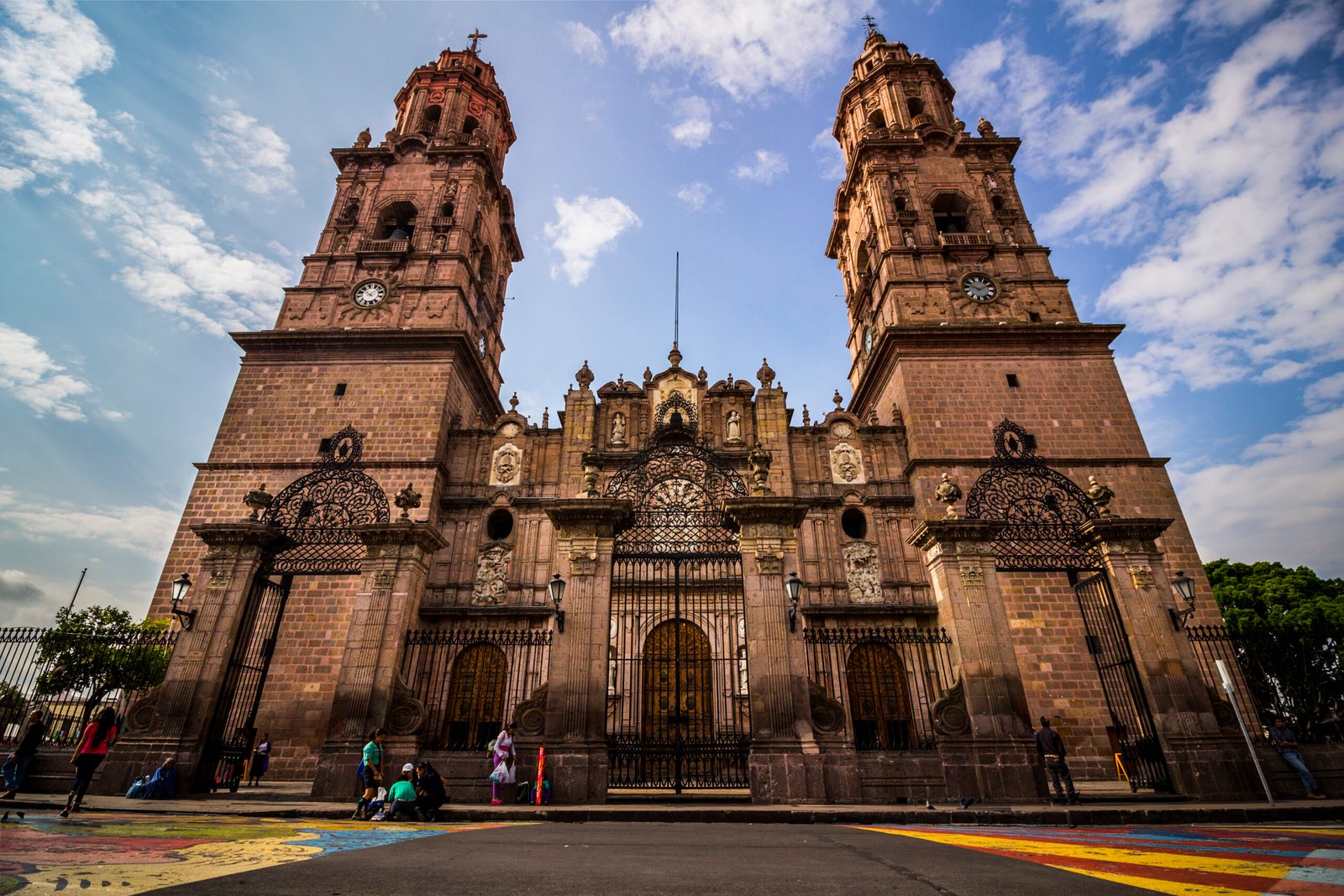
The foundation stone of Morelia Cathedral was laid on 6 August 1660, the feast of the Transfiguration of the Lord, to which the building is dedicated, by Bishop Marcos Ramírez de Prado. Some English-language sources give 6 May instead, but the official entry of the Mexican Sistema de Información Cultural and the coincidence with the titular feast make the August date the reliable one. The building replaced the earlier cathedral of what was then Valladolid, inaugurated in 1580 and later, according to the same official entry, damaged by fire. The design is attributed to the Italian architect Vicencio Barroso de la Escayola, whose name is spelled very differently across the sources, which also write «Vicenzo Barroccio»; he directed the works until his death in 1692. Regional histories record a first opening for worship in 1705, with the building still unfinished. The completion of towers and façades came only in 1744, the date carved on the crowning of the main façade, after 84 years of work. INAH reports that experts consider the building the finest example of «barroco tablereado», the «panelled» Baroque, while the interior, in sober Doric order with neoclassical altarpieces, belongs to a later season. The pink cantera towers reach 66.8 metres, crosses included. On their position in the ranking of Mexico’s tallest the sources do not agree, fourth for some, seventh for others, so here only the height is given. A local tradition, presented as such by the sources, holds that the two crowning crosses, one of iron, one of stone, represent the divine and the human nature of Christ. Inside are kept an eighteenth-century silver manifestador 3.19 metres high, with 29 statuettes and 42 gilded reliefs; the Señor de la Sacristía, a sixteenth-century Christ made of corn-cane paste in the indigenous pre-Hispanic technique; and the neoclassical silver baptismal font in which, as INAH recalls, both José María Morelos and Agustín de Iturbide were baptised, the priest-hero of Mexican independence and its first emperor. The monumental organ «San Gregorio Magno», built by E. F. Walcker & Co. of Ludwigsburg with 4,600 pipes, was inaugurated around 1905, the sources ranging between 1905 and 1907, and according to its own builder was at the time the largest in Latin America, a period claim reported here as such. Since 1966 it has been the heart of the international organ festival «Alfonso Vega Núñez». Every Saturday evening, with the «Encendido de Catedral», the façade goes dark and lights up again progressively amid music and fireworks, a free show documented by the federal culture portal. The cathedral is not individually inscribed on the World Heritage List: it is, however, the keystone monument of the Historic Centre of Morelia, inscribed in 1991 under criteria (ii), (iv) and (vi), whose towers, in the official description, «dominate the city».
About the Cathedral
Morelia Cathedral, dedicated to the Transfiguration of the Lord, rises on Avenida Madero in the heart of Morelia, Michoacán. Built between 1660 and 1744 to a design attributed to the Italian architect Vicencio Barroso de la Escayola, it is regarded by INAH experts as the finest example of “barroco tablereado”, the paneled Baroque of New Spain. Its twin pink cantera towers reach 66.8 metres, and its silver baptismal font served both José María Morelos and Agustín de Iturbide. It anchors the UNESCO-listed Historic Centre of Morelia (1991).
Key facts
- 6 August 1660: first stone laid by Bishop Marcos Ramírez de Prado, on the feast of the Transfiguration, to which the cathedral is dedicated.
- 1692: death of the designer, Italian architect Vicencio Barroso de la Escayola, who had directed the works since the beginning.
- 1705: opened for worship while still unfinished, according to regional histories.
- 1744: towers and facades completed — the date is carved on the crowning of the main facade — after 84 years of construction.
- 66.8 m: height of the twin pink cantera towers, crosses included.
- c. 1905: the monumental Walcker organ “San Gregorio Magno” inaugurated, with 4,600 pipes.
- 1991: the Historic Centre of Morelia inscribed on the UNESCO World Heritage List, criteria (ii), (iv), (vi).
History
Begun in 1660 to replace the earlier cathedral of what was then Valladolid, the building took 84 years to complete. Its Italian designer, Vicencio Barroso de la Escayola, directed the site until his death in 1692; regional histories record a first, unfinished opening for worship in 1705, and the carved date of 1744 on the main facade marks the completion of the towers. Two figures who would define Mexican independence — the priest-general José María Morelos, after whom the city was renamed, and Agustín de Iturbide, its first emperor — were baptized in the cathedral’s silver font, a detail preserved by INAH.
In the early 20th century the cathedral received its monumental German organ, built by E. F. Walcker & Co. of Ludwigsburg with 4,600 pipes — reportedly, in the maker’s own claim at the time, the largest in Latin America. Since 1966 it has anchored the international organ festival “Alfonso Vega Núñez”, one of the oldest of its kind in the Americas.
What you see
A pink cantera colossus in “barroco tablereado” — the paneled Baroque that INAH experts consider best represented here — with twin 66.8-metre towers whose silhouettes carry across the whole valley. The sober Doric interior, refitted with Neoclassical altarpieces, holds an 18th-century silver manifestador 3.19 metres high with 29 statuettes and 42 gilded reliefs, the 16th-century Señor de la Sacristía made of indigenous corn-stalk paste, and the Neoclassical silver baptismal font of Morelos and Iturbide. On Saturday nights the facade goes dark for the “Encendido de Catedral”, then reappears section by section under lights, music and fireworks.
Practical information
- Opening hours: generally open daily (one official-adjacent source indicates 9:00–21:00); check locally before visiting.
- Admission: free; the Saturday-night light show is free and public, starting around 20:45.
- Location: Av. Francisco I. Madero Poniente s/n, Centro Histórico, 58000 Morelia, Michoacán, Mexico.
- Status: active seat of the Archdiocese of Morelia, with regular Catholic worship.
Getting there
The cathedral stands between the Plaza de Armas and Avenida Madero, the main artery of Morelia’s historic centre, within easy walking distance of the aqueduct and the colonial core. GPS: 19.7022°N, 101.1923°W.
Nearby
- Historic Centre of Morelia — the UNESCO-listed ensemble of 249 protected pink-stone monuments around the cathedral.
- Plaza de Armas and Palacio de Gobierno — the civic heart of the city, directly beside the cathedral.
- Morelia Aqueduct — the 18th-century arcade at the eastern end of Avenida Madero.
Sources
- Instituto Nacional de Antropología e Historia (INAH) — “Catedral de Morelia” and Lugares INAH records.
- Sistema de Información Cultural (SIC), Secretaría de Cultura de México — official cathedral record.
- cultura.gob.mx — “Encendido de Catedral” official event page.
- Organization of World Heritage Cities (OVPM) — Morelia city record.
- Ciudades Patrimonio de México — cathedral and Luces de Catedral pages.
- Festival de Órgano de Morelia “Alfonso Vega Núñez” — organ history.
- Wikipedia (English and Spanish) — “Morelia Cathedral” / “Catedral metropolitana de Morelia”, used as a map and cross-checked.
Find it on the map
See this place and what’s around it →📷 Become a Cultural Heritage Online photographer
Share your photos of places: they stay published under your name as the author. The more they're seen, the more you get noticed — and soon a contest will reward the most appreciated photos.
Log in or sign up free to add a photo