
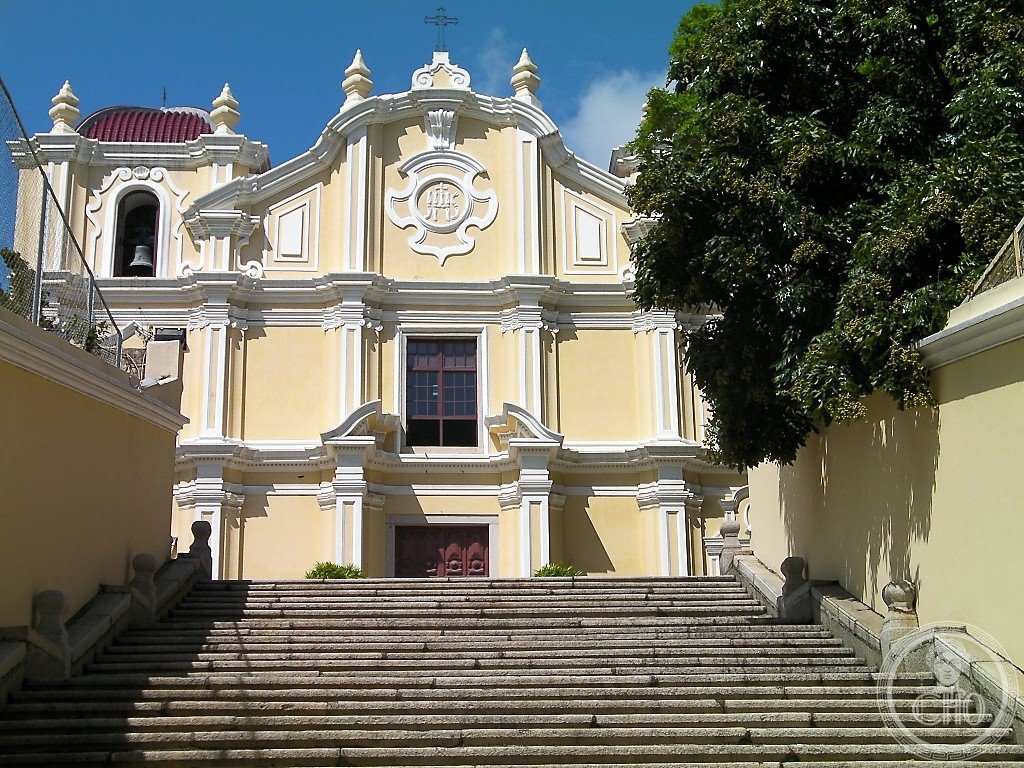
On Rua do Seminário, in Macau, the seminary of Saint Joseph was founded by the Jesuits in 1728, at first as a simple residence, and took on proper teaching duties from 1732. Together with the older College of Saint Paul, it trained for decades the missionaries bound for China, Japan and other Asian missions. The first stone of the adjoining church was laid on 10 October 1746, the feast of Saint Francis Borgia, with the masonry begun in 1751 and substantially finished in 1758. The name of the architect is not confirmed by independent sources, although one isolated source credits the initiative to Father Luís Sequeira and the design to Brother Folleri, described as an Italian architect. When the Jesuits were expelled from Portuguese territories in 1762, at the will of the Marquis of Pombal, the seminary closed. It reopened, according to sources that disagree on the exact year between 1783 and 1784, entrusted to the Lazarists, secular priests of the Congregation of the Mission; in 1800 Queen Maria I of Portugal granted it the title of «House of the Congregation of the Missions». The church holds a relic consisting of a fragment of the humerus of the right arm of Saint Francis Xavier. Its presence in Macau is well documented, although the specific details of its historic journey through the city before reaching this church are not confirmed by more than one source. A museum of sacred art, laid out in the building, is said to have opened on 8 October 2016. The dome of the church, not confirmed as the oldest in China, contrary to what tourist sources sometimes repeat, is about 12.5 metres across and rises some 19 metres, lit by two rows of sixteen lantern windows. The building was closed to the public from 1995 because of structural instability caused by a termite infestation in the wooden structures of the dome, and reopened on 3 December 1999, after a restoration that replaced the covering with a new concrete dome faithful to the original design. Today the church remains open to the public, while the seminary building, which cannot be visited, houses the Faculty of Religious Studies and Philosophy of the University of Saint Joseph. The building is named individually within the Historic Centre of Macau, inscribed on the UNESCO World Heritage List in 2005.
About the Seminary and Church
St. Joseph’s Seminary and Church, on Rua do Seminário in Macau, was founded by Jesuits in 1728 to train missionaries for China, Japan, and other Asian missions. Its attached baroque church, built 1746-1758, holds a relic of St. Francis Xavier’s arm bone and stands today as an individually named monument within the UNESCO-listed Historic Centre of Macau.
Key facts
- 1728: the seminary founded by the Society of Jesus, taking on formal teaching functions from 1732.
- 1746–1758: the attached church built, its cornerstone laid on the feast of St. Francis Borgia.
- 1762: the Jesuits expelled from Portuguese territories; the seminary closes.
- 1783/1784: the seminary reopens under the Lazarists, secular priests of the Congregation of the Mission (sources differ on the exact year).
- 1995–1999: the church closed for structural repairs after termite damage to the dome, reopening 3 December 1999 with a replica concrete dome.
- 2005: individually named within the UNESCO World Heritage-listed Historic Centre of Macau.
History
Founded in 1728 to train Jesuit missionaries bound for China, Japan, and beyond, the seminary and its church survived the 1762 expulsion of the Jesuits from Portuguese territory to reopen under a different religious order within a couple of decades. It later held one of Macau’s most significant Catholic relics, a bone from St. Francis Xavier’s arm, and after a 1990s closure for structural repair, reopened at the turn of the millennium. The church remains active today, while the seminary building now houses a university theology faculty rather than a working seminary in the historic sense.
What you see
A yellow-ochre baroque facade with white pilasters, approached by a monumental staircase, crowned by a reddish dome roughly 12.5 meters across and 19 meters high, lit by two rows of sixteen clerestory windows; inside, a side altar holds the relic of St. Francis Xavier’s arm bone.
Practical information
- Opening hours: the church is generally open daily outside services; the seminary building itself is not open to visitors, and the attached sacred art museum has its own hours.
- Address: Rua do Seminário, São Lourenço, Macau, China.
Getting there
The church stands on Rua do Seminário, in Macau’s São Lourenço area, near St. Lawrence’s Church. GPS: approximately 22.1919°N, 113.5375°E.
Nearby
- St. Lawrence’s Church — another baroque colonial-era church, a short walk away.
- A-Ma Temple and the Barra district — Macau’s historic waterfront quarter, nearby.
Sources
- Macao Cultural Affairs Bureau (culturalheritage.mo) — official heritage listing.
- UNESCO Bangkok regional office (archived) — restoration history.
- Wikipedia (English and Portuguese) — “St. Joseph’s Seminary and Church”
- University of Saint Joseph, Macau (usj.edu.mo) — current institutional role.
Find it on the map
See this place and what’s around it →📷 Become a Cultural Heritage Online photographer
Share your photos of places: they stay published under your name as the author. The more they're seen, the more you get noticed — and soon a contest will reward the most appreciated photos.
Log in or sign up free to add a photo