
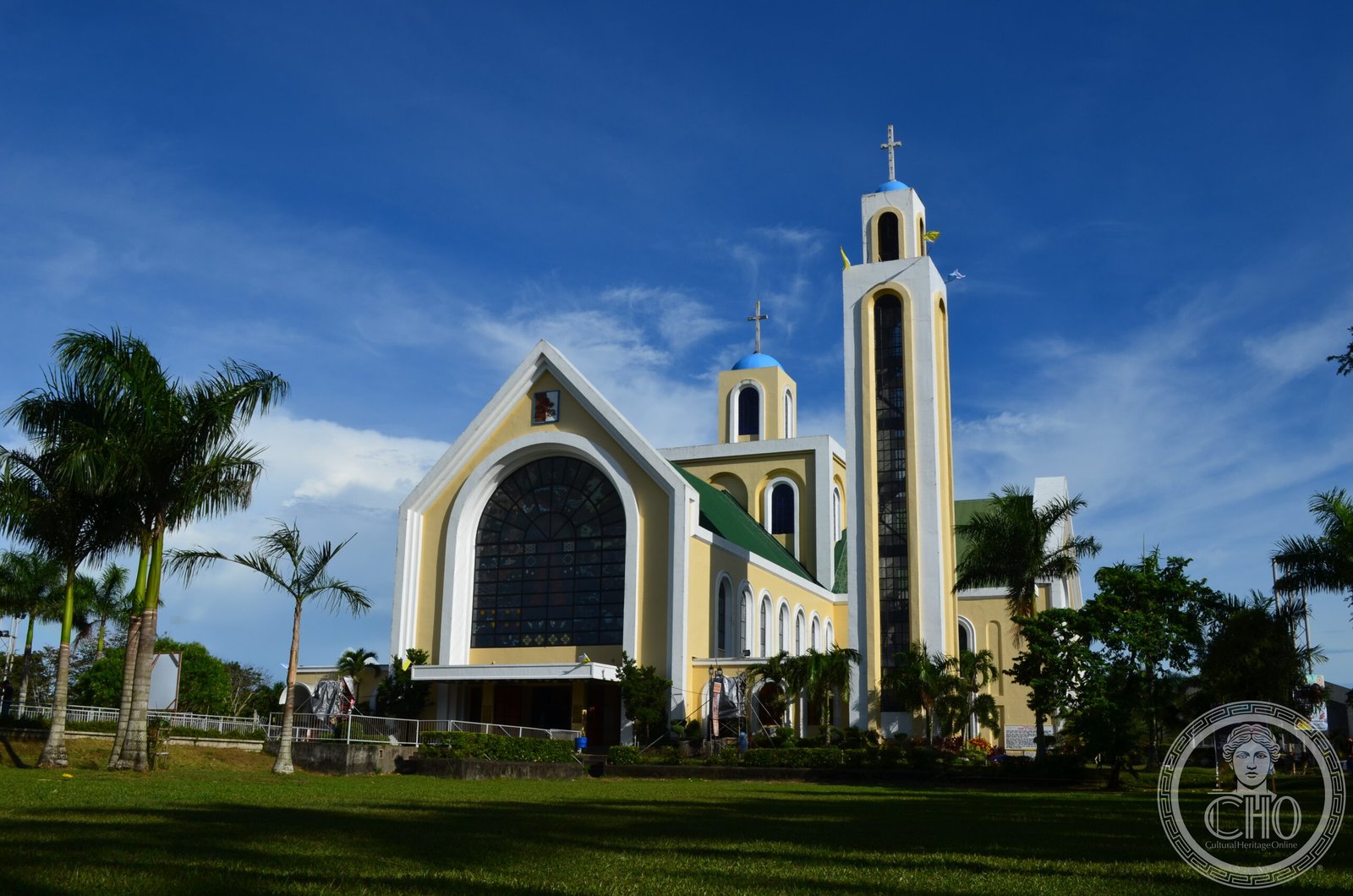
In Naga City, in the province of Camarines Sur, in the Philippines, the minor basilica of Our Lady of Peñafrancia holds the most venerated Marian image of the Bicol region. The devotion begins with an image found on the Peña de Francia mountain, in the Spanish province of Salamanca, by a hermit named Simón Vela in 1434. Sources differ on his nationality: French according to the archdiocese, a Franciscan layman according to others. The devotion reached Naga between 1710 and 1712 through Miguel Robles de Covarrubias, a native of San Martín del Castañar, near Salamanca. Sources do not agree on whether he was already a priest at the time, or was ordained only later at Nueva Cáceres, today’s Naga. Robles first had a small chapel built, and commissioned a local craftsman to carve a wooden statue in baliti wood. A masonry church was then raised in 1741 under Bishop Ysidro de Arevalo. The present basilica was conceived by Archbishop Pedro Paulo Santos y Songco in 1960, on land donated by the married couple Macario and Irene Mariano. The foundation stone was laid on 18 April 1976, Easter Sunday, under Bishop Concordio Sarte, but the works halted for lack of funds. They resumed under Father Sofio Balce with the “Operation Peñafrancia Basilica” campaign and ended in September 1981. The building was solemnly dedicated on 22 May 1982 by Cardinal Sin, in the presence of Cardinal Julio Rosales. The name of the architect is not documented in any source consulted. Pope John Paul II raised it to a minor basilica on 22 May 1985, although one source gives 2 May as the date of the Vatican decree, at the request of Archbishop Leonardo Z. Legaspi. The devotion is celebrated every year with the Traslación, the transfer of the image to the metropolitan cathedral of Naga, and with the famous fluvial procession along the Naga river, or Bicol, formally instituted by Bishop Francisco Gainza from 1 September 1864. It now draws over a million devotees, with recent estimates of up to 1.8 million participants according to the Naga tourist office. On 16 September 1972, during the procession, the Colgante bridge, overloaded with spectators watching the votive pagoda go by, collapsed. It caused one hundred and thirty-eight confirmed deaths, mostly by drowning or by electrocution from power cables that fell into the water. Contrary to a widespread rumour, this was not the sinking of the religious boat, but the structural failure of the bridge itself.
About the Basilica
The Basilica Minore de Nuestra Señora de Peñafrancia, in Naga City, Camarines Sur, Philippines, houses the most venerated Marian image in the Bicol region, a devotion that arrived from Spain in 1710–1712. The current basilica was built 1976–1981 and elevated to minor basilica status in 1985.
Key facts
- 1434: the original Marian image found on Peña de Francia mountain, Salamanca, Spain.
- 1710–1712: the devotion brought to Naga by Miguel Robles de Covarrubias.
- 1741: a stone predecessor church built under Bishop Ysidro de Arevalo.
- 1 September 1864: the annual fluvial procession formally instituted by Bishop Francisco Gainza.
- 1976–1981: current basilica built, dedicated 22 May 1982.
- 22 May 1985: elevated to minor basilica by Pope John Paul II.
History
A Marian devotion carried from a Spanish mountain shrine to the Bicol region in the early 1700s grew, over two and a half centuries, into one of the Philippines’ largest annual religious gatherings: the Peñafrancia fluvial procession, which now draws over a million pilgrims each September. That growth was not without tragedy. In 1972 an overcrowded bridge collapsed over spectators watching the procession, killing 138 people — a disaster of crowd infrastructure rather than of the river procession itself.
What you see
A modern basilica with a large fan-shaped stained-glass window and a square bell tower, its design a departure from the colonial-era stone church that preceded it on an earlier site nearby.
Practical information
- Opening hours: generally open daily outside services; check current hours before visiting.
- Address: Basilica Road (also cited as Balatas Road), Naga City, 4400 Camarines Sur, Philippines.
Getting there
The basilica stands in Naga City, near Balatas Road. GPS: 13.6319°N, 123.2000°E.
Nearby
- Naga Metropolitan Cathedral — the destination of the annual Traslación procession, where the image resides before being returned to the basilica.
Sources
- Wikipedia — “Peñafrancia Basilica,” “Our Lady of Peñafrancia”
- Archdiocese of Cáceres (official site) — history of the Peñafrancia devotion.
- GCatholic.org — basilica records.
- Dateline Ibalon, Bicol Mail — local historical coverage of the 1972 Colgante Bridge collapse.
- Philippine Daily Inquirer, GMA News, Naga City Tourism — recent Peñafrancia Festival attendance figures.
Find it on the map
See this place and what’s around it →📷 Become a Cultural Heritage Online photographer
Share your photos of places: they stay published under your name as the author. The more they're seen, the more you get noticed — and soon a contest will reward the most appreciated photos.
Log in or sign up free to add a photo