
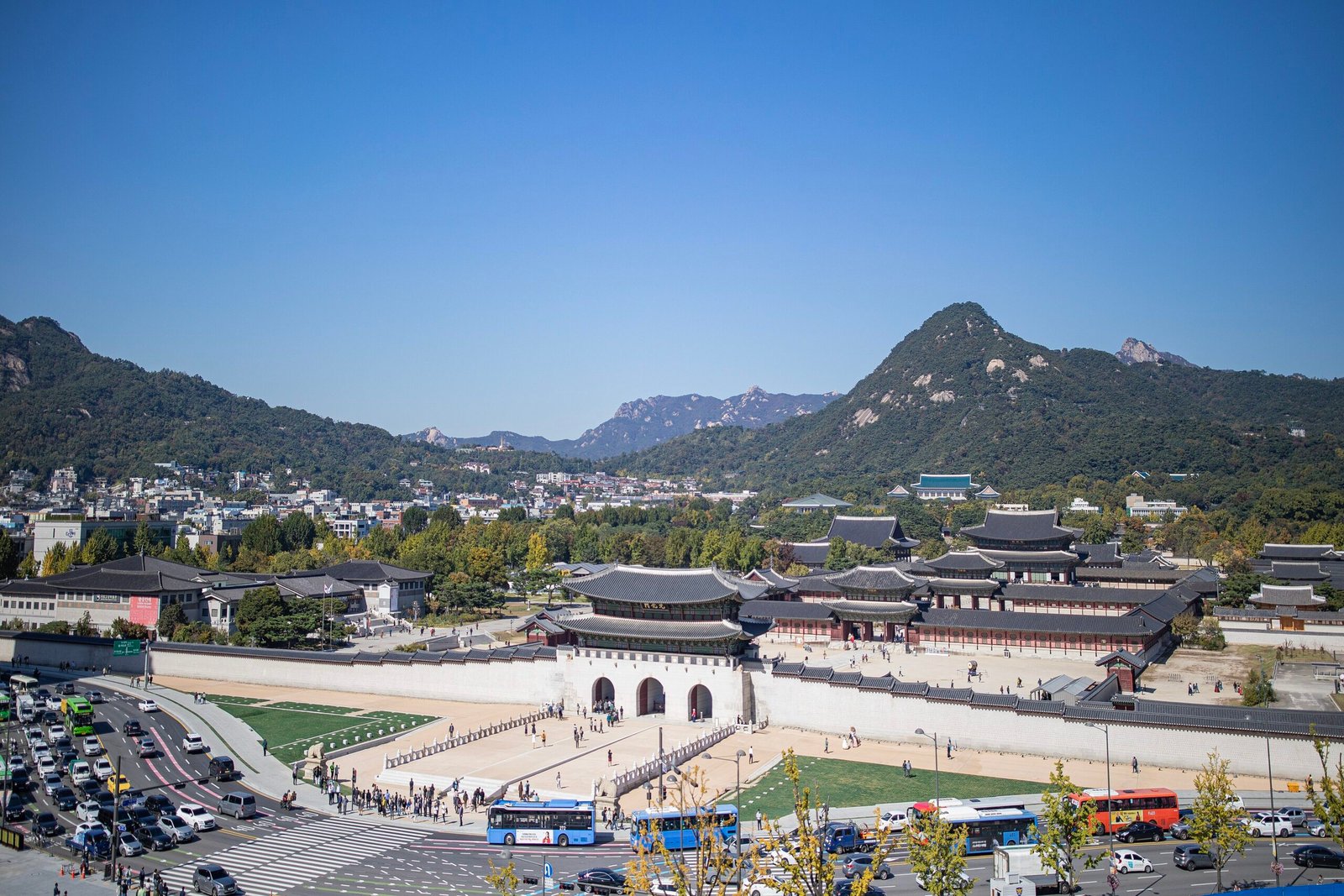
Gyeongbokgung
The first royal palace of the Joseon dynasty, Gyeongbokgung rose from near-total destruction to become a symbol of Korean cultural resilience and sovereignty.
At a glance
Established in 1395, Gyeongbokgung was Seoul’s earliest major landmark and seat of Joseon power. After Japanese colonization devastated its structures, decades of restoration work have returned dozens of buildings to the palace complex, which now welcomes thousands of visitors annually.
History
Founded in 1395 as the primary royal residence, the palace reached its zenith under Sejong the Great (r. 1418–1450), who commissioned the creation of Hangul, Korea’s native writing system, within its walls. The palace stood as a beacon of Joseon authority for nearly two centuries.
In 1592, invading forces during the Imjin War burned the entire complex. Reconstruction stalled due to financial constraints following the conflict. Not until the reign of King Gojong in the late 19th century did restoration efforts resume.
Japan’s 1910 colonization of Korea targeted the palace as a symbol of Korean sovereignty. Japanese authorities systematically dismantled the complex: roughly 500 structures were sold and transported elsewhere, reducing the surviving pre-colonial buildings to just 40 by Korea’s 1945 liberation. Colonial-era administrative buildings, including the Government-General of Chōsen Building, replaced much of the original architecture.
Modern restoration began in the 1980s following political and economic stabilization. Two major reconstruction programs—spanning 1990–2010 and 2008–2045—have recreated dozens of structures and continue to reshape the palace landscape.
What you see
The palace complex combines surviving pre-colonial structures with carefully researched reconstructions of lost buildings. Visitors encounter both original Joseon-era masonry and timber work alongside newly rebuilt quarters, audiences halls, and residential pavilions.
The changing of the guard ceremony, performed twice daily, reflects traditional Korean court protocols and provides insight into palace life and hierarchy.
Cultural significance
Gyeongbokgung embodies Korea’s historical continuity and resistance. Its near-obliteration and systematic restoration represent both colonial trauma and national determination to reclaim cultural identity.
The palace houses two major institutions: the National Folk Museum of Korea and the National Palace Museum of Korea, anchoring it as a center for understanding Korean heritage.
Key facts
- Country: South Korea
- City: Seoul
- Founded: 1395
- Coordinates: 37.579884, 126.9768
- Access: Gyeongbokgung Station (subway)
- Admission: Free for visitors wearing hanbok (traditional Korean dress)
- Hours: Seasonal evening openings available
Practical information & getting there
Gyeongbokgung Station provides direct subway access to the palace. The site is open year-round, with extended hours during certain seasons. Admission is complimentary for those dressed in hanbok; standard entry fees apply otherwise. The changing of the guard ceremony occurs twice daily. Both the National Folk Museum and National Palace Museum operate within the complex and offer contextual understanding of the palace’s history and its role in Korean court life.
Sources & resources
Find it on the map
See this place and what’s around it →📷 Diventa un fotografo di Cultural Heritage Online
Condividi le tue foto dei luoghi: restano pubblicate con la tua firma come autore. Più vengono viste, più ti fai conoscere — e presto un concorso premierà le foto più apprezzate.
Accedi o registrati gratis per aggiungere una fotoDo you manage this place?
This page is read by travellers and heritage enthusiasts who find it on Google. Keep it accurate — and make it work for you. Free for non-profit heritage institutions.