
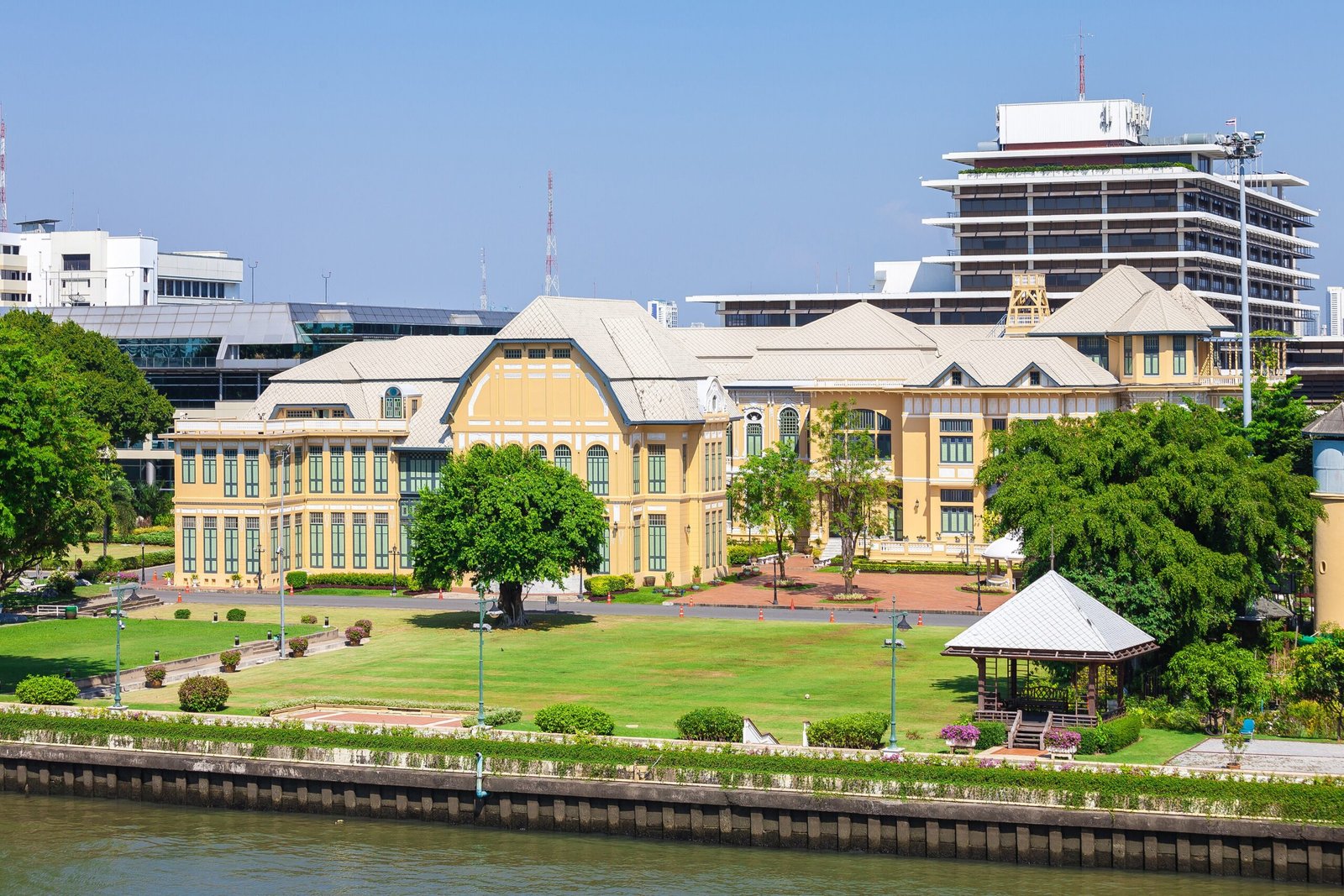
A former royal residence whose elegant European-styled buildings witnessed the dramatic events of Thailand’s 1932 revolution, now preserved as a historic monument on the Chao Phraya River.
At a glance
Bang Khun Phrom Palace comprises two architecturally distinct structures on the east bank of the Chao Phraya River in Phra Nakhon District. The main residence, completed in 1901–1902, displays neo-Baroque and Rococo influences, while the Queen’s residence, built around 1913, exemplifies German Art Nouveau design. Today it stands as a registered ancient monument and significant cultural landmark.
History
The palace served as the residence of Prince Paribatra Sukhumbandhu until the Siamese revolution of 1932, when forces seized the Royal Plaza and attempted to prevent the Prince’s escape by boat from the pier behind the palace. Following his forced exile, the compound transitioned to government use.
From 1945 onwards, the palace housed the headquarters of the Bank of Thailand. It later accommodated the Bank of Thailand Museum until 2017, when the main exhibition relocated to the Bank of Thailand Learning Center in a former banknote printing-press building. The palace was recognized with the ASA Architectural Conservation Award in 1993.
What you see
The main residence, Tamnak Yai, faces Samsen Road and was designed by Mario Tamagno in neo-Baroque and Rococo styles during 1901–1902. Its ornate detailing reflects early-20th-century European architectural fashion adapted for a tropical setting.
The river-facing Tamnak Somdet, built around 1913 for Queen Sukhumala Marasri (the Prince’s mother), showcases Karl Döhring’s interpretation of Jugendstil, Germany’s distinctive variant of Art Nouveau. This stylistic contrast illustrates the cosmopolitan tastes of Siam’s elite during the absolute monarchy.
Cultural significance
Bang Khun Phrom Palace embodies a pivotal moment in Thai history. The dramatic events of 1932—when the Khana Ratsadon seized power and confronted Prince Paribatra—unfolded here, marking the end of absolute monarchy in Siam. The palace’s architecture documents the European influences that shaped Thai royal aesthetics in the early modern era.
Key facts
- Location: Samsen Road, Phra Nakhon District, Bangkok, Thailand
- Coordinates: 13.76861111, 100.49944444
- Main residence designed by Mario Tamagno (1901–1902)
- Queen’s residence designed by Karl Döhring (c. 1913)
- Registered ancient monument; ASA Architectural Conservation Award (1993)
- Housed Bank of Thailand headquarters from 1945
Practical information & getting there
The palace is situated on the east bank of the Chao Phraya River in central Bangkok, accessible via Samsen Road. Current visiting hours and public access policies should be confirmed before planning a visit. The site’s status as a registered ancient monument reflects its protected heritage status.
Sources & resources
Find it on the map
See this place and what’s around it →📷 Become a Cultural Heritage Online photographer
Share your photos of places: they stay published under your name as the author. The more they're seen, the more you get noticed — and soon a contest will reward the most appreciated photos.
Log in or sign up free to add a photoIs this page about you?
This page is read by travellers and heritage enthusiasts who find it on Google. Tell us how you are connected to this place and we will take it from there.