
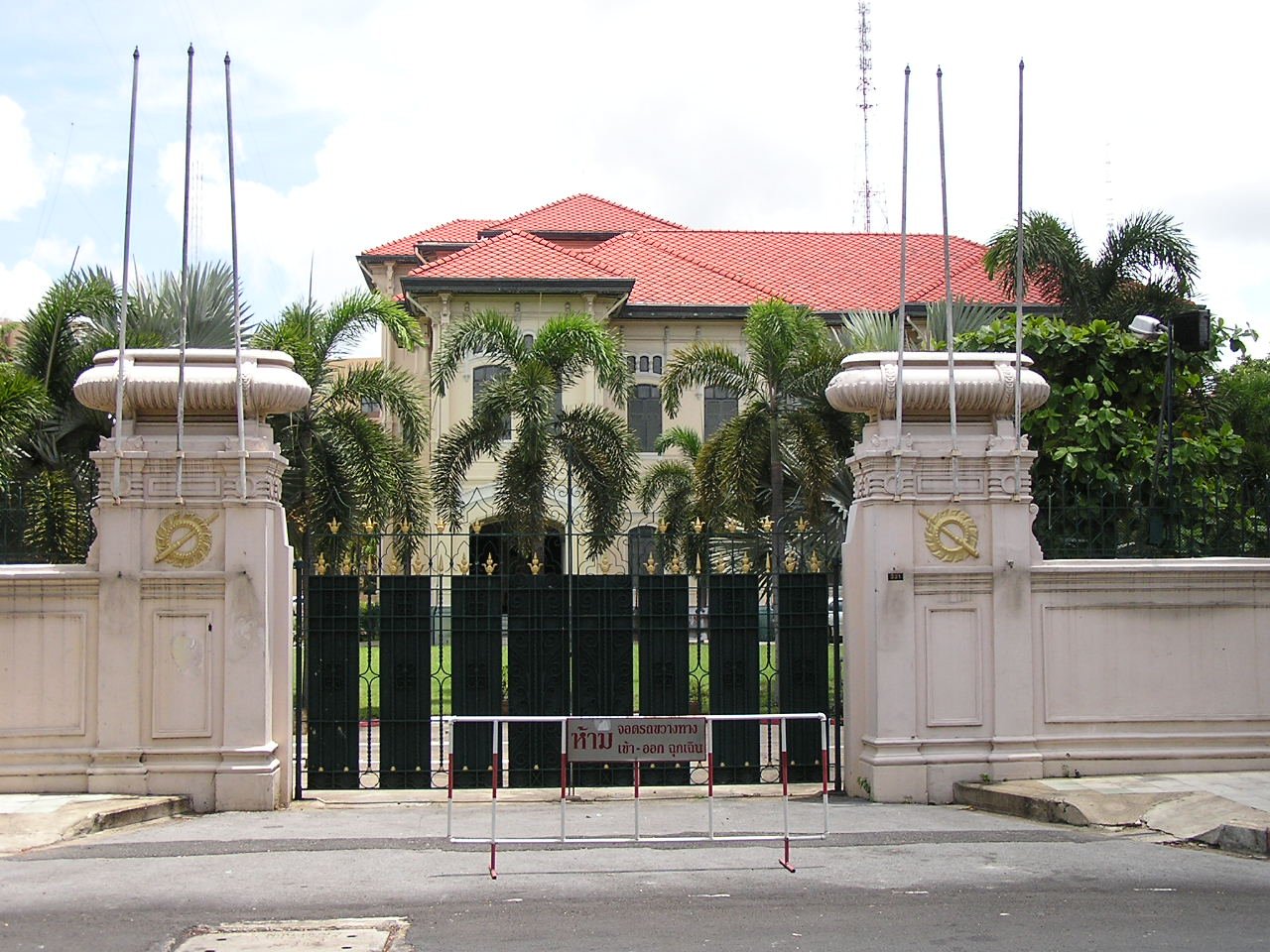
A Bangkok mansion built for a Siamese prince and his Ukrainian wife, later commandeered as the nation’s first Prime Minister’s Office during Thailand’s constitutional transformation.
At a glance
Paruskavan Palace stands as a pivotal bridge between royal residences and state administration in modern Thailand. Built in the early 1900s for Prince Chakrabongse Bhuvanath—son of King Chulalongkorn—the palace blends Western architectural ambition with Eastern materials and sensibility, shaped by the tastes of his Ukrainian wife, Kateryna Desnytska.
History
Construction began in 1903 near Amphorn Sathan Residential Hall, where the King resided. The project proved ambitious: on 30 December 1903, 22,075 baht was allocated for 275 metres of walls. By April 1904, completion of the walls (excluding the roof) cost 61,173 baht. Three architects were engaged, but two fell gravely ill during construction—Mr Tamayo contracted cholera and returned to Europe; Mr Scos died of smallpox. Beyrolepi led the project to completion by the end of 1905.
Prince Chakrabongse and Katya’s son, Prince Chula Chakrabongse, was born here on 28 March 1908. After their divorce in 1919, the palace reverted to the Crown.
The building’s political significance emerged sharply in 1932. Following King Prajadhipok’s constitutional proclamation on 10 December that year, the palace was seized during Thailand’s political transformation. When General Phraya Phahonphonphayuhasena assumed the premiership on 21 June 1933, the Prime Minister’s Office relocated to Paruskavan Palace, making it the nerve centre of Thai governance until Field Marshal Plaek Phibunsongkhram’s premiership in December 1938.
What you see
The palace exemplifies early 20th-century eclecticism. Kateryna Desnytska redesigned its interiors with Western-style sofas and armchairs rendered in Eastern materials, creating spaces that reflected her own cultural synthesis. Her hand appears equally in the palace gardens, which she designed personally.
Cultural significance
Paruskavan Palace marks the intersection of royal patronage, international marriage, and state transformation. It housed one of Siam’s most celebrated cross-cultural unions and witnessed the architectural ambitions of the Chakri dynasty in its mature phase. Its later role as Thailand’s first Prime Minister’s Office—seized during the 1932 revolution—makes it an emblem of the nation’s transition to constitutional monarchy.
Key facts
- Location: Bangkok, Thailand (13.7689°N, 100.5107°E)
- Built: 1903–1905
- Commissioned by: King Chulalongkorn for Prince Chakrabongse Bhuvanath
- Current use: Headquarters of the National Intelligence Agency; Museums of the Police Department and Metropolitan Police Bureau
Practical information & getting there
The palace is located near Amphorn Sathan Residential Hall in central Bangkok. Now used as government offices and museums, access may be restricted; verify current opening hours and visitor policies with the relevant agencies before planning a visit.
Sources & resources
- Paruskavan Palace — Wikipedia
- Cultural Heritage Online
Find it on the map
See this place and what’s around it →📷 Become a Cultural Heritage Online photographer
Share your photos of places: they stay published under your name as the author. The more they're seen, the more you get noticed — and soon a contest will reward the most appreciated photos.
Log in or sign up free to add a photoIs this page about you?
This page is read by travellers and heritage enthusiasts who find it on Google. Tell us how you are connected to this place and we will take it from there.