

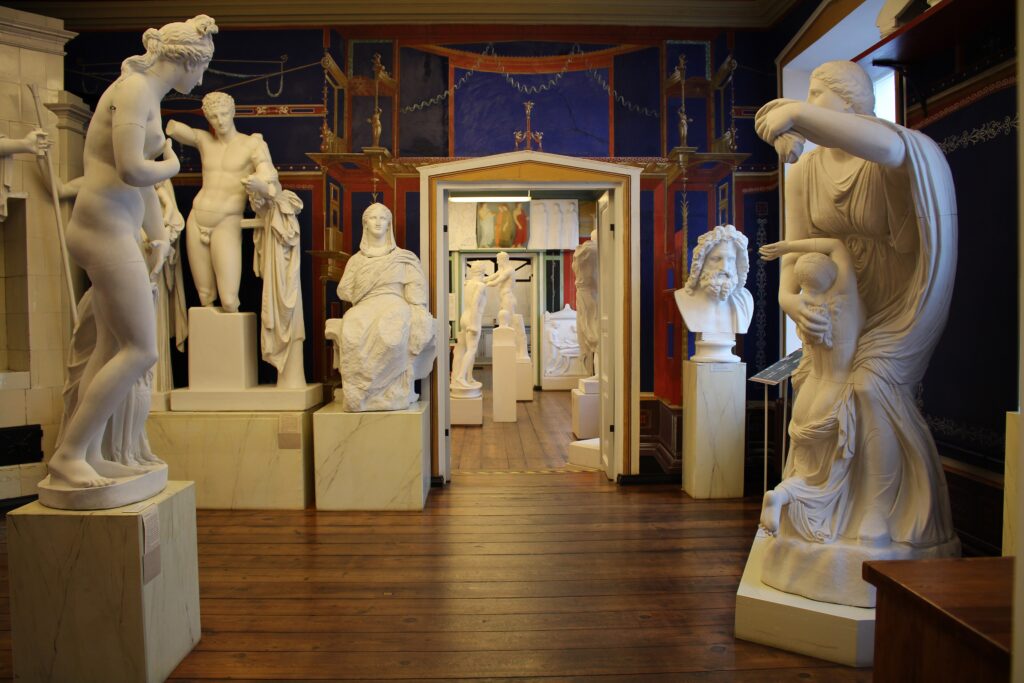
Estonia’s oldest art museum holds plaster casts of Greek antiquities alongside Egyptian mummies spanning over two millennia.
At a glance
The University of Tartu Art Museum occupies the Main building of Tartu University, functioning as a branch of the larger University of Tartu Museum. Its permanent collection combines classical sculpture reproductions with rare archaeological materials from Egypt, creating an unusual synthesis of Western and Eastern antiquities under one roof.
History
Established in 1803 at the Imperial University of Dorpat, the museum claims status as Estonia’s oldest art institution. The Egyptian mummies entered the collection in 1819, donated by Otto von Richter, a private collector whose estate enriched the university’s holdings.
What you see
The museum’s physical setting is the neoclassical Main building of Tartu University. Within these walls, visitors encounter full-size plaster cast reproductions of Archaic, Classical, and Hellenistic Greek sculptures—educational casts that preserve masterworks in accessible form for scholarly study and public appreciation.
Cultural significance
The museum represents an important chapter in Estonian cultural history as the nation’s pioneering art institution. Its Greek casts reflect 19th-century academic practice, while the Egyptian mummies offer tangible connection to ancient Africa and demonstrate the collecting ambitions of early modern scholarship.
Key facts
- Country: Estonia
- City: Tartu
- Founded: 1803
- Coordinates: 58.38083°N, 26.71996°E
- Houses two Egyptian mummies, carbon-dated to between 410 and 50 BC
- Current chief: Mariann Raisma
Practical information & getting there
The museum is located in the Main building of Tartu University in central Tartu. For current opening hours, admission fees, and visitor information, consult the University of Tartu Museum’s official website or contact the institution directly.
Sources & resources
Find it on the map
See this place and what’s around it →📷 Become a Cultural Heritage Online photographer
Share your photos of places: they stay published under your name as the author. The more they're seen, the more you get noticed — and soon a contest will reward the most appreciated photos.
Log in or sign up free to add a photoIs this page about you?
This page is read by travellers and heritage enthusiasts who find it on Google. Tell us how you are connected to this place and we will take it from there.
This entry stays online and free either way — and a free account lets you add to it yourself.