

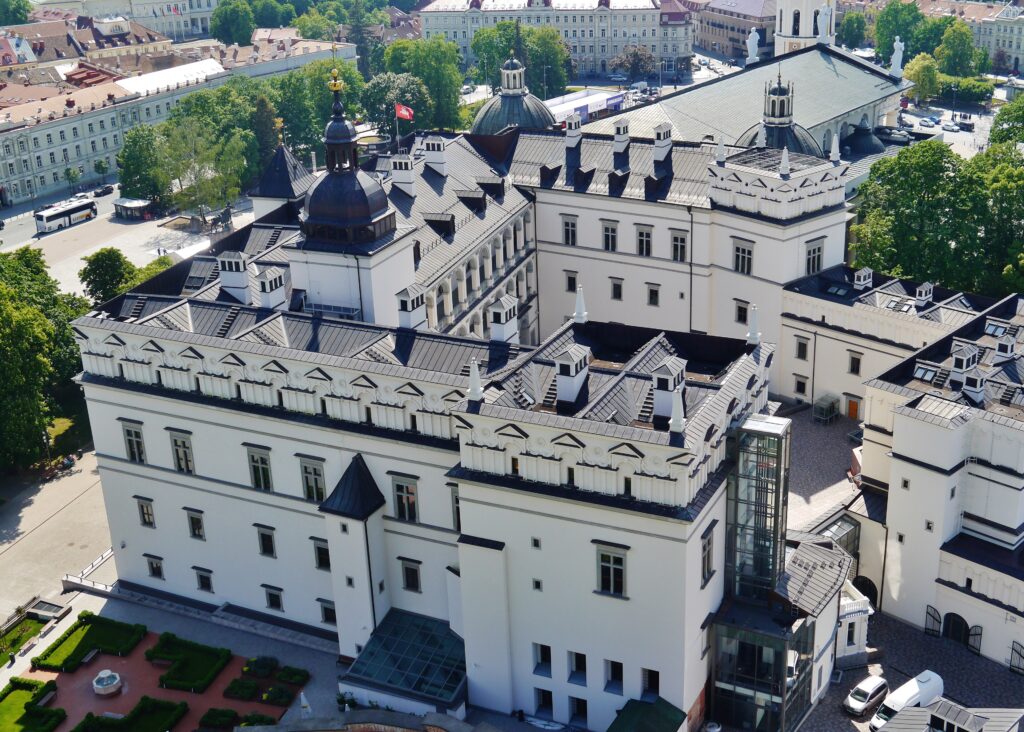
A Renaissance palace reconstructed on the site of the original 15th-century seat of power, which served as a political and cultural heart of the Polish–Lithuanian Commonwealth for four centuries.
At a glance
Located in Vilnius’s lower castle, this palace was the official residence and administrative centre of the Grand Duchy of Lithuania. The original structure spanned from its 15th-century construction through to its demolition in 1801. A painstaking reconstruction, completed in 2018, has restored the palace in Renaissance style to its former prominence.
History
The palace was originally built in the 15th century as the official seat of the rulers of the Grand Duchy of Lithuania and future Kings of Poland. It flourished particularly during the 16th and mid-17th centuries, evolving architecturally with each generation of rulers.
A major reconstruction between 1520 and 1530, ordered by Sigismund I the Old, cost 100,000 gold ducats according to contemporary court records. This ambitious renovation was believed to have been undertaken to mark the proclamation ceremony of his son, Sigismund II Augustus, as Grand Duke of Lithuania.
For four centuries, the palace remained one of the three pillars of the Polish–Lithuanian Commonwealth—politically, administratively, and culturally central to the realm—until its demolition in 1801.
What you see
The reconstructed palace adopts Renaissance architectural principles, reflecting the style favored during the 16th-century renovations ordered by Sigismund I. The modern rebuilding, completed over 16 years from 2002 to 2018, recreated the palace on its original foundations within the lower castle complex of Vilnius.
Cultural significance
The palace embodied the power and ambitions of Lithuania’s medieval and early modern rulers. Its reconstruction represents a contemporary commitment to restoring a symbol of Grand Duchy sovereignty and the shared heritage of the Polish–Lithuanian Commonwealth, one of early modern Europe’s most influential political unions.
Key facts
- Country: Lithuania
- City: Vilnius
- Coordinates: 54.6862, 25.289
- Original construction: 15th century
- Demolished: 1801
- Reconstruction completed: 2018
Practical information & getting there
The reconstructed Palace of the Grand Dukes of Lithuania is situated in Vilnius’s lower castle district. For current opening hours, admission fees, and guided tour availability, consult local tourism information or the palace’s official website.
Sources & resources
Find it on the map
See this place and what’s around it →
Advertisement. Pictured, from the Cleveland Museum of Art (CC0) and not for sale: Latz commode, Meissen group, Paul Storr tureen. How we handle this
📷 Become a Cultural Heritage Online photographer
Share your photos of places: they stay published under your name as the author. The more they're seen, the more you get noticed — and soon a contest will reward the most appreciated photos.
Log in or sign up free to add a photoIs this page about you?
This page is read by travellers and heritage enthusiasts who find it on Google. Tell us how you are connected to this place and we will take it from there.