
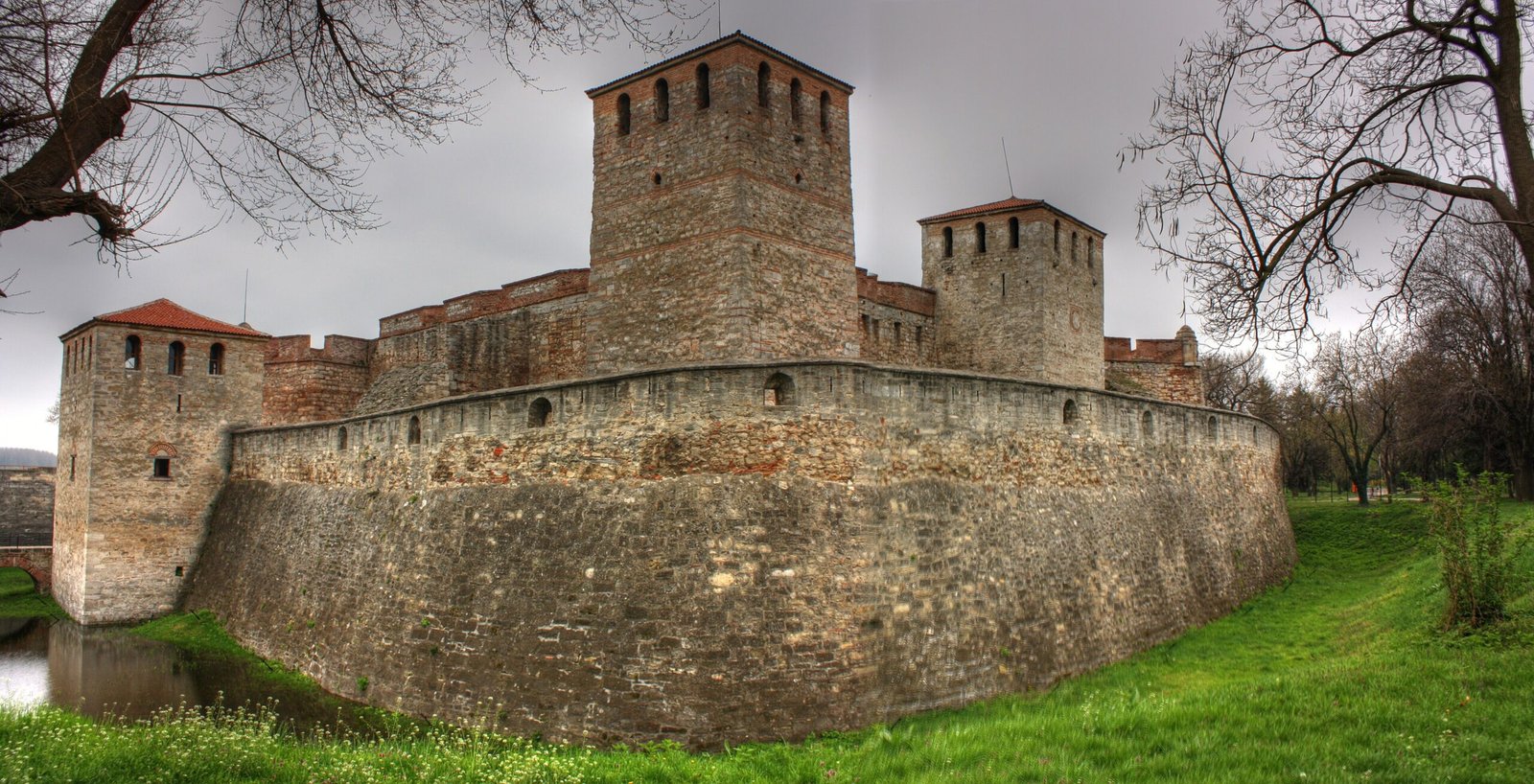
Bulgaria’s only entirely preserved medieval castle, Baba Vida crowns the northwestern frontier town of Vidin. Two concentric walls and nine towers—three standing to their full original height—tell stories of Byzantine sieges, Hungarian conquest, and Ottoman rule.
At a glance
A fortified citadel rising 39 metres above sea level, Baba Vida anchored Vidin’s defences through the medieval period and beyond. Its name derives from a legendary princess who chose to rule unmarried and build her stronghold rather than marry.
History
Construction began in the 10th century on the site of the Roman castellum Bononia. According to local legend, the castle was built by Vida, eldest daughter of a Danubian Bulgarian king, who inherited Vidin and lands stretching north to the Carpathians.
During the Middle Ages, Baba Vida served as the primary citadel of northwestern Bulgaria. It famously withstood an eight-month Byzantine siege led by Basil II. Tsar Ivan Stratsimir (1356–1396) enlarged and modernized the fortress, making it his capital. Between 1365 and 1369, Hungarian forces under Louis I captured the castle, though Stratsimir reclaimed it within months, albeit under Hungarian overlordship.
Ottoman pressure intensified in 1388 when forces invaded and made Stratsimir a vassal. In 1396, he joined King Sigismund’s crusade against the Ottomans, but the catastrophic Battle of Nicopolis in 1397 sealed his fate. The Ottomans secured most of his domains shortly after.
Under Ottoman occupation, the castle functioned as a warehouse, prison, and residence—notably for Osman Pazvantoğlu. It ceased serving defensive purposes by the late 18th century.
What you see
The fortress comprises two concentric curtain walls and approximately nine towers. Three towers preserve their full medieval height complete with original battlements, making Baba Vida architecturally singular in Bulgaria—the country’s only entirely preserved medieval castle.
Cultural significance
Baba Vida embodies the layered history of the Balkans: Roman foundations, medieval Bulgarian independence, and Ottoman transition. The castle’s survival is exceptional; most medieval Balkan fortifications were destroyed or heavily modified. Today it stands as Vidin’s primary landmark and a testament to the region’s strategic importance.
Key facts
- Country: Bulgaria
- City: Vidin
- Coordinates: 43.99°N, 22.89°E
- Period: 10th–18th centuries
- Founded: 10th century
- Notable rulers: Tsar Ivan Stratsimir (1356–1396)
Practical information & getting there
Baba Vida functions today as a museum and popular tourist attraction. The fortress is actively maintained and open to visitors. Vidin is accessible by road in northwestern Bulgaria, near the Danube River and the Serbian border.
Sources & resources
Find it on the map
See this place and what’s around it →📷 Become a Cultural Heritage Online photographer
Share your photos of places: they stay published under your name as the author. The more they're seen, the more you get noticed — and soon a contest will reward the most appreciated photos.
Log in or sign up free to add a photoIs this page about you?
This page is read by travellers and heritage enthusiasts who find it on Google. Tell us how you are connected to this place and we will take it from there.