
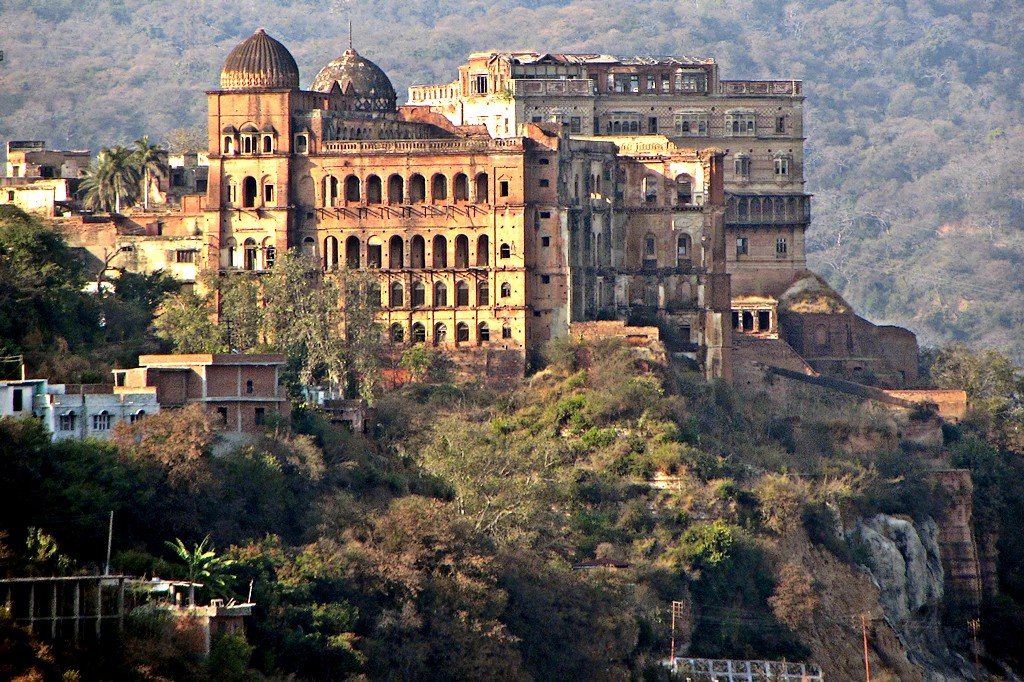
A sprawling palace complex in Jammu’s old city, built over 150 years by the Dogra dynasty. Rajasthani, Mughal, and European baroque styles converge in its courtyards, halls, and ornamental rooms.
At a glance
Mubarak Mandi is the former principal residence of the maharajas of Jammu and Kashmir, built starting in 1824 and continuously expanded by successive rulers. The complex overlooks the Tawi River from the heart of Jammu’s walled city. Today it houses the Dogra Art Museum and stands as a landmark of regional cultural heritage.
History
Construction began in 1824 and continued for more than 150 years as successive maharajas enlarged and embellished the complex. Mubarak Mandi served as the principal seat of power until 1925, when Maharaja Hari Singh relocated his residence to Hari Niwas Palace in northern Jammu. The Dogra dynasty ruled Jammu and Kashmir as maharajas until the mid-20th century, making this palace the ceremonial and administrative heart of their domain.
What you see
The complex comprises multiple palaces, courtyards, and ceremonial halls unified by an architectural language blending three traditions. Rajasthani design meets Mughal spatial principles and European baroque ornament in structures such as the Darbar Hall, Gol Ghar, Pink Palace, and Sheesh Mahal. Each building served distinct functions within the royal household and governance.
Cultural significance
Once the center of Dogra political power and royal ceremony, Mubarak Mandi embodies Jammu’s historical identity. The complex now houses the Dogra Art Museum, which preserves miniature paintings, royal artefacts, and manuscripts that document the region’s cultural life. The site remains a focal point for understanding the architectural and artistic traditions of Jammu and Kashmir.
Key facts
- Country: India
- City: Jammu, Jammu and Kashmir
- Construction began: 1824
- Coordinates: 32.7389°N, 74.8742°E
- Former principal seat of the Dogra dynasty until 1925
Practical information & getting there
Mubarak Mandi is located in the old walled city of Jammu. A portion of the complex is open to the public as the Dogra Art Museum. The palace has undergone restoration efforts to address damage from natural disasters and neglect; check current access and hours before visiting.
Sources & resources
Find it on the map
See this place and what’s around it →📷 Become a Cultural Heritage Online photographer
Share your photos of places: they stay published under your name as the author. The more they're seen, the more you get noticed — and soon a contest will reward the most appreciated photos.
Log in or sign up free to add a photoIs this page about you?
This page is read by travellers and heritage enthusiasts who find it on Google. Tell us how you are connected to this place and we will take it from there.