
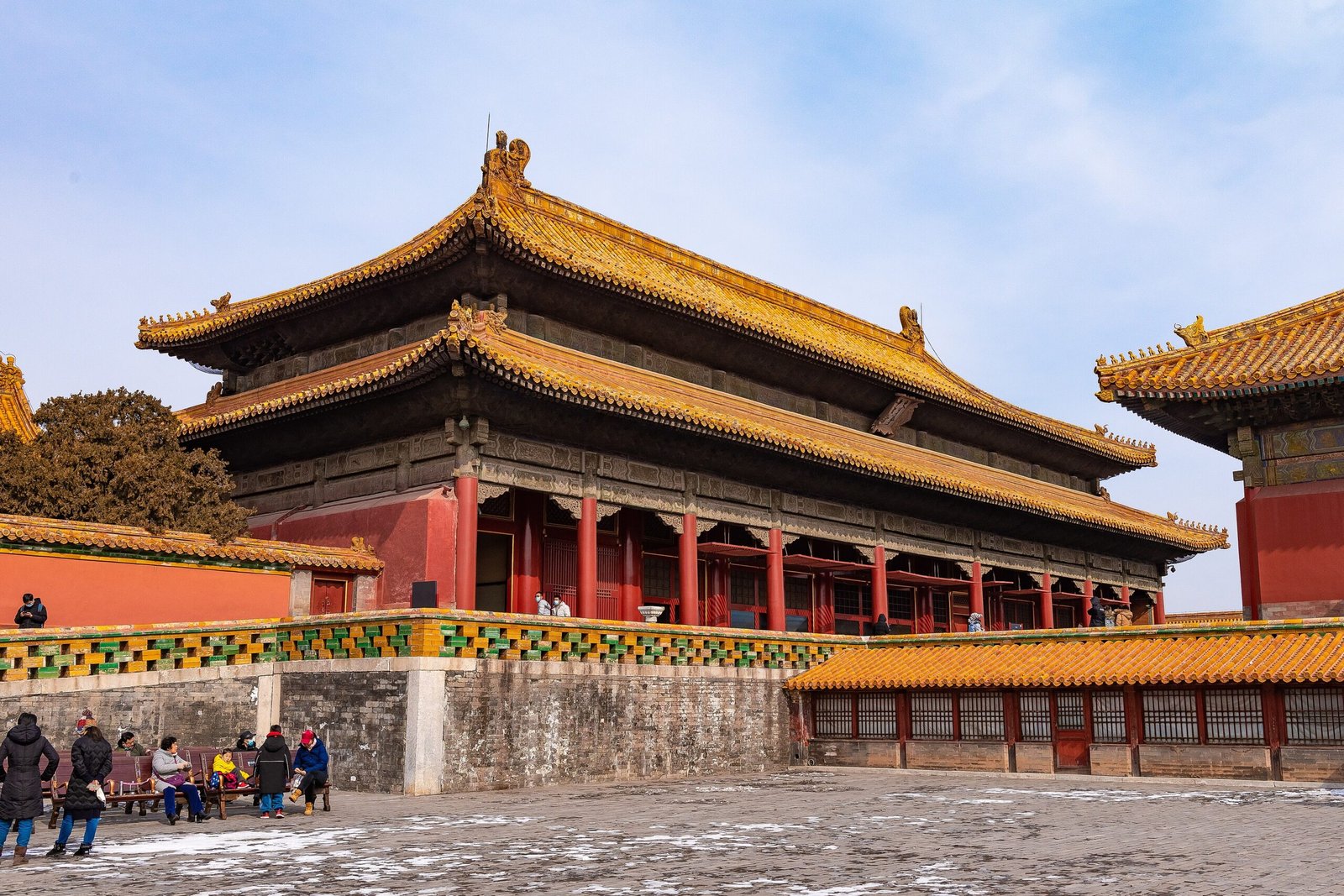
The northernmost of three main halls in the Forbidden City’s Inner Court, this double-eaved palace served as the imperial bride chamber and witnessed the sacred union of Chinese emperors and their consorts.
At a glance
Located within the Forbidden City, the Palace of Earthly Tranquility occupies a position of symbolic importance in the imperial household. Nine bays wide and three bays deep, it stands as a masterpiece of Ming architectural tradition, adapted over centuries to reflect both imperial custom and dynastic change.
History
During the Ming dynasty, the Palace served as the official residence of the Empress. The structure’s role shifted fundamentally under Qing rule, when the Manchu rulers converted large portions for Shamanist worship, introducing shrines, prayer mats, and a dedicated kitchen for sacrificial preparations. From the Yongzheng Emperor’s reign onward, the Empress no longer resided here permanently. Two rooms, however, retained their original ceremonial purpose: the wedding ceremony would be conducted in the main hall, after which the Emperor and newly wed Empress would retire to a private chamber for their wedding night.
What you see
The palace exemplifies double-eaved construction—a hallmark of high-ranking imperial buildings. Red dominates the visual scheme, representing love, sex, and reproduction in Chinese cosmology. The front section reveals Qing-era modifications: altar spaces, devotional furnishings, and the functional kitchen stand as testament to Manchu religious practice alongside imperial ceremony.
Cultural significance
The Palace of Earthly Tranquility embodies the intersection of imperial governance, dynastic succession, and spiritual belief. Its transformation from Ming residence to hybrid Qing sanctuary illustrates how conquered rulers adapted Chinese architectural spaces to their own cultural and religious needs while preserving the emperor’s matrimonial rituals.
Key facts
- Country: China
- City: Beijing
- Coordinates: 39.91938889, 116.39047222
- Northernmost of three main halls in the Forbidden City’s Inner Court
- Nine bays wide, three bays deep
- Ming-dynasty residence of the Empress; converted for Shamanist worship under Qing rule
Practical information & getting there
The palace is open to visitors as part of the Forbidden City Museum complex in central Beijing. Access is via the main palace gates; visitors typically reach it by proceeding northward through the Inner Court after passing the Hall of Union and Palace of Heavenly Purity.
Sources & resources
Find it on the map
See this place and what’s around it →📷 Become a Cultural Heritage Online photographer
Share your photos of places: they stay published under your name as the author. The more they're seen, the more you get noticed — and soon a contest will reward the most appreciated photos.
Log in or sign up free to add a photoIs this page about you?
This page is read by travellers and heritage enthusiasts who find it on Google. Tell us how you are connected to this place and we will take it from there.